






TL;DR: Twelve fairy tales sharpened to a point. Silverman’s debut works through image rather than plot: mothers folded into chairs, husbands stitched into shrouds, daughters reborn as snakes, sisters howling in antler masks, fishing villages swallowed by mist. The prose is spare and physical. The violence is precise. The strongest pieces do not leave the skull.

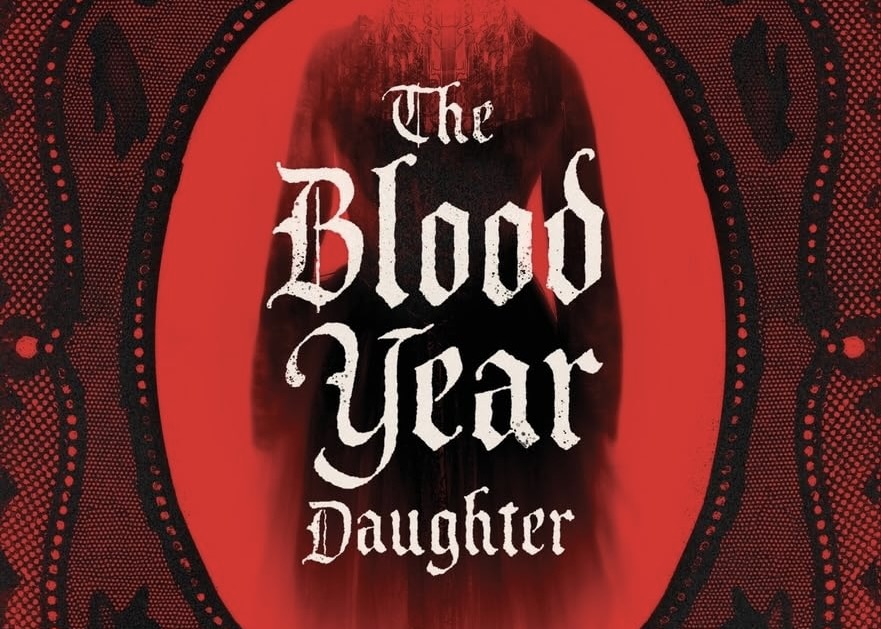
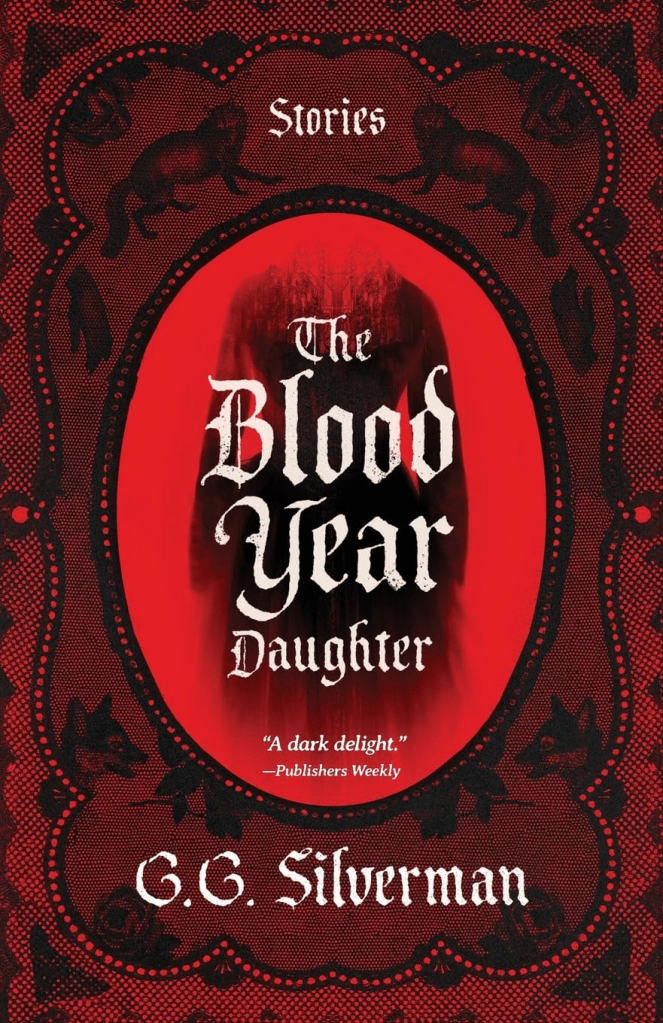
The Blood Year Daughter is the debut story collection of G.G. Silverman, twelve stories long, published by Creature Publishing of Charlottesville. The cover is a photograph of a bridal gown, taken by the author. The book contains, in this order: a peasant girl who pricks her finger and bleeds onto her sister’s wedding dress; a chorus of dead wives narrating the dispatch of their husband; a woman who builds men out of feathers, gravel, parachute silk, and silkworms; a cult of girls trained from birth to run; a fishing village swallowed by mist; teenagers staging the martyrdoms of the saints; a post-apocalyptic forest commune of girls in antler masks; a cottage of dead daughters who do not yet know they are dead; an assault survivor reborn as snakes; a wolf-girl raised in the Pacific Northwest; two sisters consuming their mother in installments; and a murdered first-place winner reincarnated in another woman’s body.
The accumulation rocks. So does the framing. (Silverman’s roots are Italian, and the first three stories sound dictated under a low-burning candle in some hill town the cartographers forgot.) The animating principle is fairy tale logic applied to specifically female endings: not what happens at the wedding, but what happens after. Or before. Or instead.
The marketing copy invokes Carmen Maria Machado and Kelly Link. The closer kin is Angela Carter (the violence) and Link (the structural drift). The sentences are short. The verbs are physical. The prose works mostly through image, and the images are mostly bodies: mothers’ bodies, daughters’ bodies, ghosts’ bodies, the bodies of men whose throats are about to be opened. When Silverman steps outside the fairy tale register, as in “Namesake Day,” a satirical piece set in a town where teenagers stage their own torture for an annual competition, the voice goes contemporary in a way that took me out of it. That story is funny and it is also the one piece in the book where the prose is visibly doing less than it does elsewhere.

“Fold,” about two daughters who eat their mother in pieces, is the best thing here. The mother bends herself into a chair. She becomes a bed. She lets her daughters dig into her belly with one finger and then a second finger and then their teeth. The story builds by addition (clothes made of the mother’s hair, eyes the daughters carry to school in their pockets, custard scooped from the mother’s torso). It accumulates a tenderness that should not be possible in a story whose subject is consumption. It is also short. It does not explain itself. It does not announce its intentions. Whatever it is doing about motherhood as resource, motherhood as edible, motherhood as the price of survival, it does that work without instructing the reader what the work is.
“We, the Ghosts” runs second. A doctor in some unspecified Italian past examines a feverish young woman, marries her, takes her blood in vials. The collective first-person narration belongs to his earlier wives. The voice is plural and patient. The story turns on an act of needlework, and that turn, executed in two short paragraphs with no commentary, is the most precise piece of horror writing in the book.
Other things land. “Forgotten Girls” is a quiet ghost story whose central revelation arrives early enough that the prose is forced to live inside it rather than build toward it, and it does. “Unbecoming,” about a cult of girls trained from birth to run, has perhaps the strongest single image in the collection, a wooden mask sewn into a girl’s hair so that pulling it off would flay her. “All Hail the Boy King,” the most plot-driven piece, achieves its bleakness through pacing rather than image, and is the story closest in shape to a conventional horror tale.
The collection’s signature move, repeated across nearly every story, is transformation as resolution: a woman becomes a fox, becomes snakes, becomes a ghost, becomes a baby, becomes a mother, becomes a wife who sews her husband shut. The repetition is not a flaw exactly. It is the book’s argument. (The argument being that the available exits are mostly mythological. The argument being that the realistic ones have been tried.) But once that argument has been made twice, by the fourth and fifth iteration it begins to register as a guarantee, and the guarantee mutes some of the suspense. You know, by then, that the protagonist will get out, take revenge, or cross a threshold into another body. You stop wondering if. You start wondering how.

The closing story, “And the First Shall Go Last,” is the longest, the most ambitious, and arguably the most uneven. Told in second person, future tense, it tracks a child spelling-bee champion alongside the man preparing to kill her. The prose works hardest here, and where it strains it strains visibly. The killer’s interiority is the weakest writing in the book. He is rendered the way a literary writer who has never been to a true-crime convention imagines such a man to be rendered, which is to say with too much abjection and not enough mundanity. But the structural conceit (the future tense doing the work that fate does in a Greek tragedy, what is going to happen and you cannot stop it) is something Silverman has not tried in any earlier story, and it is doing what it sets out to do.
A note on the author. Silverman is first-generation Italian-American, based north of Seattle, where she also keeps a working studio as a visual artist (paper sculpture, fine art photography, botanical drawing). Her short fiction has been a finalist for the Speculative Literature Foundation’s Diverse Writers Grant and the Barbara Deming Memorial Fund Award, and the manuscript that became this book was a finalist or semifinalist for several short-collection prizes (the Santa Fe Writers Project, Dzanc, the OSU Non/Fiction Collection Prize) before Creature picked it up. The acknowledgments thank, by name, Joyce Carol Oates, Amy Hempel, Ted Chiang, Alexander Weinstein, and Ramona Ausubel; pieces from this book were workshopped with each. (The acknowledgments are unusually candid about this.) Silverman has earlier published a YA zombie comedy. The Blood Year Daughter is her first work of literary fiction, and the seriousness of its assembly shows in the prose and occasionally, faintly, in the feeling of reading something workshopped almost to translucency.
The book is not a masterpiece. It is consistent in a way that few debut collections are, and consistency at this register is its own kind of accomplishment. There are at least three stories you will think about a week later. There are no stories you will be sorry you read.
Whether the mythic vocabulary holds for you depends on whether you find the women-into-foxes-into-snakes-into-mothers economy a useful one. If you do, this is twelve variations on a theme you already love. If you do not, it is at least an occasion to reconsider whether the realistic registers you prefer have been doing the work you think they have been doing.
The cover is a bridal gown.

The Blood Year Daughter by G.G. Silverman, published April 28, 2026 by Creature Publishing.

 The Blog Without a Face
Leave a comment