
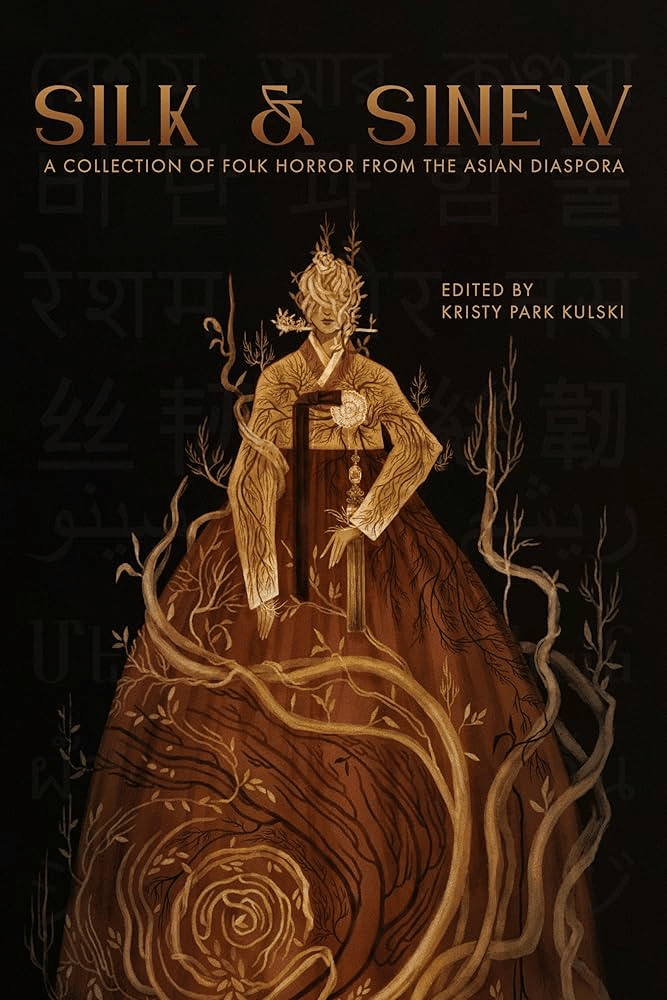
Silk & Sinew is the rare anthology that feels like a statement, not a sampler. It corrals a wicked roster of Asian diaspora writers and arranges them by landscape – soil, estuary, bedrock, roots, air – which sounds ornamental until you realize the book is tuning your brain to read for place as much as plot. The result is a collection that is weird, ambitious, and memorable in all the right ways. It’s folk horror with receipts. It’s also a blast, albeit the kind that laughs like a knife.
Editor Kristy Park Kulski is a historian turned horror conjurer, which explains why so many stories hum with context instead of leaning on exoticism. She’s got novels under her belt and a puckish public persona that promises righteous mischief. She delivers. The curation is careful, purposeful, and sometimes downright audacious. Grouping by landscape does more than avoid tonal whiplash. It lets the book build an argument about how bodies, families, and communities are shaped by the terrains they cross and the borders they’re told not to.
This is not a costume party of borrowed myths. These tales drag folklore into the fluorescent glare of diaspora life, where the scariest monsters are often policy, memory, and the family ledger that never quite balances.
Standout stories include a brutal beauty about a mother whose daughters are literally her body’s bill to the world. It is tender enough to make your heart ache and feral enough to chew on your ankle. Another highlight is a forensic excavation story set against the backdrop of political violence. There is a ghost, sure, but the true haunting is history that refuses to stay politely buried. A sly parable about appetite and outsiders serves small-town bigotry with a grin and a fatal aftertaste. A tight intergenerational tale about tethers and bargains asks what you owe the people who made you and what they owe you back. And there’s a crisp, aching piece by a master of the political-uncanny that bottles the loneliness of unbelonging so efficiently you can practically smell the airport terminal it lives in.
Elsewhere, liminal stories blur shoreline and city block, home and exile, living and not-quite. A pair of atmospheric stunners bracket the final section, sketching sky and ash and breath in a way that feels like an elegy you accidentally inhaled. The table is long and rich, but the anthology never reads like a kitchen-sink dump. It’s a playlist, not a backlog.
If folk horror is usually about the cost of tradition, Silk & Sinew is about the cost of survival. The book bucks amnesia. Its folklore is not a quaint import for spice but the record-keeping system of people who had to build religion from whatever the land would admit. Bodies and borders are the two big motifs. Bodies as offerings, caretaking as ritual, the invoice of womanhood stamped into skin. Borders as jokes, porous, moving, enforced only when it benefits power. The organizing landscapes are more than chapter headers. Soil means origin and burial. Estuary is crossing and salt. Bedrock is history under pressure. Roots are inheritance, tangled and sometimes choking. Air is aftermath, rumor, and the stories we tell to stay intact.
Stylistically, this thing rips. You get multiple textures that all cut. Some pieces are clinical in their precision, like a pathologist’s slide glowing with sick color. Others are fabulist and dreamy, moving like fog through streetlights. Then there are the nasty little daggers, the two to four thousand worders that waste not a syllable and still manage to draw blood. Voice is a strength across the board. Nobody is doing karaoke versions of anyone else.
The collection’s quiet thesis is that diaspora folk horror isn’t about importing a monster. It’s about refusing erasure. When you’re told to assimilate until you disappear, the land remembers you better than the census does. The ghosts here are not seasonal attractions. They are accountants. They track debts that families owe and debts the state pretends not to. The rituals are labor disguised as magic because no one paid for the labor. The prices are not metaphors. This is why so many endings feel like contracts being enforced. The book suggests, not gently, that what we call a curse is often just cause and effect stretched across generations that didn’t get a fair shot at naming the terms.
There’s also a streak of righteous, salty humor that keeps the collection from sinking into dourness. Female rage shows up not as a lecture but as a lawful natural force. It is the tide. It comes for you whether you posted thoughts and prayers or not.
Strengths first. The curation is excellent. The landscape structure earns its keep by building resonance, letting symbols stack, and preventing the mid-anthology sag that kills so many collections. The best stories are flat-out great, the kind that make you change how you read the next one. Line by line, the prose quality is high. The art and design match the mood. And the thing has an actual voice, which is rare in anthologies and rarer still in themed ones.
Quibbles. Two stories overstay their welcome. Folk horror is pressure cooking, not slow roasting. A few pieces chase similar prey from similar angles. If you read cover to cover in one sitting, you may feel echoes rather than harmony in a couple spots. These are the smallest of dings on a sturdy suit of armor.
Originality sits north of the border. The anthology dodges tourist-trap folklore and goes straight to the messy mechanics of diaspora living: intergenerational bargains, language that betrays you at customs, neighborhoods where the map insists nothing happened but the ground says otherwise. The spins on witches, hauntings, and bargains feel earned, not showroom-shiny.
Pacing is strong. The landscape breaks re-oxygenate the reading experience so the long pieces have room and the short ones hit like gut punches. Character work is a standout. Even the most allegorical stories have people in them, not walking symbols or meme delivery devices. You can hear the clatter of kitchens, the shuffle of second jobs, the silence between parents and children that stretches like old taffy.
Is it scary? Yes, in the way that sits behind your sternum for a week. This is not a parade of jump scares. It’s dread braided with grief and memory. The excavation story is terrifying because you know exactly which headline it belongs to. The revenge pieces are frightening and cathartic at once, like hearing a verdict read in a courtroom that usually loses the paperwork. The quieter hauntings feel like a hand on the back of your neck when you walk past the alley you grew up near.
Silk & Sinew is excellent. It’s the sort of anthology that convinces you themed collections can still surprise you if the theme is a living organism. It’s angry without being preachy, beautiful without being precious, and clever without letting cleverness do the emotional heavy lifting. If you care about folk horror, diaspora literature, or just reading things that actually leave a mark, this belongs on your shelf. Not someday. Now.
TL;DR: A razor-sharp, landscape-shaped anthology of Asian diaspora folk horror that ditches tourist kitsch for history’s teeth. The best stories are instant re-reads, the curation is bold, and even the few meanders can’t blunt its edge. Come for the monsters, stay for the bookkeeping of ghosts.








Recommended for: Readers who want folklore that bites instead of winks, anyone who collects intergenerational grudges like baseball cards, exhausted daughters who are done being the family’s unpaid exorcist, and academics who like their footnotes with blood.
Not recommended for: Cozy-horror pilgrims seeking cinnamon-scented hauntings, folks who believe “the past is over” because a realtor said the bones are good, and anyone allergic to stories that point at power and say you did this and the land remembers.
Published May 6, 2025 by Bad Hand Books.

 The Blog Without a Face
Leave a comment