
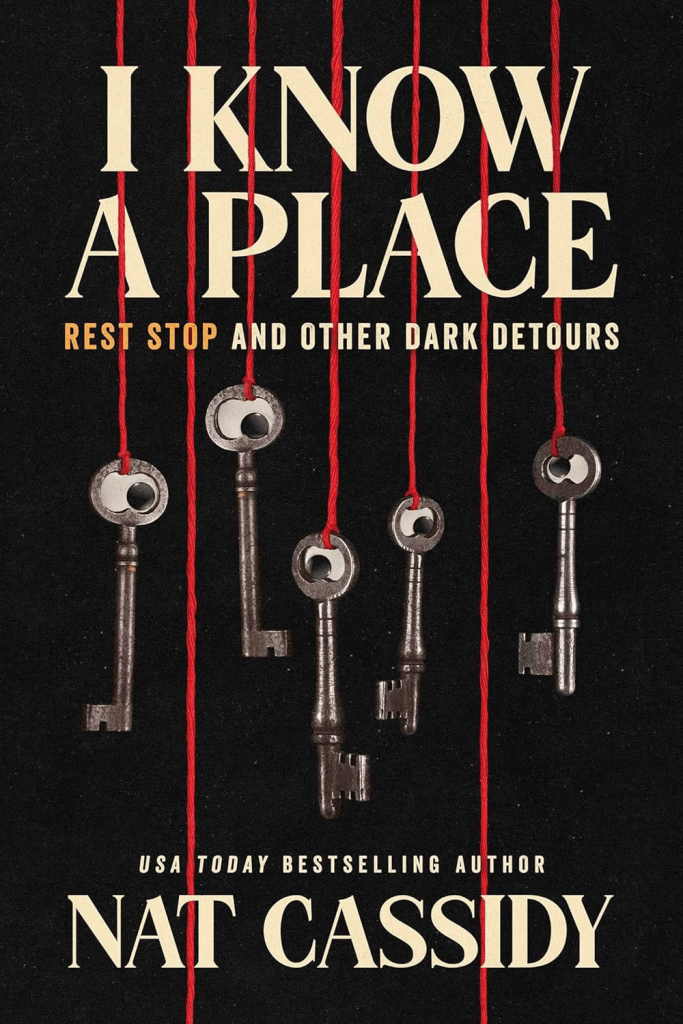








TL;DR: Nat Cassidy’s I Know a Place is a killer collection: punchy, viciously funny, and relentlessly propulsive, with set pieces that snap tight and then splatter. He’s got rare control over comedy, panic, and gore, and every story moves viciously. A riotous, high-skill tour of modern dread that never loses momentum.

There is a phrase that runs through this collection like a thread through old cloth, surfaced once in plain view and again at its close in disguise and several times in between in the mouths of men whose smiles do not reach their eyes. I know a place. Four words a stranger speaks to another stranger when he wants the stranger to come with him. Cassidy has built thirteen stories around the proposition that this sentence is the foundation of horror, that what frightens us is the open palm and the mild voice and the offer of somewhere else, and that whatever waits at the other end of the invitation is almost always worse than the place we agreed to leave.
The book opens on a chamber piece. A man named Abe stops at a gas station in Arizona at two in the morning and finds himself locked in a bathroom by something he is unwilling at first to understand. “Rest Stop” is the hub the rest of the volume turns on, a novella consuming nearly a third of the binding, which earned a Bram Stoker Award nomination for the standalone edition that preceded this one. It is a chamber piece in the way a coffin is a chamber. Cassidy keeps Abe in that tiled room past the point of bearable. He drops creatures from the ceiling vent. He cuts the lights. He slips notes under the door. He does what the older masters did with a single set, which is to constrict the geography until the reader cannot stop looking at the only thing left to look at, and somewhere in that confinement the story acquires a theological cast the prose refuses to apologize for. The grandmother who lurks at the back of Abe’s consciousness, the tiny old Polish woman with her Holocaust silences and her cruelties, is the second character in a chamber piece that ostensibly contains only one.
The remaining twelve pieces fan out from that center in directions which have no business sharing a binding and which somehow do. One is an epistolary folk horror in which a young American woman emails her newly acquainted English father from an ancestral castle as the tapestries on the walls reveal what they were sewn to depict. One is the recovered confession of a South Dakota boy who has displaced himself backward through time and made himself into a oneman Beatles, the sort of conceit that should collapse on contact with the page and does not. One is a performance piece scripted for three to six voices, with breaks and stage directions, that begins as a children’s joke and stops being one. One is a meet-cute in a bar in Olympia in March of 1974 in which a young woman speaks to a handsome man about the breakup of the Beatles and Stevie Wonder’s loss of smell, and the reader, knowing inside the first page who is sitting on the next stool, can do nothing.
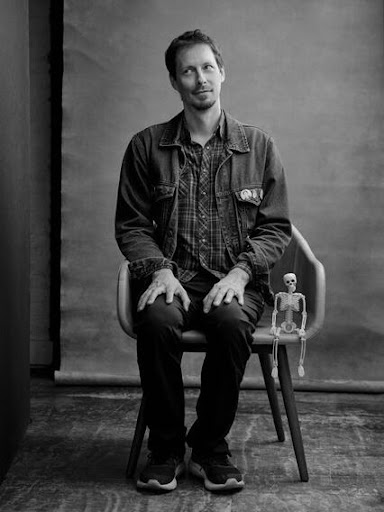
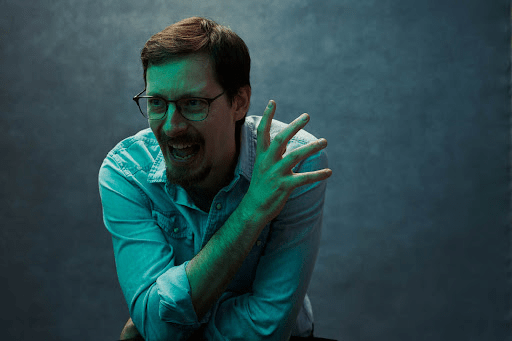
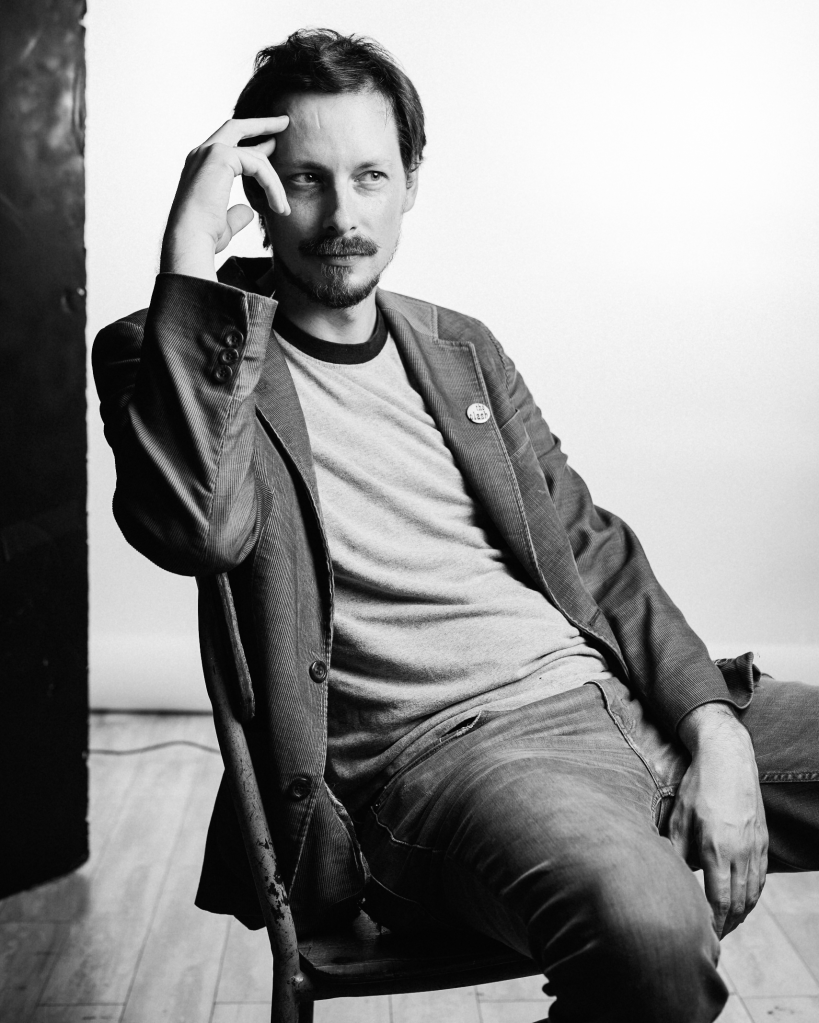
Cassidy is a man who came to prose from the stage and the screen. He won the New York Innovative Theatre Award for a oneman show on H. P. Lovecraft and another for a play about Caligula. The Kennedy Center commissioned him to write the libretto for a short opera about the end of the world. He is also a working television actor, the sort of bonybrowed character man cast as the bad guy of the week on Law & Order: SVU and FBI and Quantico, and a member of the audio drama company Gideon Media. The career explains the collection. The collection is in significant part the work of a writer who has spent his adult life standing in front of audiences asking what shape a voice ought to take to hold them. Mary, his 2022 debut novel for Tor’s Nightfire imprint, was named to Audible’s hundred best horror novels of all time. Nestlings followed. His 2025 novel When the Wolf Comes Home, which Stephen King called a classic, landed on the USA Today bestseller list. He is a writer in the strong middle of his powers.
What he has in rare quantity is range. The voice in “Generation,” where an obstetrician sits across from couples and delivers what she calls The Speech, is nothing like the voice in “Nice,” a black comedy in which a Christmas elf attempts to manipulate a sixyearold and finds out which sixyearold he has chosen. Both are distinct from the voice of “Come,” told by an asexual high schooler who turns out to be the only person in the building unlikely to be killed by a cursed videotape. The collection is most alive when voice and premise lock into each other; it is at its weakest where Cassidy reaches for a virtuoso effect and the effect arrives slightly ahead of any reason to perform it. “The Lunar Eclipse” is mostly atmosphere and elegant page composition, which is sometimes enough and sometimes not. “Jubilee Juncture” has a body horror reveal that lands without the escalation it needed. “Into the Life of Things” closes on an ending that feels overly engineered. These are not failures. They are the cost of a writer who throws a different shape every time he steps to the line, and most of the throws connect, and several of them connect very hard indeed.
Two pieces should be flagged on their own. “Laughlines” is folk horror executed entirely as email correspondence, the constraint generating most of its dread; the inversion in its closing pages is one of the rare moments in modern horror where an emoji acquires the force of an obscenity. “Meet-Cute #1: The Unluckiest Girl,” brief and inarguable, refuses to do anything except let the reader watch what is about to happen and trusts the refusal to do the work. These are the strongest argument that Cassidy can sustain a register over a short distance without it collapsing into mannerism.
The book is bookended by predation. Both meet-cutes turn on a man who has decided in advance where he is going to take the woman. In the first that place is a stretch of forest somewhere outside Olympia. In the second it is a bar with warm light and an Alison Krauss song. The difference between the two outcomes is the entire moral architecture of the collection, and Cassidy is too honest to pretend the second is a refutation of the first. He is interested in what we agree to and what we cannot take back, in why we keep saying yes anyway, in the offered hand and the said yes and the followed-through invitation. At higher altitude the whole collection is a sustained argument that the foundational gesture of horror is the open mouth and the mild instruction, and that everything else, the cosmic and the supernatural and the gore, is freight loaded onto that small wagon.
What does not entirely cohere is the suspicion that Cassidy has more ideas than the form can comfortably hold. A collection this various is by definition a collection that wobbles between its modes; some readers will want a tighter book and others will want this exact looseness. The cumulative effect even where individual pieces falter is of a writer in firm command of his instrument and willing to play it hard. He is not yet at the level of the masters he is most often compared to. He is closer than the comparison usually implies.
I know a place, the man says to the woman in 1974, and she goes with him. I know a place, the bar and the rest stop and the castle and the yoga retreat all whisper. I know a place. We go.


 The Blog Without a Face
Leave a comment