
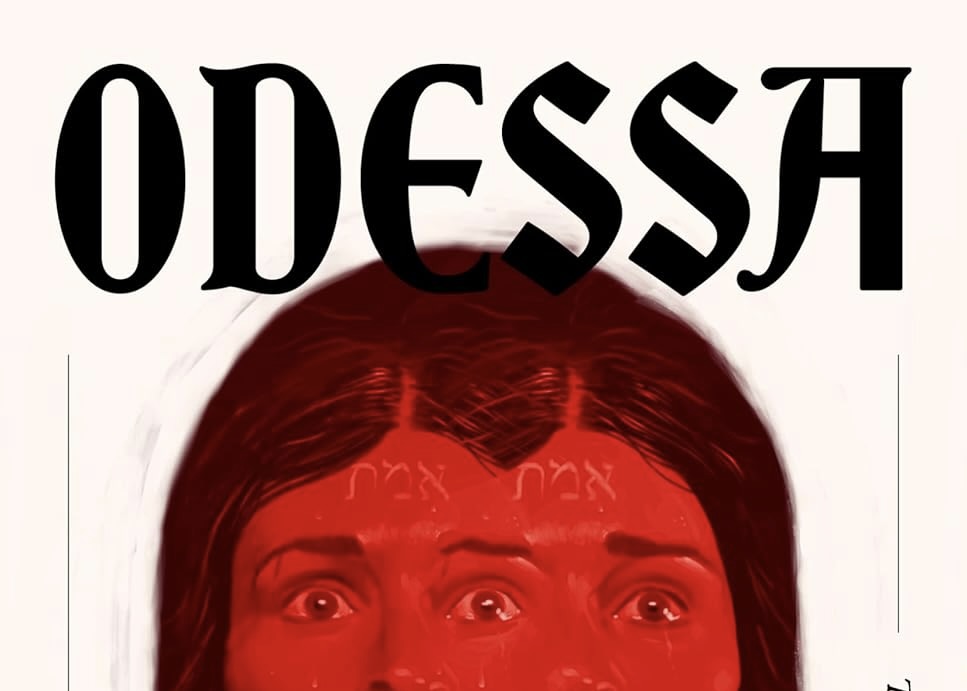







TL;DR: Gabrielle Sher’s Odessa is a debut of startling precision: Jewish gothic rendered with the patience of a folk tale and the nerve of a trap. Sher builds a world on exact small details, lets the horror rise out of them without announcement, and trusts her images to carry what words cannot say. The mushrooms are going to stay with you.

Frieda counts her family on her fingertips. Yetta, Ephraim, Mordechai, me. One, two, three, four. Touch the thumb to each finger in turn, whisper the name, begin again. If I count to four none of them will die today. If I buy three fish at the market one of us will die. She does this while her husband is across town assembling a small secret arsenal of clubs and daggers in the back of a furniture shop, and while her fifteen-year-old daughter is slipping out of the house at night to lie in the wet grass with a boy she has not yet agreed to marry, and while her small son sleeps in the bedroom they all share and coughs in a way that reminds her of winters where children died. The counting is how she stays married to the idea that she can still protect anything at all. Gabrielle Sher does not tell us this is what the counting is. She just lets Frieda do it, again and again, until the reader is doing it along with her, and the moment Frieda skips a number the skipping is its own catastrophe.
That is the kind of novel Odessa is. The premise is big and loud. A Jewish family in the city of Odessa in 1905, the shtetl at the edge of the city where the houses lean toward each other like infected trees reaching for the sun, a cantor who remembers when his synagogue was the most famous in Europe, a new rabbi who wears his hair and beard cropped short in an effort to look less obviously Jewish, and a pogrom arriving the way a pogrom always arrives, which is not as a surprise. In its aftermath, a father who has been studying Kabbalah in secret with the rabbi and the cantor for five years will do what all of that study was for. He will try to bring his dead daughter back. The book is called Odessa but it could almost as easily be called Clay. The father and his two collaborators take the daughter’s body to a mikvah in the woods, dig clay from the floor of the spring, pack it into a wooden box the father has built, bury her in it, carve the Hebrew word for truth into the forehead of what they make. The thing they make sits up.
So much, so much big. And yet the novel’s first instinct is always to find the small specific weight. Mordechai, the father, thinks of his wrecked synagogue as having the gravity of a mountain carved by a human hand. Benyamin, the boyfriend, is only ever slightly more present than his own curls. Ephraim, the little brother, is described exactly once as a kitten in his sister’s arms, sickly and bony, and then the book simply trusts you to keep imagining him that way for four hundred pages and you do. Sher’s similes are the kind Flannery O’Connor would have read with pleasure. A secret, Frieda thinks, attaches itself to her like a tick. She can feel its tiny fangs lodged in her skin and its small body slowly ballooning with her blood. That is a sensation rendered so accurately you have to sit with it. A mikvah, one character observes, is a creature with one foot in the world and one in the forest. A hiding place in a wall, inhabited during the pogrom by a terrified mother and her son, fills up with mushrooms afterward. This is the book’s sensibility in miniature. Terror leaves a residue the shape of a garden.
The trap the novel is setting becomes clear slowly. The father has brought his daughter back, yes. He has also brought her back without the memory of what happened to her in the last minutes of her first life. He tells himself this is mercy. He tells his wife, when she asks, that their daughter’s mind is protecting her from fear. What he has actually done is construct a version of his daughter that will be easier to send into battle, and he has done it without asking her a goddamn thing. Meanwhile, unguarded, the original dead body rises and walks. She remembers everything. She wants what the living daughter has been assigned not to want, which is for what happened to her to have happened to her. The book is a horror novel about the argument between these two girls. It is also a horror novel that declines to treat that argument as an argument, because the argument is not one. The body is not wrong. The body is the witness.
Sher is at her best when she refuses to announce any of this. The assault is never named. The word is not there on any page. It is simply the shape of every page, the thing everyone in the room is arranging themselves around. Mordechai keeps calling it something else. He is a man who has decided to call it something else and will continue calling it something else until the world makes him stop. The reader gets to watch what that costs him, what it costs his wife, what it costs both of the daughters he now has. That is the cleanest, cruelest move in the book. The father’s self-deception is presented without comment. We see what he believes about himself and what he is actually doing at the same time, and the gap is where the dread lives.
Gabrielle Sher came to this book the long way around. Hamilton College, a Rosenfeld Chapbook Prize for a novella called Bowerbird, then an MFA and a PhD at the University of St Andrews, where her supervisor was the Scottish poet John Burnside before his death in May of 2024. The dissertation she wrote is called Who Made Us Monsters? Narrative Psychology and the Female Jewish Gothic, and Odessa began its life inside it. This is the kind of origin story that usually produces a novel that has swallowed its own footnotes and cannot stop tasting them. Odessa does not do this. It has the argument underneath the sentences and lets the sentences keep their job, which is to be exact. The book is dedicated in effect to the author’s grandmother Lynn Sher, whose words about a woman who left everything behind sit as the epigraph. You can feel the grandmother in the book. Not in any narrated way. In the sense that the book believes a story told by a woman to another woman over a long time matters and is worth getting right.
The novel does thicken a little in its final third. The barricade at the shtetl’s edge, the rescue of a captured boy in the town square, the quieter female exodus running on a separate track, all of it arrives close together, and the metaphorical weather gets dense enough that you notice it as weather. The dybbuk-sister occasionally speaks in a register one degree more theatrical than the book she is in. Benyamin is more of an assignment than a person. These are complaints at the scale of one degree of tilt on a structure that is mostly standing dead straight. I noticed them. I did not care very much.
The horror here is Jewish in a way horror is rarely Jewish. The ritual that remakes a dead girl is not exoticized. The Hebrew sits on the page without translation that I needed. The women are not window dressing for men’s mysticism. Miriam, who at first appears as Frieda’s best friend and spends most of the book in a small wooden house that looks like a raft out in a field, turns out to have been running a second kind of exodus entirely, a quieter one with worse odds. That she has been doing it all along while the men were in the back room building daggers is the joke the book refuses to make explicit. Both of them count as trying. One of them is actually working.
I am going to be thinking about the mushrooms for a long time.

Odessa by Gabrielle Sher,
published April 21, 2026 by Little, Brown and Company.



Leave a Reply