
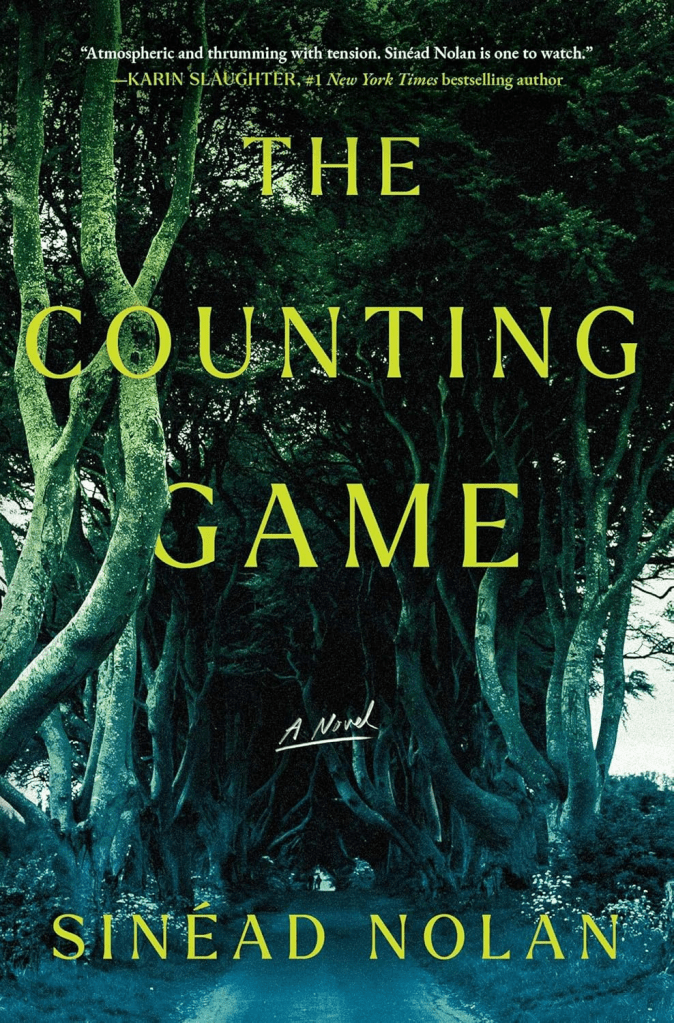



TL;DR: The Counting Game has a setting that breathes and a child protagonist good enough to make you resent everything around him. Jack’s chapters are tender, textured, and genuinely unnerving. But the pacing drowns in its own middle third, the adult lead never comes alive, and a moody folklore mystery deserved a better ending than a villain monologue. A frustrating near-miss from a writer worth watching.

There’s a scene in The Counting Game where nine-year-old Jack, asked to imagine his missing sister sitting in an empty chair, conjures her so vividly she puts a finger to her lips and starts bleeding from her nose. It’s the kind of moment that makes you sit up and think: okay, this book knows what it’s doing. And for stretches, it really does. The problem is that for equally long stretches, it doesn’t, and the distance between those two modes is where a promising debut goes to sag.
The setup is strong. Rural Ireland, 1995. Thirteen-year-old Saoirse vanishes while playing a counting ritual in the forest with her younger brother Jack. He won’t talk. The village of Drumsuin is one of those places where missing girls are practically a local tradition and the woods have a reputation that keeps people out. Freya Hemmings, an English psychotherapist carrying her own grief like a suitcase she refuses to set down, is brought in to coax the truth from Jack. Decent bones. A locked-room mystery with a child’s mind as the locked room.
And Jack is, honestly, the best thing here. Nolan writes his perspective with a gentleness and specificity that feels earned. His world is full of small, fierce logic: he names his fish Jack Dempsey and worries no one will feed it while the adults panic; he draws invisible letters on his stuffed bear’s chest; he categorizes adults by their smells and the sounds their chairs make. There’s a scene where he hides in an airing cupboard during a game with Freya and the book becomes something genuinely warm, this kid remembering what it’s like to just laugh. That warmth makes the horror land harder. The image of his mother’s body at the base of a cliff, seen through a child’s eyes that can register the wrongness of her angles but not yet the permanence of it, is quietly devastating.

The forest works as atmosphere too. Pine musk on the tongue, drizzle finding the back of the neck, the crunch of soft ground underfoot. There’s a chase sequence where the prose goes staccato and breathless in a way that matches the panic. The Creature that supposedly haunts the woods functions well as folklore, as a child’s way of metabolizing fear. Nolan has a good eye for the textures of dread: the way a village tightens around a disappearance, the specific claustrophobia of everyone knowing your business and nobody saying what they know.
So where does it go wrong? Pacing, mostly. The middle third is a swamp. Freya’s chapters repeat emotional beats without deepening them. We learn she lost a daughter. We learn it again. Her sessions with Jack, which should be the engine of the plot, often feel like they’re idling: she asks a question, Jack deflects, she reflects on her own pain, the chapter ends. Repeat for fifty damn pages. There’s a version of this structure that ratchets tension. That’s not quite what we get.
Sinéad Nolan comes to fiction from an interesting angle. Born in Dublin in 1985, she was roughly Jack’s age during the novel’s 1995 timeframe, and grew up climbing trees in forests that clearly informed this book’s setting. She studied creative writing at Derby, earned a master’s in journalism from Nottingham Trent, and spent years writing features for the Irish Independent and Sunday World before retraining as a counsellor and psychotherapist at thirty. She now works in private practice in London. That dual background is legible on the page: the journalism in her eye for procedural detail, the clinical expertise in the Jack-and-Freya dynamic. She developed the novel through the Faber Academy’s writing course in 2019, and the manuscript attracted nine literary agents. She’s cited Claire Keegan, Ishiguro, and Plath as influences, which tracks: you can feel Keegan’s rural Ireland and Ishiguro’s buried grief trying to push through the genre scaffolding. The trouble is the scaffolding keeps winning. Her second book, Shadow Play, is reportedly in progress.
Because underneath the folklore and the atmosphere, this is ultimately a pretty conventional whodunit, and it resolves like one. The supernatural ambiguity the book spends so long cultivating gets set aside for a reveal that feels imported from a more ordinary novel. The villain, once unmasked, delivers a monologue laying out motives and methods with the subtlety of a case file. After all that careful, moody work building a world where the forest might genuinely be alive and malevolent, arriving at a drawing-room confession is deflating as shit.

Freya herself is the weaker protagonist by a wide margin. Competent, caring, grief-stricken, determined, and none of it adds up to a person I believed in. Her internal monologue has a flat quality that might be intentional given her profession but reads as underwritten. When she’s in danger in the final act, I felt less “oh shit” and more “huh, okay.”
There are real pleasures scattered through, though. The one-eyed garda offering Blackjack sweets to a kid who won’t talk. The stuffed bear Wilberry with his sewn-on half-smile and missing button eye that mirrors the garda’s face, a detail so good it almost makes you angry the book doesn’t sustain that craft throughout. Aunt Bronagh snooping at the edges of conversations in a way that could be protective or predatory. Jack drawing the number eight over and over because eight is infinity, because Saoirse promised forever.
I wanted to like this more than I did. The setting breathes, the child protagonist feels real and stubborn, and the author’s professional background gives her access to psychological territory most thriller writers only gesture at. But the pacing problems are real, the resolution undersells the premise, and the adult narrator who’s supposed to be our way in is the least interesting person in the book. Not a waste of time, but a frustrating one, because you can see the better novel inside it, counting to ten, waiting to be found.

The Counting Game by Sinéad Nolan,
published April 7, 2026 by Gallery Books.
 The Blog Without a Face
Leave a comment