


TL;DR: Big Rig Vol. 1 is medieval demon-siege horror stapled to a modern highway rampage, equal parts holy relic quest and heavy-metal chase scene. It lands because the art stays brutally readable while the palette and page turns keep escalating the panic, making Hell feel loud, close, and expensive. Perfect for readers who want their horror fast, gnarly, and sincere.

This book comes in like a semi-truck through a church wall. It opens in a grime-smeared Dark Ages where Hell is not a metaphor, it is an active zoning dispute, and the locals are losing. You get bells, smoke, panic, and that immediate sickening detail work, like an eyeball in the mud that the story will absolutely not let you forget. And then, without asking your permission, it slams the pedal into a different gear and starts stitching eras, myths, and engines together into a holy-road-war fever dream.
This thing also reads like a very specific group-chat idea that somehow got a real budget, and that is basically the origin story: Post Malone shows up as creator and co-writer, bringing the “what if Army of Darkness had an eighteen-wheeler and zero shame” instinct, then pairs up with Adrian Wassel, a writer-editor who co-founded Vault Comics and has spent years shepherding punchy indie books that move fast and hit hard. On art, Nathan C. Gooden is an obvious choice for this flavor of mayhem because he is a Vault co-founder with a background in animation and a track record for clean, brutal readability, the kind of draftsman who can make chaos legible without sanding off the gore. Der-Shing Helmer handles color with that controlled, high-contrast restraint that keeps the demonic stuff feeling nasty instead of noisy, and she is not just a colorist but a creator and editor with a science-leaning indie pedigree, which might explain why the palettes feel disciplined even when the story is all gas. Jim Campbell’s lettering is the final engine part, a veteran comics letterer who knows how to make screams, impacts, and jokes land in the same page without turning it into typographic soup. The “why” is simple and kind of beautiful: everybody involved seems committed to making a maximalist, blasphemous, heavy-metal horror comic that reads like it was made by people who actually like comics, not people trying to politely translate comics into something else.
Demons have invaded medieval Europe, and a secret order believes a specific holy weapon is the key to pushing back. The narrative follows the desperate chain of custody around that weapon, shifting between siege mentality medieval horror and rough, modern roadside survival. The stakes stay blunt and human even when the lore gets big: people are bargaining, running, sacrificing, and trying not to become something worse in the process.
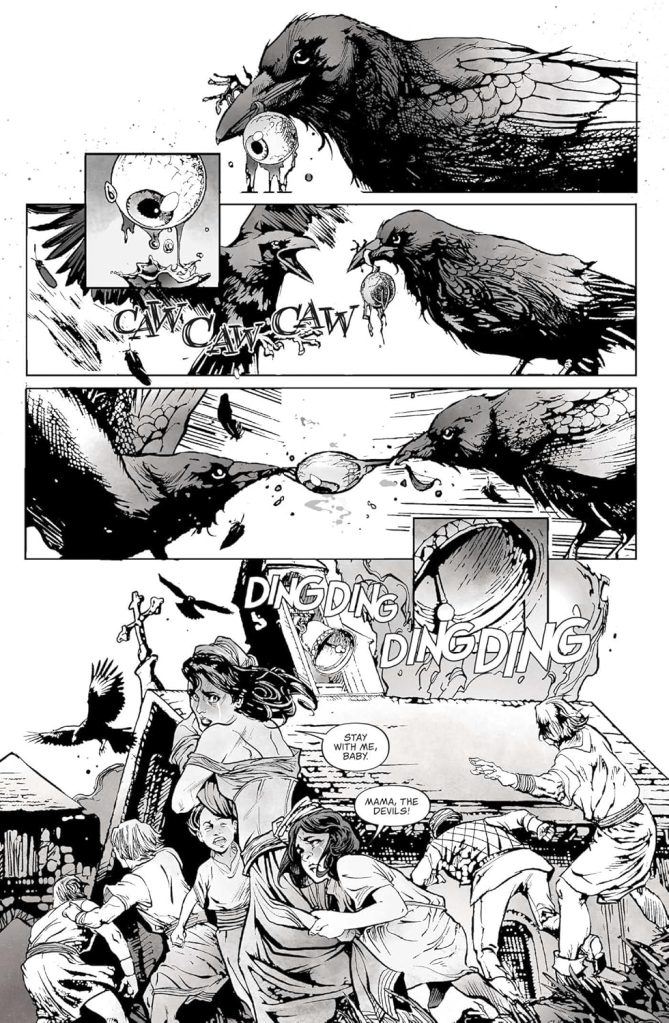
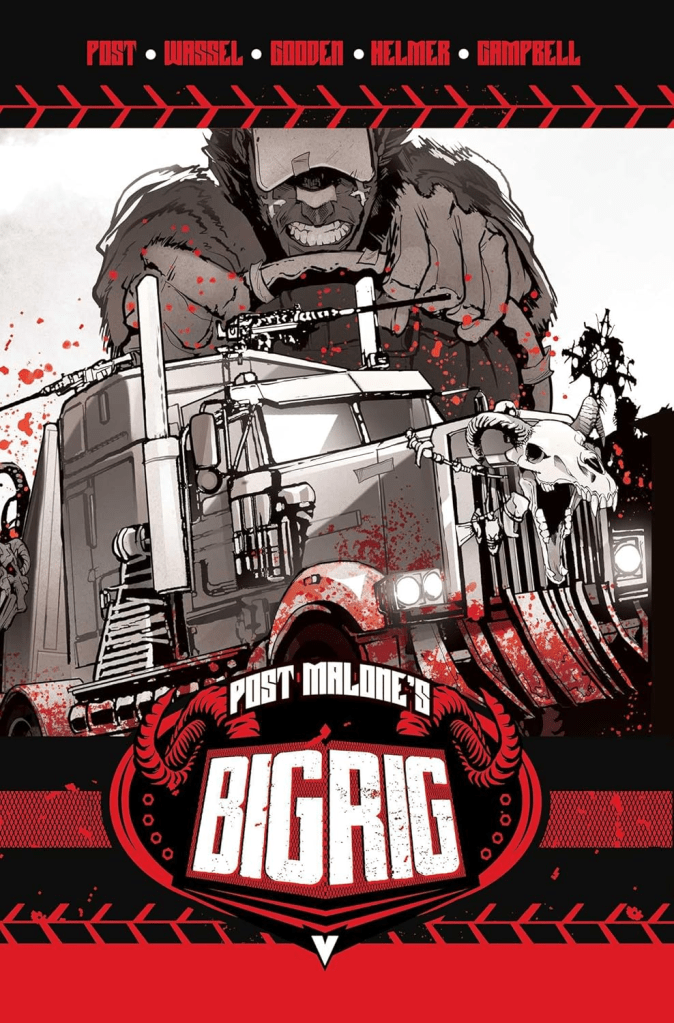
The first thing that lands is the visual language. Nathan Gooden’s inks have that confident, chunky clarity that keeps the action readable even when the page is crowded with bodies and claws. Faces are the big tell. You get fear that looks like a physical condition, clenched mouths, eyes wide enough to swallow a whole prayer. The book likes high-contrast staging, silhouettes against a big white moon, figures swallowed by smoke, and then sudden close-ups that feel like being grabbed by the collar. Der-Shing Helmer’s palette is mostly restrained and mean, leaning hard into blacks, grays, and bone whites, with red used like an alarm bell. When the red shows up, it is never decorative. It is blood, it is Hell, it is consequence. The negative space does real work here, especially in the quieter panels where a face hangs in a gray wash and you can feel the next bad choice creeping in.
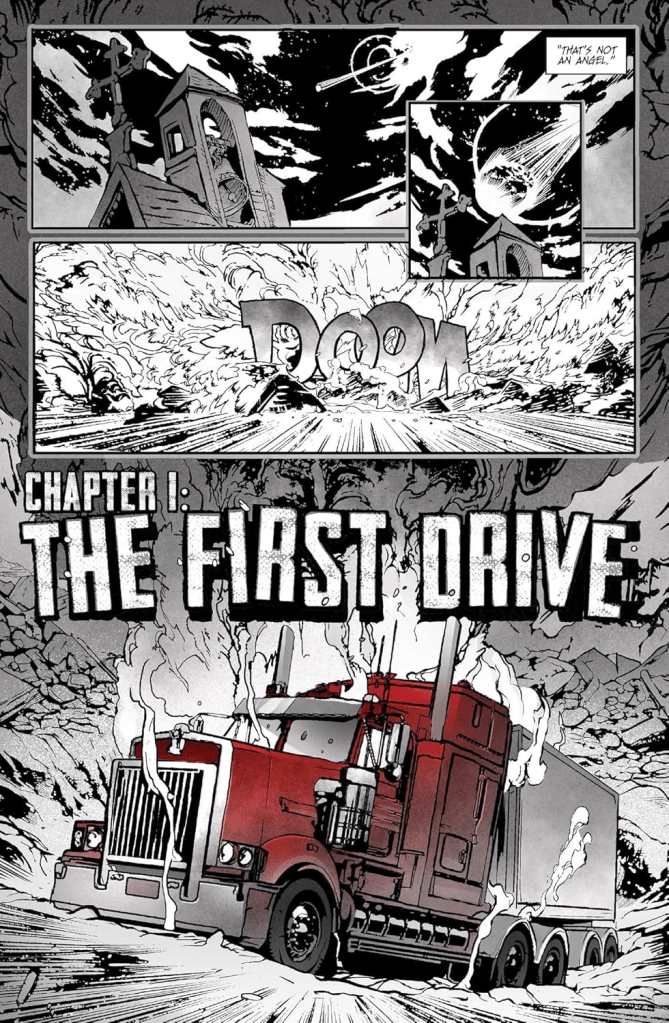
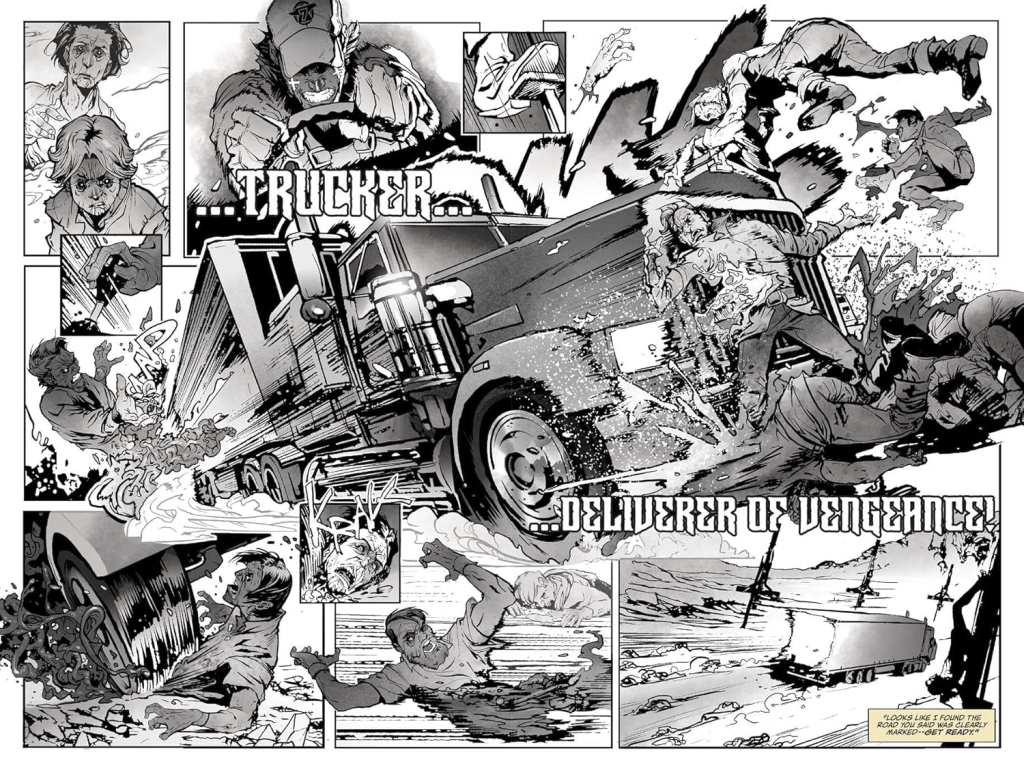
Paneling and pacing are where the comic is most fun and occasionally most chaotic. When it wants speed, it uses montage stacks and narrow strips that feel like flashes of memory or quick cuts in a trailer, giving you just enough information to keep your gut braced. There are pages built like a pressure chamber, tight grids that force you to watch a threat close in panel by panel, no escape hatch. Then it rewards that compression with a splash that detonates, like the big rig itself becoming a weapon, the page suddenly widening and roaring. The best page turns are the ones that convert a moment of desperation into a new kind of horror, not a twist ending, but a new layer of “oh, we are doing this now.” When it’s less successful, the transitions can feel like the book is sprinting ahead of its own clarity, especially during lore-heavy detours where new names and orders and places pile up faster than the emotional point of view can anchor them.
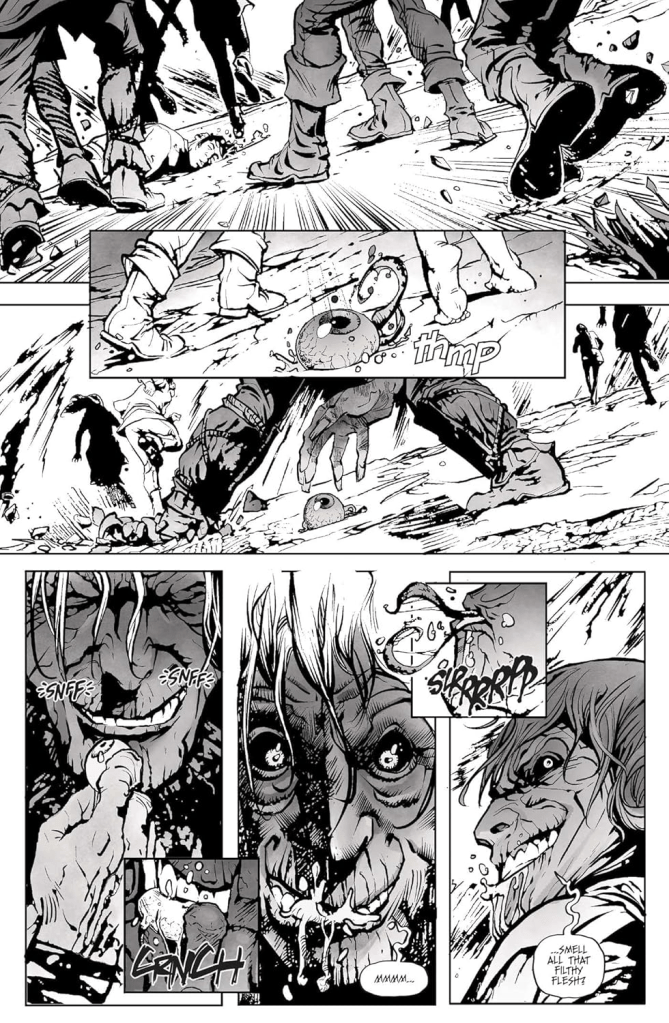
Action is blocked with clear silhouettes and purposeful body language. You can tell who is advancing, who is cornered, who is improvising with a hammer because nothing else is left. Gooden’s fight choreography favors impact over ballet, which fits the book’s vibe. The violence is often ugly and practical, staged in a way that emphasizes weight and panic rather than coolness. Even when the page is busy, spatial coherence usually holds. You know where the danger is coming from, and you know where the characters wish they were instead.
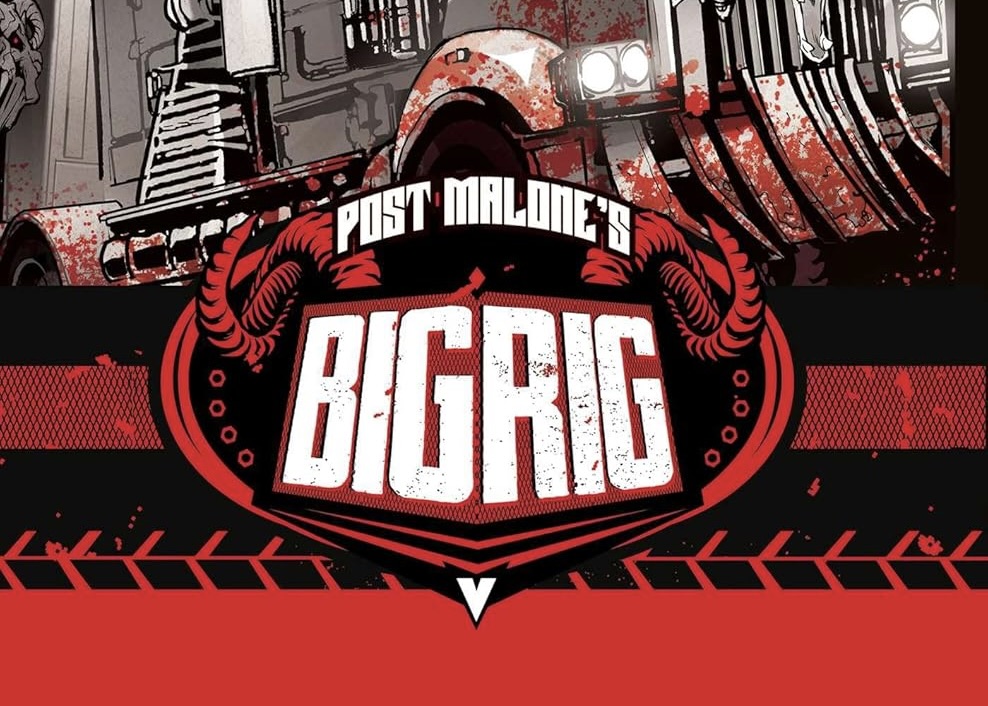
Jim Campbell’s lettering deserves its flowers because it is doing more than just delivering dialogue. Balloon density is generally controlled. The book does not drown you in text, which is important when the visuals are already loud. Captions, when they show up, carry a gravelly storybook tone that sells the “this is an old war repeating itself” feel. Sound effects are integrated with an ear for texture. You get big, obnoxious impacts when the truck or the violence needs to feel like a slammed door in your chest, and smaller, scratchier noises when the horror is creeping. Even the typography in chapter cards and design elements leans into the highway motif, like the story is branding itself with tire marks.
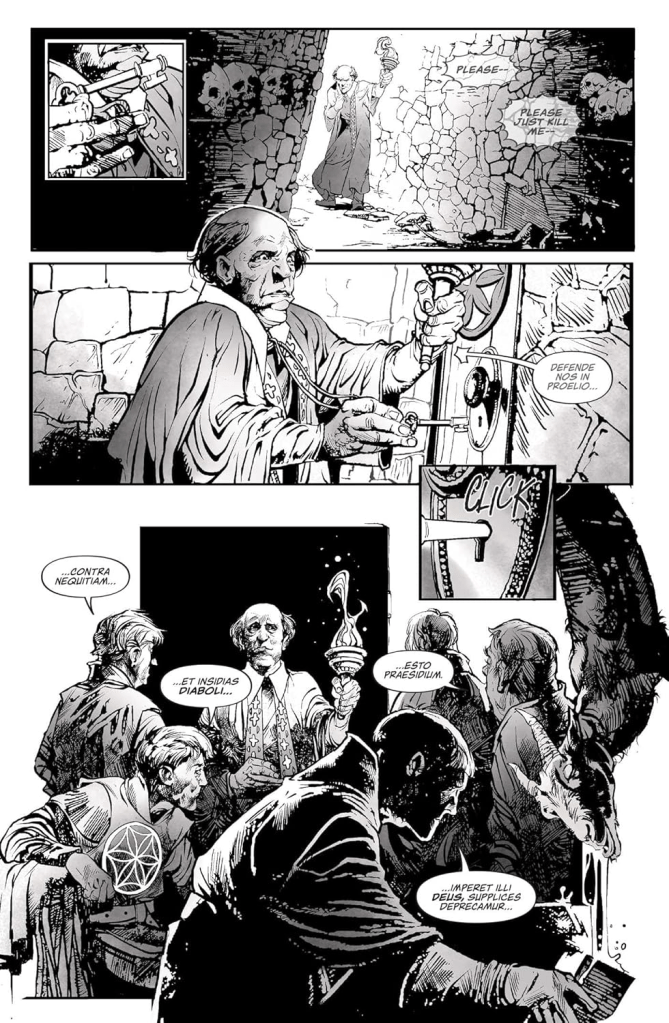
Dread mechanics here are less about mystery and more about inevitability. The book generates tension by making every option feel expensive. There’s a constant sense of being pursued, not only by literal monsters, but by the consequences of oaths and bargains. It uses repetition as a threat, returning to images of mouths, hunger, and holy language that turns sour. The restrained color scheme helps, too. When the red finally spikes, it feels like the world has slipped a gear, like the narrative is saying, “You thought you were just in danger, but now you’re in Hell’s line of sight.” It’s not subtle dread, it’s dread as a chase scene, and it mostly works because the craft stays legible even when the mythology gets baroque.
This is a story about faith as a transaction and duty as a kind of violence. The book keeps asking what a “holy weapon” actually means when it is being handled by exhausted people who are scared, compromised, and angry. It’s also about inheritance, not just bloodline stuff, but the way old wars hand their trauma forward and call it righteousness. The most interesting tension is the one between salvation and appetite, between defending a city and becoming the kind of monster who can “justify” anything because the enemy is worse.
The book sometimes loves its own mythos a little too much. There are stretches where new factions, names, and lore beats arrive in a rush, and if you are not already the kind of reader who enjoys being tossed into the deep end of invented history, you might feel the story tug away from the immediate emotional heat. I also wanted a few more silent beats in certain sections, just one extra breath before the next escalation, because the comic is so eager to keep the momentum that it occasionally skips the most haunting part, which is sitting in the aftermath.
If you want a clean, minimal, character-first horror narrative, this may feel like too much mythology strapped to a rocket. But if you like your horror loud, graphic, and fueled by a sincere belief that demons should get hit by a truck, you are going to have a very good time. It’s a solid, gnarly ride with a sharp visual identity and enough momentum to carry you even when the lore gets busy.
Read if you like horror that’s loud, fast, and gnarly, with a chase-scene heartbeat and splatter on the windshield.
Skip if you need subtle, quiet dread and long, mournful character interiority instead of “floor it, pray later.”
Creator & Co-writer Post Malone. Co-writer Adrian Wassel. Art by Nathan Gooden. Colors by Der-Shing Helmer. Lettering by Jim Campbell
Published April 7, 2026 by Vault Comics.
 The Blog Without a Face
Leave a comment