





TL;DR: Matheson’s suburban nightmare still hits where it hurts: the crawlspace between masculinity, marriage, and mortality. The domestic drama slaps, the cellar set pieces still snarl, but some gender dynamics feel stuck in amber. Prioritize it if you want existential dread with your giant spider, not if you need modern sensibilities to carry the day.

Dropping in 1956, this book arrives in the thick of Atomic Age anxiety and paperback-rack sci-fi, when everyday life kept flirting with catastrophe. Matheson funnels big postwar jitters into a middle-class apartment and then a basement where the water heater becomes a sun and a paint can becomes a cliff. You can feel the era’s radiation fears vibrating beneath the plot, along with midcentury ideas about manhood and breadwinning. It also sits in dialogue with contemporaries who made domestic spaces monstrous, but Matheson’s trick is intense interiority instead of cosmic sermonizing. The novel later shared DNA with its film adaptation written by Matheson himself, which cemented the imagery for generations.
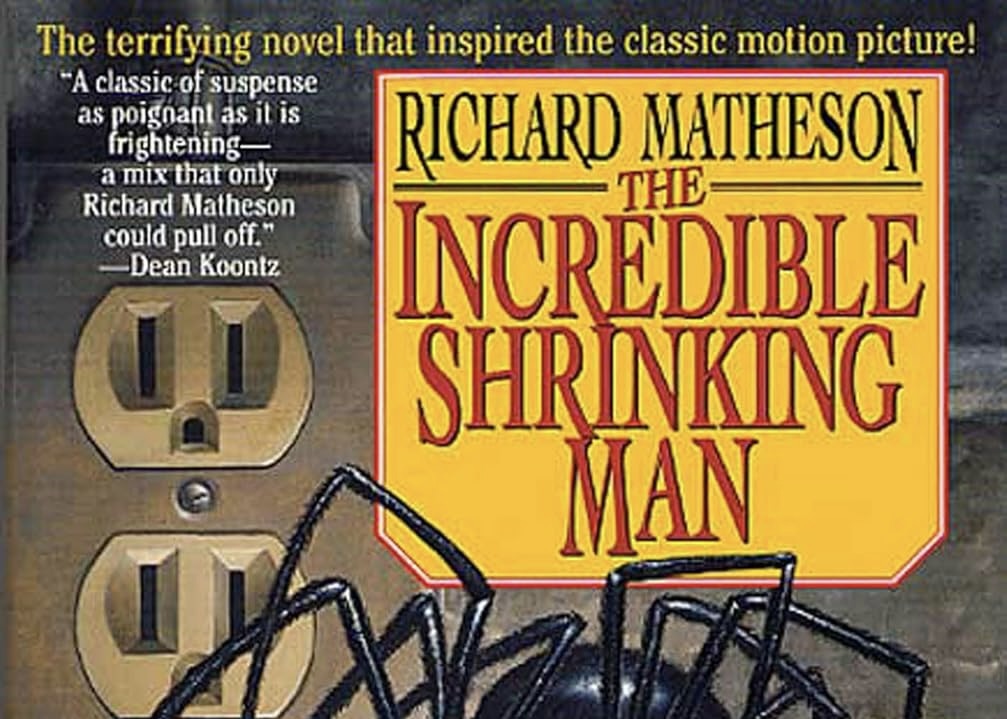
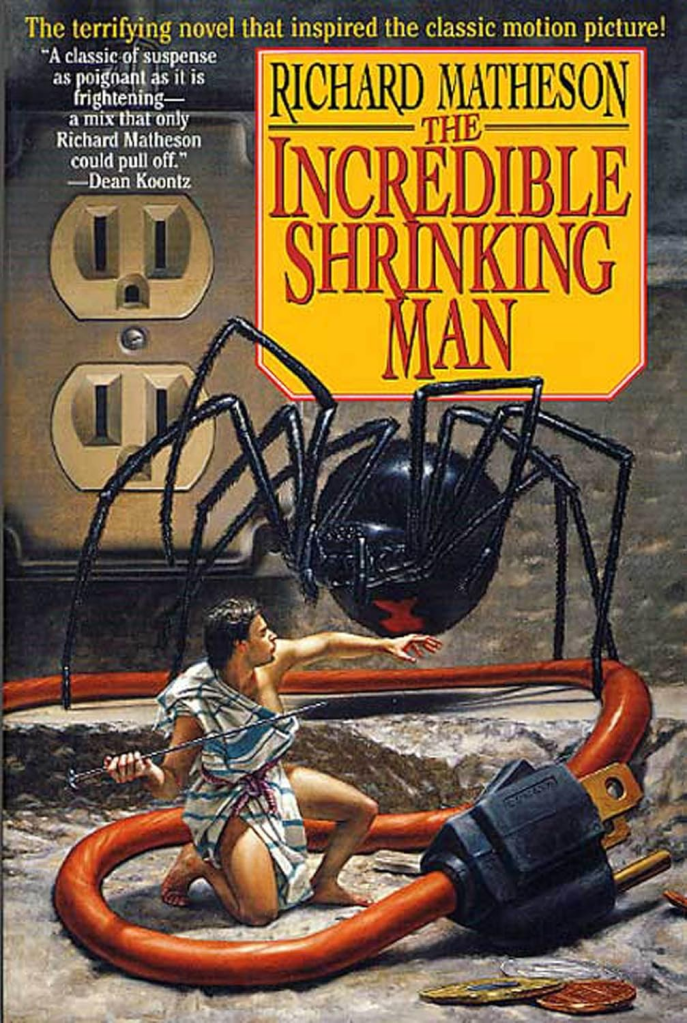
Scott Carey, an ordinary guy, gets hit by a mysterious spray during a day on the water, and then everything he owns starts getting bigger because he is getting smaller. As inches fall away, so does job, sexual confidence, and marital equilibrium. He’s eventually trapped in the house’s cellar, fighting the cat, raiding a refrigerator like it’s K2, and squaring off against a black widow whose glossy abdomen looks like a parked car. The stakes are brutally simple: stay alive one more day and figure out whether a man who keeps shrinking can still matter. The texture is dust, splinters, and the groan of the furnace like a thunder god next door.
First, the concept is pure nightmare math. A steady, measurable fade toward zero that turns every household object into a set piece. Early on, the spray and the tingling “beginning” plant a hook so clean you barely feel it slide under your skin. Second, the survival sequences are ferocious. Matheson’s black widow duel is still a knuckle-whitener, not because it is flashy but because the details are tactile and cruel. Third, the images of scale keep paying off. A thimble becomes a well. A rope becomes a mountain road. A paint can handle becomes salvation. If there is dulling, it creeps in around the interpersonal frames: the book’s treatment of marriage, sex, and “man’s place” feels era-bound, which may push modern readers out of the trance whenever the action pauses to lecture. Still, when the cellar closes in and Scott whispers “I made it” after a death-defying climb, you feel it in your ribs.

The prose is lean, rhythmic, and stage-managed for tension. Matheson writes like a camera operator with a stopwatch. Chapters flicker between present-tense peril and past-tense domestic unraveling, letting dread accumulate as both the basement war and the upstairs life collapse. Dialogue is economical. Scene construction hinges on physical problem-solving, which feels surprisingly modern. What dates it is the moral framing around gender and desire. Scott’s crisis often collapses into a referendum on virility, and women tend to function as mirrors that either reflect his stature or fail to. There are also bits of clinical fascination with the “freak case” that read like medical theater from the era. Yet the writing avoids excess and keeps finding concrete, sticky images. A single line like “It was the beginning” still lands because of placement and restraint.
The obvious theme is scale as a metaphor for power. Shrinking becomes the anti-superpower, stripping job, intimacy, and social status until all that remains is selfhood that must define itself without witnesses. Body horror maps onto anxiety about aging and illness, that slow subtraction you can measure in belt holes and mirror angles. There is also a quiet theology running under the floorboards: what is a person when society can no longer see them? The horror machinery expresses this through humiliations that stack like bad dreams. A cat is not just a cat; it is the universe’s boot. The spider is not only a predator; it is a ticking clock with legs. If everything can be taken, what’s left but will and wonder?
The book minted a template for micro-scale survival horror that countless stories borrowed, from film’s cheery riffs to grimmer bottle episodes in television and comics. More specifically, it showed how to make domestic space epic without cosmic tentacles, foreshadowing later horror that collapses the apocalypse into a single room. The cellar duel with the spider is a forever scene, and the closing gesture toward infinitude gives the genre permission to end on metaphysics instead of jump scares.
Within Matheson’s arc, this sits alongside his best work at turning ordinary life into panic, less cosmic than Lovecraft, more domestic than Bradbury, and meaner than most of the era’s pulps. For the 1950s, it belongs on the shelf with suburban-set anxieties that insist the apocalypse is not a mushroom cloud but the slow grind inside your own house.
Competent, grimly entertaining, and intermittently profound, The Shrinking Man still works whenever the basement lights click off and the rope swings. Some of its ideas about people have shrunk worse than Scott, but the survival beats and the final reach toward the infinite still punch through.

Read if you crave meticulous survival puzzles with splinters under the nails.
Skip if require characters to evolve beyond the 1950s idea of marriage before you can buy in.
The Shrinking Man by Richard Matheson,
first published in 1956.

 The Blog Without a Face
Leave a comment