





TL;DR: A decade on, A Collapse of Horses remains a cold, immaculate panic attack in short-story form. Evenson strips language to nerve and jams doubt into your sensory ports. Minimalist, uncanny, brutally controlled. Not cozy. Not cute. It’s dread as a literary instrument, played perfectly.

Brian Evenson is a cornerstone of literary horror and the weird: a prolific novelist and short-story surgeon who has taught at Brown and, since 2016, in CalArts’ School of Critical Studies. He’s racked up serious hardware, including a 2017 Guggenheim Fellowship, the 2019 Shirley Jackson Award and the 2020 World Fantasy Award for his collection Song for the Unraveling of the World. Beyond acclaimed books like The Open Curtain, Last Days, Immobility, Windeye, A Collapse of Horses, and later collections, he also moonlights as B. K. Evenson for media tie-ins, proving he can haunt both the ivory tower and the pop arena without breaking stride.
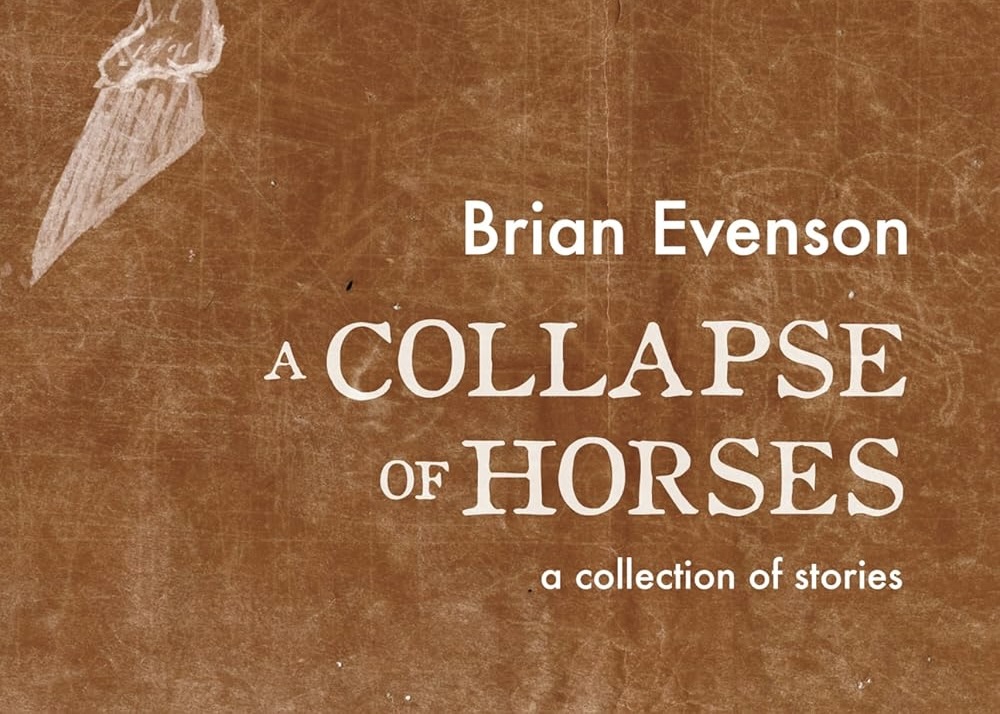
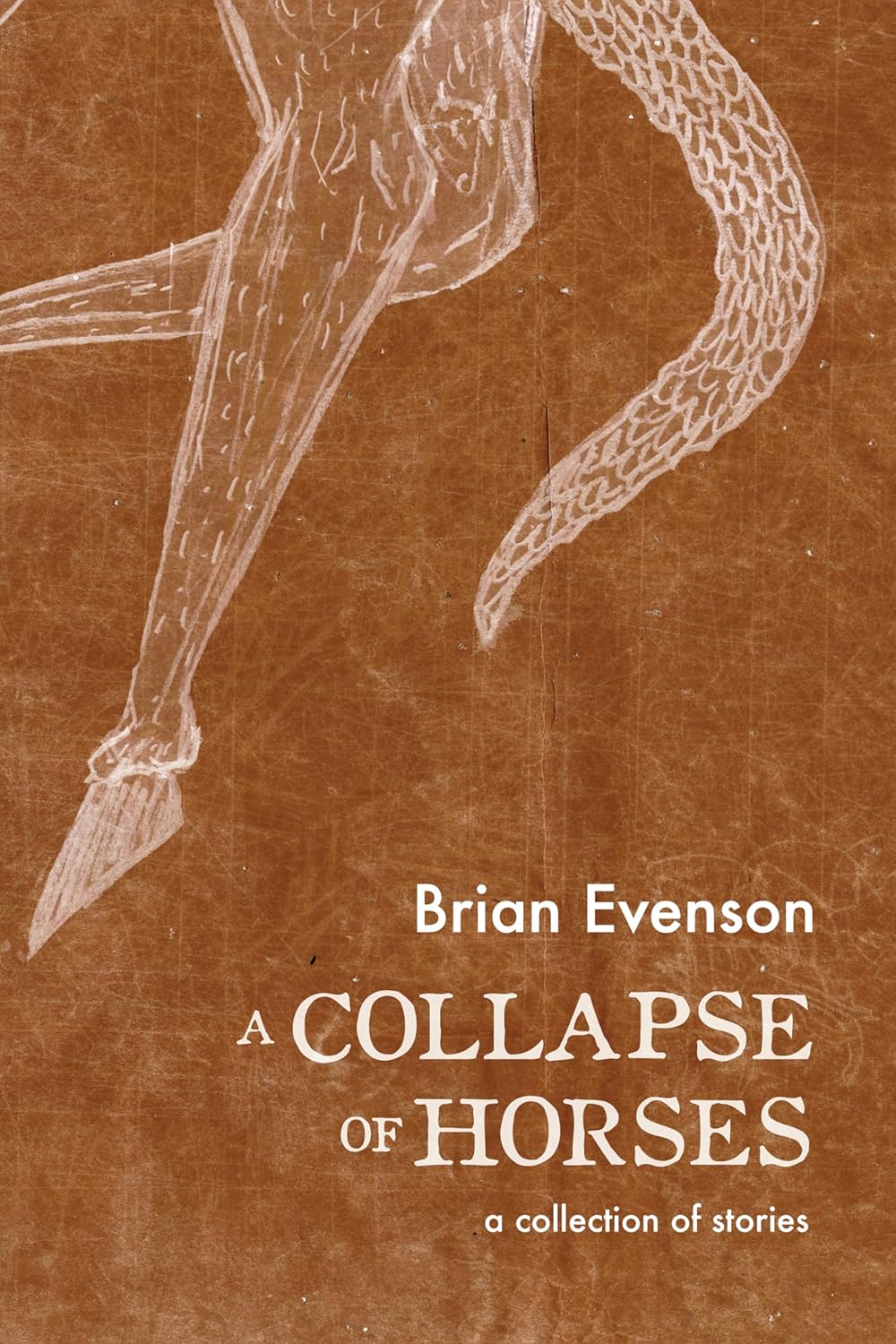
A Collapse of Horses is a 2016 story collection from Coffee House Press that plays like a greatest-hits mixtape of Evenson modes. You get frontier nightmare fuel in “Black Bark,” a carceral mind-screw in “A Report,” dreamlike seaside rot in “Seaside Town,” product-horror in “BearHeart™,” and the title story where the simplest pastoral image turns reality unstable. Doors don’t open to rooms here, they open to doubt. People keep doing ordinary things while the universe casually moves the furniture and insists nothing changed. You finish a story convinced you caught it… then some little hinge in your head clicks and the whole house is different.

The big thematic engine is epistemic dread. Evenson’s favorite cruelty is to make certainty impossible. Characters misremember, misrecognize, and misreport. Bodies leak, break, or mutate into symbols. Objects act like jokes told by a god with dead eyes. Horses may be dead or alive or both. The collection treats meaning like a dangerous chemical: if you grab too fast it burns.
Symbolically, there’s recurrent hardware: doors, windows, corridors, masks, cliffs, medical devices, and “ordinary” consumer junk that hums with malice. The natural world isn’t a comfort, it’s a stage set with a trapdoor. Violence is often offstage, yet its shadow is black and exact. Even names slide around like oil on water. That ambiguity is not a gimmick; it’s the point. You’re supposed to feel the floor flex.
The sentences are short, cold, and wickedly calibrated. He uses clean language that refuses to be simple. Paragraphs end where you expect relief and give you knives instead. Evenson’s minimalism is not spare so much as weaponized. He keeps cutting connective tissue until only nerve remains. It’s horror by subtraction.
A decade in, these stories feel weirdly prophetic. We live in an era where truth has plastic bones. Evenson understood early that terror isn’t only what chases you in an alley; it’s the shiver when language fails to lock to reality. “A Report” is basically a parable of systems that outsource cruelty then gaslight the participants. “A Collapse of Horses” builds a Schrodinger pasture in your head, a cognitive splinter that won’t stop itching. The collection interrogates how narratives get made under pressure: how we smooth the edges of experience to survive, and how that smoothing becomes the monster.
He also writes obsession with frightening empathy. People cling to rituals and talismans because certainty is a drug. The book keeps asking what you’ll sacrifice to feel sure. Identity here is a house with mislabeled rooms. You move through your life, then one day the wall where you kept your memory map is gone. That’s the horror. Not the scream. The sudden silence that follows it.

Originality: Off the chart. Plenty of writers borrow from Aickman, Ligotti, or Beckett. Evenson doesn’t borrow. He reverse engineers dread into a clean, proprietary chassis. Even when a premise sounds familiar, the execution is unnervingly singular. “BearHeart™” could’ve been satire. He makes it an ontological prank that leaves fingerprints.
Pacing: Ice-cold slow burn, then a slingshot snap. Most stories creep with a procedural calm. He documents the weird, doesn’t declaim it. You’re reading a tidy paragraph about a hallway lamp and suddenly your gut drops through three floors. The restraint is the throttle. If you like bombast, wrong party. If you like controlled demolition, enjoy.
Character development: He doesn’t write cuddle-able goofballs or quippy Final Girls. He writes people on tilted planes who keep trying to walk straight. They’re often nameless or sketched with a few strokes, yet they feel sickeningly real because their mental spirals are precise. You won’t leave saying “what a charming protagonist.” You’ll leave wondering why you recognized yourself in their worst moment.
Scare factor: Full of existential suffocation. It’s not the kind of book that makes you check the closet. It’s the kind that makes the hallway feel longer. You will catch yourself re-describing banal objects as if they’re lying to you. The fear sticks because it rewires your sense of how things cohere.
The world keeps getting Evensonian. Institutions threaten one person while punishing another. Memories come back wrong. Consumer culture sells you plush companions with teeth. Rural spaces are gorgeous and poisoned. And prose style matters. Evenson demonstrates that horror doesn’t require a thesaurus of ichor. It requires control. He can twist a whole narrative with a single ambiguous clause. That discipline is rare. Ten years on, the stories feel not dated but honed.
If your diet is plot-forward or character-huggy, the austerity may feel chilly. Some endings are more severance than resolution. Personally, I love it. The book promises dread, delivers dread, then refuses to debrief you like a responsible adult. That refusal is the art.

This is indie-lit horror with a philosopher’s backbone and a butcher’s efficiency. Bold premise density, killer atmosphere, razor prose, and thematic teeth. On The Blog Without a Face’s masochistically tough curve, this collection earns its place among the decade’s best. Near-masterpiece stories live here, and the floor never dips below excellent.

Recommended for: Readers who like their horror clinical and mean; fans of Aickman, Ligotti, and anyone who ever stared too long at a perfectly normal door and felt judged; people who think ambiguity is sexy; ranchers who prefer their horses both alive and not.
Not recommended for: Folks who need tidy bow-tie endings; readers who want banter and hugs; anyone shopping for “comfort horror”; owners of bear-shaped consumer products with suspicious smiles; people who get angry when reality refuses to show its receipts.
A Collapse of Horses by Brian Evenson,
published February 9, 2016 by Coffee House Press.



 The Blog Without a Face
Leave a reply to Mr. November Cancel reply