
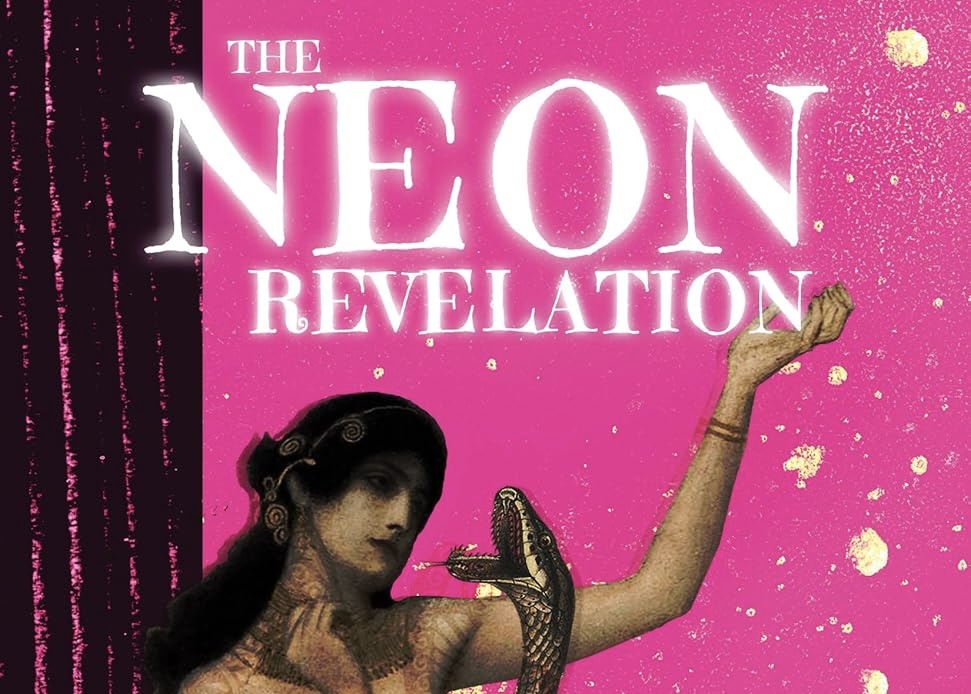





TL;DR: The Neon Revelation is a furious, chewy, gloriously messy splatter of cult horror and cosmic weirdness about queer grief and revenge colliding with American Christian nationalism. If you want a trans final girl who does not give a single holy shit about respectability while an “angel” mutates a Nevada compound, this will absolutely hit. If you need tidy theology or polite horror, turn back now.

Madden comes into this one already steeped in off kilter, politically barbed horror, and The Neon Revelation feels like the book where all of that earlier work coheres into something bigger and meaner. You can feel the confidence here. This is not “what if a cult was spooky,” it is “what if we actually look at the fascist shit rotting under the floorboards of American Christianity and feed it to an eldritch thing in a barn.” It reads like the next step in a body of work that has always liked to poke at power structures but now has a sharper knife and a lot more blood.
Roan, a heavily tattooed trans woman carrying the grief of her dead partner Nico and their unborn child, infiltrates Bolumbia, a religious retreat in a lush Nevada valley that markets itself as a miracle soaked oasis. In reality it is a white nationalist flavored cult led by Saxton James and his wife Harrow, built around a mysterious “angel” locked in a barn. Roan is there to kill Andrew Garrett, the guy who coerced Nico into sex and walked away from the pregnancy that killed her. Harrow, meanwhile, is trying to be the perfect tradwife mouthpiece for the movement while fantasizing about the entity that powers their miracles. As pilgrims arrive, cameras loom, and offerings pile up, Roan’s quest for revenge and Harrow’s crumbling faith spiral toward a bloody, reality warping showdown in and around that barn.
Madden welds queer rage to cult horror in interesting ways. Roan is not some sanitized representation project; she is pissed, foul mouthed, horny, deeply traumatized, and extremely ready to fuck somebody up. The early scenes of her entering Bolumbia, clocking the fake frontier aesthetic, the cowboy militia, the angel flag, and immediately thinking “this whole place is bullshit but I could almost fall for it” are sharp as hell. The book is at its best when it lets Roan’s interior voice chew on how evangelical rhetoric about suffering is indistinguishable from the grind of late stage capitalism and everyday transmisogyny, then immediately cuts to her planning how to lure Andrew down to the river and end him. That revenge set piece, with Roan weaponizing her own desirability and the way men read her body while her brain screams about what he did to Nico, is brutal and satisfying without ever pretending murder fixes grief.

Harrow’s side of the book is a quieter kind of fucked up, and it gives the novel texture. She is the “Mother” of the community, constantly sexualized and used by Saxton while being told sex is only for procreation, haunted by infertility and erotic thoughts about the so called angel. Her fantasy life, that drifting, star speckled “shadow” lover who slowly turns into whatever lives in the barn, is where the cosmic horror really starts to hum. The angel is a monster, but also a vector for forbidden desire, for a self that is not wife, not vessel, not mouthpiece. When things finally break bad, the book pays off that tension in a way that feels both blasphemous and oddly hopeful.
Madden’s writing has a good, nasty rhythm. Sentences are conversational but barbed, full of asides that sound like an exhausted friend telling you about the worst church lock in of all time. The dual POV structure, flipping between Roan and Harrow, works; their voices are distinct enough that you can feel when the camera shifts. Scenes are built out in sensory detail: the heat and dust, the smell of the river, the angel barn as a forbidden, humming organ at the edge of the valley. The pacing is mostly strong. The opening chunk spends a long time in sermon and tour mode, which occasionally feels like you are stuck in a real church service, but the book uses that drag to sell the mechanisms of cult love bombing and propaganda. Once Roan makes her move on Andrew and the entity steps into the foreground, the back half goes hard, with some legitimately wild body horror imagery and reality distortion that feels earned rather than random.

There is the obvious critique of religious nationalism, where American flags and Thin Blue Line banners sit comfortably next to a made up angel standard and everyone talks about protecting children while being viciously transphobic and misogynist. There is bodily autonomy and reproductive trauma, stitched through Nico’s death, Harrow’s infertility, and the way the so called miracles lean on pregnancy, childbirth, and violation. Supernatural impregnation and birth are not just gross set pieces, they are how the book talks about what it means to have your body turned into someone else’s holy battleground. And underneath that is a thread about the hunger for belonging, how even someone like Roan, who understands exactly how these people would dehumanize her, still feels the hook of a place that promises family, safety, and meaning. The result is a mix of incandescent queer fury and this weird, stubborn hope that maybe the thing in the barn is less monstrous than the humans who try to own it.
The Neon Revelation feels like it sits somewhere between cosmic splatterpunk sermon and very pissed off exvangelical testimony. It is not as polished or expansive as the absolute top tier of the year, but it brings a voicey, queer perspective and a willingness to get sincerely gross that makes it stand out in a field crowded with safe “cult thriller” paperbacks.
A strong, fucked up, politically sharp cult horror novel whose messy, queer rage and barn bound angel linger longer than the few pacing hiccups.

Read if you want a queer, trans protagonist who gets to be angry, messy, and violent without apology.
Skip if you have a low tolerance for explicit religious bigotry on the page, even when the book is clearly calling it out.
The Neon Revelation by TT Madden,
published December 16, 2025 by Timber Ghost Press.

 The Blog Without a Face
Leave a reply to Grab the Lapels Cancel reply