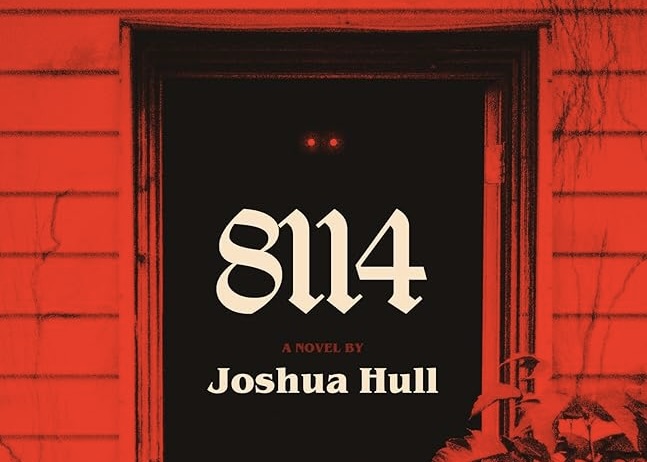

Joshua Hull is a Midwest filmmaker-turned-author who co-wrote the Lovecrafty film Glorious and snagged a Hoosier film award before publishing the novella Mouth. 8114 is his debut novel with CLASH Books, which already tells you we’re not here for safe, beige horror. Expect indie nerve, not studio notes.
Paul Early is a chatterbox who parlayed his high school radio itch into a true-crime podcast called Adam Benny is Missing. Then he blows it in spectacular fashion: Adam isn’t missing, just surviving, and Paul has kicked a hornet’s nest with a microphone. He records an on-air mea culpa that is about as fun as gargling thumbtacks.
Paul slinks back to his Indiana hometown, where a best friend dies by suicide and leaves a voicemail that curdles the blood. The message speaks of sins that spread like mold, a place that is hungry, and a past that refuses to stay politely boxed up. Paul follows the rot to 8114, the blighted farmhouse where he grew up, and learns his friend chose the property for his last act. The rest is a descent through barns, memories, and the kind of small-town dread that smells like damp plywood.

The book’s form is part confession, part field report, part found-audio energy. The table of contents itself is a vibe: podcast “episodes” spliced among chapters as if the story keeps leaking into the feed. It’s clever without feeling like a gimmick.
Hull is obsessed with contamination. The rot is literal and moral. The novel treats gossip, podcasts, and social media like spores that breed faster than truth. It also treats guilt like black mold, blooming where you refuse to look. The language of spread and infection isn’t subtle, but it works because the book keeps touching the nerve: you cannot disinfect the past if you keep broadcasting it like a jingle.
Critical chorus on the opening pages waves a neon sign at the book’s target: narcissism amplified by tech, microphones handed to the worst impulses, and a “black mold” aesthetic that clings to memory. The story then proves it.
Symbolically, 8114 is not a haunted house so much as a malignant ecosystem. Animals die, machines fail, friends deform into apparitions, and every approach to the property feels like wading into a fungus bloom. There is an unforgettable sequence in a parking lot where a voicemail metastasizes into whispers and stink, and the phone seems to crawl with mold. That is the book in miniature: a banal object colonized by grief and bad stories.
Stylistically, Hull writes like someone telling you something awful at a bar just before last call. The voice is confessional, self-dragging, sometimes very funny, and then suddenly deadly earnest. The podcast interludes nail the tone of apology culture and parasocial theater, right down to Paul’s repeated I really messed up cadence.
Beneath the jump-scares and barn doors, this is a novel about accountability. True crime promises catharsis while turning strangers into content. Paul wants redemption through production, which is a hell of a needle to thread. When people tell him to stop, he keeps talking. When reality tells him 8114 is not a story but a wound, he starts a new show anyway. If you’ve ever side-eyed the voyeurism of the genre, this book is the ghost of every exploited subject knocking on your headphones.
Hull is also poking at how towns curate their own legends. The police chief’s weary don’t make me say it face and the way everyone treats 8114 like a sickness give the town the air of a body trying to hold down a fever. The tragedy that pulls Paul home is personal, but the infection has always been communal. Even the book’s clever structure argues that “narrative” is a vector. Once you hit publish, the spores travel.
Strengths
- Atmosphere that reeks in the best way. The Indiana details, the ruined barns, the sense that even sunlight has mildew on it. Hull keeps staging scenes where the ordinary flips into grotesque at a blink. The voicemail set piece is a stone-cold banger.
- Form serves theme. Chapters, podcast updates, and “episodes” interleave to show how media frames grief. It feels like the book is infecting itself.
- Moral clarity without sermonizing. Paul’s apology isn’t clean or heroic. It’s messy and honest enough to sting.
Critiques
- A little on-the-nose at times. The mold metaphor gets said out loud more than it needs to. The book already nails contagion through imagery.
- Stakes occasionally repeat. A few beats reassert that the house is bad instead of discovering a new angle on the badness. When the prose is this punchy, you want every scene to escalate rather than echo.
- Side characters blur. The chief pops, the bartender pops, but some supporting faces feel like decently drawn townsfolk rather than fully inhabited lives.
Originality, pacing, characters, scary?
- Originality: High. Meta-true-crime grafted onto black-mold Americana is a fresh angle, and the podcast-as-text isn’t a gimmick so much as the delivery system for rot.
- Pacing: Strong start and mid-game. The confession, the death, the return to 8114, the voicemail from hell, then the barn revelation. A couple loops of house-is-sick could be trimmed, but momentum mostly holds.
- Characters: Paul is believably flawed and painfully human. The chief gets a memorable wary-gravitas scene that hints at a town-wide compromise with the uncanny. Some others read functional.
- Scare factor: Effective dread with spikes of nasty. The book excels at the moment everyday tech turns predatory and the way the property itself feels like a wet lung. The parking lot visitation is nightmare fuel.
It is bold in premise, atmospheric as hell, thematically consistent, and written with bite. The metaphor sometimes shouts what the scenes already show, and not every supporting character carries equal heat.
TL;DR: A talky true-crime podcaster detonates his life, goes home, and finds his childhood farmhouse rotting with memory, malice, and mold. Hull mixes confession, small-town poison, and media critique into a grim, sticky ride. Smart structure, killer set pieces, a hair over-insistent on its fungus gospel.










Recommended for: Sickos who like their haunted houses damp and their ethics complicated. Podcasters who can take a joke. Readers who believe barn doors are jump-scare machines and voicemail is a horror format.
Not recommended for: Folks allergic to mold metaphors or accountability. People who think true crime is God’s work and microphones absolve sin. Anyone who insists every haunted house needs a nice priest and a tidy moral.
Published August 26, 2025 by CLASH Books.

 The Blog Without a Face
Leave a comment