

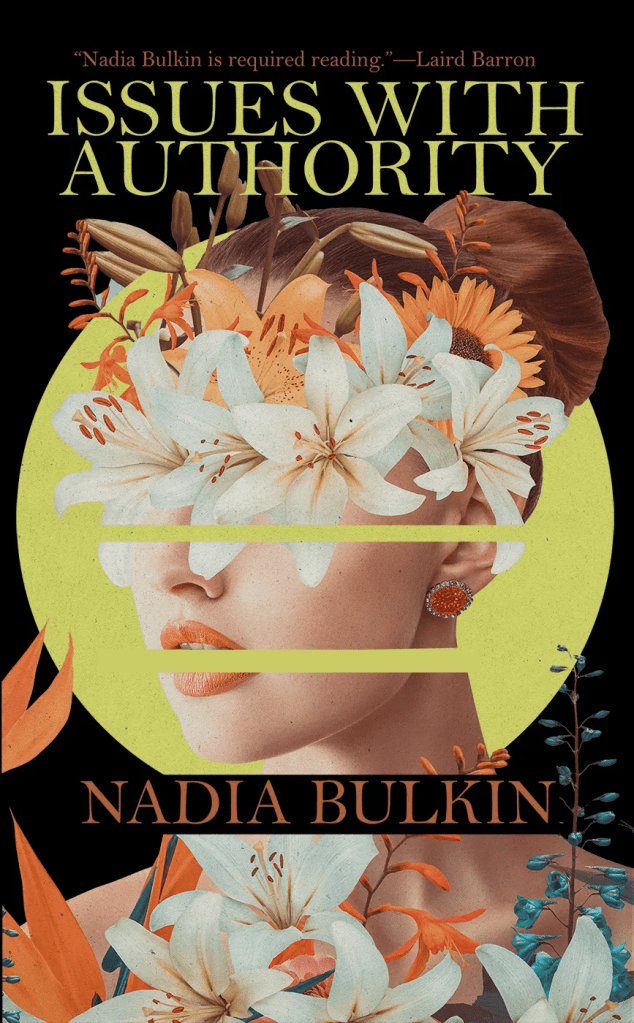
Nadia Bulkin writes political horror like a surgeon who also keeps a flamethrower in her coat. Issues With Authority is a compact, razor-edged trio about power: who wields it, who kneels to it, and how it colonizes the body. Published by Ghoulish Books, it contains three long stories, each one a different flavor of dread.
Bulkin’s earlier collection She Said Destroy put her on the map for smart, worldly nightmares. This new book doubles down on that reputation, turning cults, bureaucrats, and beauty queens into a single, pulsing thesis about control. The table of contents sets the triptych: “Cop Car,” “Your Next Best American Girl,” and “Red Skies in the Morning.”
Cop Car. Carly Parrish grows up in a mountain cult, discovers she can reach into people’s heads, and gets harvested by a hush-hush government shop that files her under R&D like a fancy grenade. She infiltrates another doomsday church, tests the tensile strength of obedience, and learns the ugly truth about what her talent is actually for. The story’s voice pivots into a chilling first-person “I” that is not human. It is as if the book removes its skin and talks back.
Your Next Best American Girl. Beauty-pageant competitors discover a trend that makes my stomach crawl in the best way. Instead of contouring, girls begin carving and burning “blight” holes into their bodies. Veronica, a driven contestant with a strict old-school coach, must decide how much of herself she is willing to feed to the algorithm. It’s satire with teeth, and blood.
Red Skies in the Morning. Two sisters revisit a seaside childhood while a particular red-lit presence stalks the younger one. The day becomes a ritual of lobster rolls, Tekken fights, and the kind of gallows intimacy siblings wield when doom is on the hour. The horror is inevitable, which is exactly why it hurts.

Bulkin’s favorite subject is authority in all its uniforms: the state, the cult, the market, the gaze. “Cop Car” maps the pipeline from neglected child to weaponized asset; it’s about how institutions love a special girl as long as she’s useful and quiet. Carly’s handlers praise her like a pet while filing off anything that looks like conscience. The story’s numbered sections and courtroom-clean prose make the moral rot pop like a bruise.
“American Girl” performs body horror as social contagion. The blight isn’t just wounds. It’s the cultural hunger that tells girls to become interesting by becoming perforated. Bulkin captures the pageant world without sneer or pity, which makes the mania scarier. Commitment is the point. The knife is only the tool.
“Red Skies” nails grief’s weird logistics. The sisters’ errands are tenderness masquerading as errands. The red-light entity reads like an outsourced fate machine, a symbol for systems that kill while insisting nobody is responsible. The title’s maritime warning is right there, but the storm is policy, ritual, habit.
Stylistically, Bulkin balances reportorial clarity with acidic asides. She is generous with concrete detail and stingy with exposition. When the book wants to get mythic, it lets a different narrator speak, and your skin says oh no before your brain catches up. The mix of institutional memos, cult prayer circles, and mall-grade Americana makes the whole thing feel frighteningly plausible. It reads like archives you should not have opened.
The collection argues that authority reproduces itself by training desire. Carly longs to know her place on the food chain and the government kindly offers a badge. Pageant girls crave visibility and the market offers a hole where a boundary used to be. The sisters want an answer and the world gives them a process. No villain gets a mustache to twirl. The scariest part is how often the victims sign the clipboard.

Bulkin is ruthless about complicity without turning puritan. She understands why people fall in line. The cherry cordial reward in “Cop Car,” the hot-knife backstage, the pier nostalgia in “Red Skies” are all pleasures with a price tag. Even the book’s structure feels like an experiment in consent. You keep agreeing to turn pages while knowing you will pay.
Strengths.
Originality is off the charts. A psychic black-ops novella that swerves into demonic metaphysics, a pageant-horror trend piece that feels like real ethnography, a sister-death procedural that weaponizes errands. The prose snaps. The worldbuilding is precise, from government “research and development” euphemisms to the slap of Tekken joystick clicks to the specific brand of backstage panic that smells like hair spray and hot plastic.
Character work is cold and effective. Carly is a classic Bulkin protagonist: hyper-competent, emotionally alien, terrifyingly honest about what power is for. Veronica and her coach Lucrece read as a brilliant odd-couple, tradition and ambition arguing in the mirror. Selene and Hannah are heartbreak that walks and talks.
Is it scary? Yes. Not jump-scare scary. Erosion scary. The kind that makes you check your phone for new holes in your life. “American Girl” has the most immediate squirm factor, while “Cop Car” is the one that will wake you up later with the quiet thought that someone else is piloting. “Red Skies” hurts the most.
Critiques.
The demon narration in “Cop Car” occasionally lingers long enough to feel like victory laps. I loved the voice, but some readers may feel the air thicken. The moral distance is the point, yet it can chill curiosity if you want messier human counterweights. Pacing across the three pieces is otherwise brisk and mean.

- Originality. High. Cults and black ops are familiar, but the execution is fresh and mean. The pageant conceit is a bull’s-eye. The red-light killer is elegantly simple.
- Atmosphere. Suffocating without fog machines.
- Prose quality. Tight, sly, and quotable.
- Thematic boldness. Political and bodily. Zero cowardice.
TL;DR: Three long stories about power and obedience. A cult-raised psychic becomes a government weapon, pageant girls chase a viral beauty blight, and sisters spend one last day under red light. Brutal ideas, clean prose, and a nasty aftertaste. Smart horror that stares back.





Recommended for: Siblings who bond by eating lobster rolls, playing Tekken, and refusing to talk about the red thing in the room.
Not recommended for: Anyone squeamish about holes, knives, or governments behaving exactly as designed.
Published September 16, 2025 by Ghoulish Books.

 The Blog Without a Face
Leave a comment