


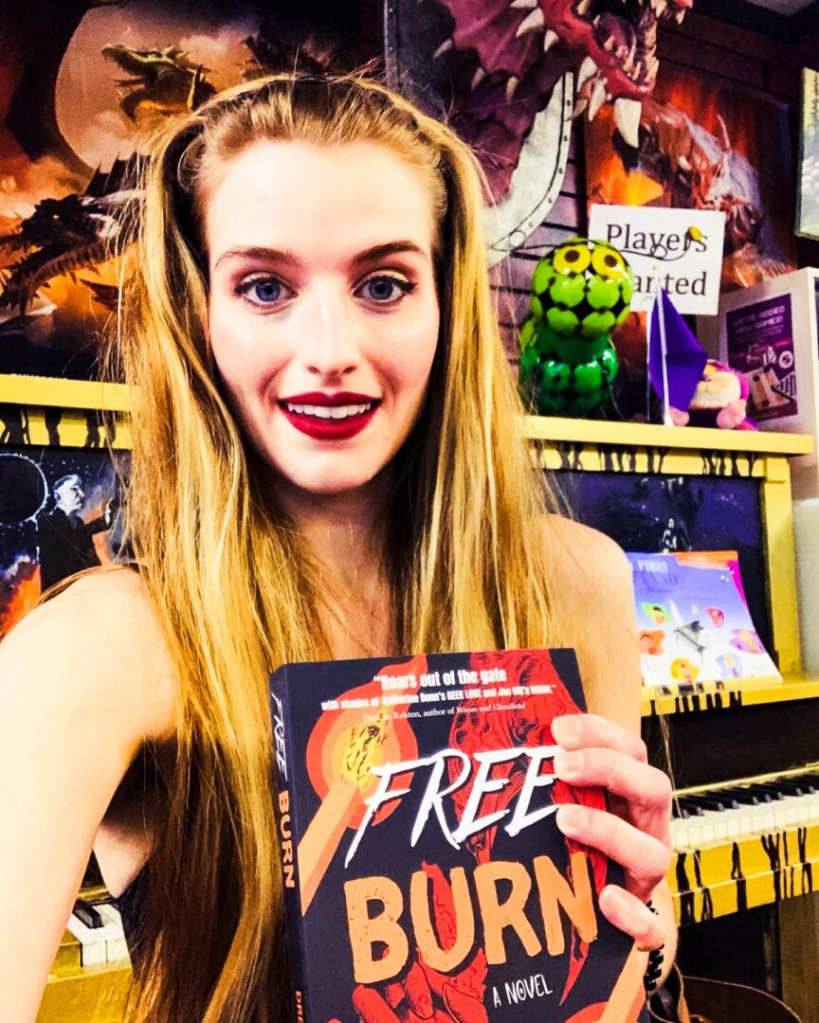
Drew Huff, a horror scribe from the apple-soaked wilds of eastern Washington, has been carving out a niche in the indie horror scene with a pen dipped in blood and existential dread. Her debut, Free Burn, was a raw, unpolished scream of body horror and trauma, a book that felt like it was written in a fever dream after a bender. Her short stories, scattered across anthologies like The Sacrament and Hot Iron and Cold Blood, lean into the same visceral, psychologically jagged territory. The Divine Flesh, her sophomore novel, is a step up in ambition, a sprawling, cosmic-horror-tinged descent into addiction, identity, and redemption that’s as messy as a slaughterhouse floor and twice as compelling. It’s not perfect, but it’s got enough guts and heart to make you forgive its stumbles.
The Divine Flesh follows Jennifer Plummer, a twenty-something junkie with a rap sheet of bad decisions and a body she shares with a cosmic entity called the Divine Flesh. This ain’t your grandma’s possession story. Jennifer’s not just haunted; she’s a reluctant meat-puppet for a goddess who’s equal parts nurturing and deranged, capable of reshaping flesh like it’s Play-Doh and reviving the dead with a lick and a prayer. The story kicks off with Jennifer waking up in a ditch, covered in ash and blood, with no memory of how she got there. She’s got a job to do: haul a mysterious shipment (parasitic eggs and drugs, not cherries) across state lines to keep her ex, Daryl, from cutting her out of his life for good. As she careens through the backroads of Idaho and Washington, dodging Mirror People (shapeshifting wasp-like freaks) and her own self-destructive impulses, the Divine Flesh keeps whispering, pushing her to let go and let chaos reign. It’s a story of addiction, love, and the desperate clawing for redemption, all wrapped in a skin suit that’s one bad day away from splitting open.
Huff’s got a lot to say, and she says it with the subtlety of a sledgehammer to the kneecaps. The Divine Flesh is a brutal allegory for mental illness and addiction, with Jennifer and the Divine Flesh embodying the fractured self. Jennifer’s the ego, selfish, broken, and drowning in drugs to numb the pain of a life that’s been one long kick in the teeth. The Divine Flesh, on the other hand, is the innocent, unblemished self, a naive godling who just wants to love and create, even if her creations are grotesque abominations. Their struggle for control of the same body is a screaming metaphor for the internal war of addiction: the part of you that wants to heal versus the part that wants to burn it all down.

The book’s central theme is redemption through integration. Huff argues that healing comes not from annihilating your demons but from embracing them, merging the ugly with the divine. It’s a bold stance, especially in a world that loves to sanitize trauma into Instagram-friendly platitudes. The Divine Flesh’s ability to reshape flesh symbolizes the transformative power of love and self-acceptance, but it’s not a clean process. It’s bloody, painful, and often horrifying. The Mirror People, with their shapeshifting empathy and sociopathic breeding cycles, reflect society’s duplicity, offering love until it suits them to destroy. Cherries, a recurring motif, are less about sweetness and more about rot, bloated, maraschino-soaked corpses bobbing in the cocktail of Jennifer’s life.
Huff’s religious imagery is relentless but not preachy. Quotes from Yeats and Hunter S. Thompson frame the narrative, tying Jennifer’s descent to a cosmic reckoning, while references to “God’s Carnival” and “Judgment Day” evoke a warped spirituality that’s more apocalyptic than redemptive. The book’s dedication—to those at rock bottom—sets the tone: this is a story for the fucked-up, the forgotten, the ones society writes off as freaks.
Huff’s prose is a noxious cocktail of grit and poetry, like she’s channeling a drunk poet laureate who’s just seen the face of God and puked on it. The first-person narration from Jennifer’s perspective is raw, immediate, and unapologetically crass. Sentences are short, jagged, and packed with sensory detail: blood tastes “salty-sweet,” orchards smell “green,” and the Divine Flesh’s voice is a cooing, sinister whisper that crawls under your skin. Huff’s dialogue is sharp and authentic, capturing the cadence of rural America’s underbelly without slipping into caricature.
The book’s structure is a chaotic road trip, jumping between Jennifer’s present, her traumatic memories, and the Divine Flesh’s surreal interludes. It’s disorienting. Jennifer’s life is a blur of drugs, blackouts, and cosmic interference. Huff’s body horror is vivid and unrelenting: flesh splits, bones sprout, and bodies are remade with a grotesque beauty that’s equal parts repulsive and awe-inspiring. The pacing is breakneck, but it occasionally stumbles under the weight of its own ambition, particularly in the second half, where the cosmic stakes feel muddled.
Regardless, The Divine Flesh is a goddamn triumph of raw, unfiltered storytelling. Huff’s ability to make you root for a deeply flawed character like Jennifer is nothing short of alchemy. She’s a fucking mess, but you’ll cry for her anyway. The book’s exploration of trauma and redemption is profound, offering a middle finger to society’s sanitized narratives about mental health. The horror is top-tier, blending visceral body horror with cosmic dread in a way that feels fresh and daring. The Divine Flesh herself is a standout, a character who’s both terrifying and heartbreaking, a goddess who just wants to be loved but keeps fucking it up.
But, the cosmic horror elements, while ambitious, sometimes feel like they’re trying too hard to be profound, especially in the climax, where the metaphysical mumbo-jumbo gets a bit too dense. Some plot threads (like the Mirror People’s origins) dangle without resolution, leaving you annoyed rather than intrigued. The pacing in the second half drags in places, bogged down by repetitive internal monologues about Jennifer’s self-loathing. And while the prose is electric, it occasionally leans too heavily on shock, with gore that feels gratuitous rather than purposeful.
Despite these drawbacks, The Divine Flesh is a bold, bloody rebuke to mediocrity, a book that takes risks and mostly lands them. It’s not perfect, but it’s got more heart and guts than most horror novels on the shelf. It’s a book you’ll recommend to your weird friends who’d rather read about flesh-eating goddesses than sparkly vampires. It’s distinctive, impactful, and well-crafted enough to earn its place in the indie horror pantheon, even if it doesn’t always stick the landing.
TL;DR: The Divine Flesh is a wild, gory ride through the hell of addiction and the hope of redemption, with a cosmic goddess riding shotgun. It’s messy, raw, and occasionally overstuffed, but it’s got enough heart and horror to make you forgive its flaws. A must-read for fans of body horror and existential dread.





Recommended for: Freaks who think love is just a prettier kind of carnage and who’d sell their soul for a good Cronenberg fix.
Not recommended for: Prudes who faint at the word “fuck” or anyone expecting a tidy, sparkly redemption arc.
Published March 4, 2025 by Dark Matter INK


 The Blog Without a Face
Leave a reply to My Name Isn’t Paul: Empathy Parasites In a Human Suit and Other Bad Decisions – The Blog Without a Face Cancel reply