
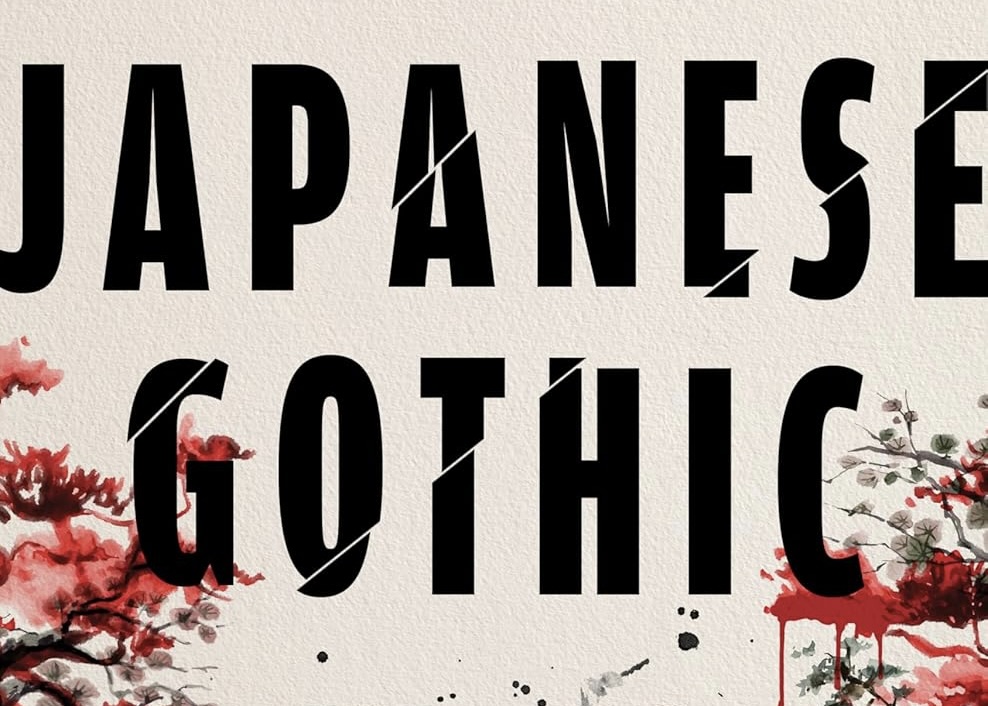
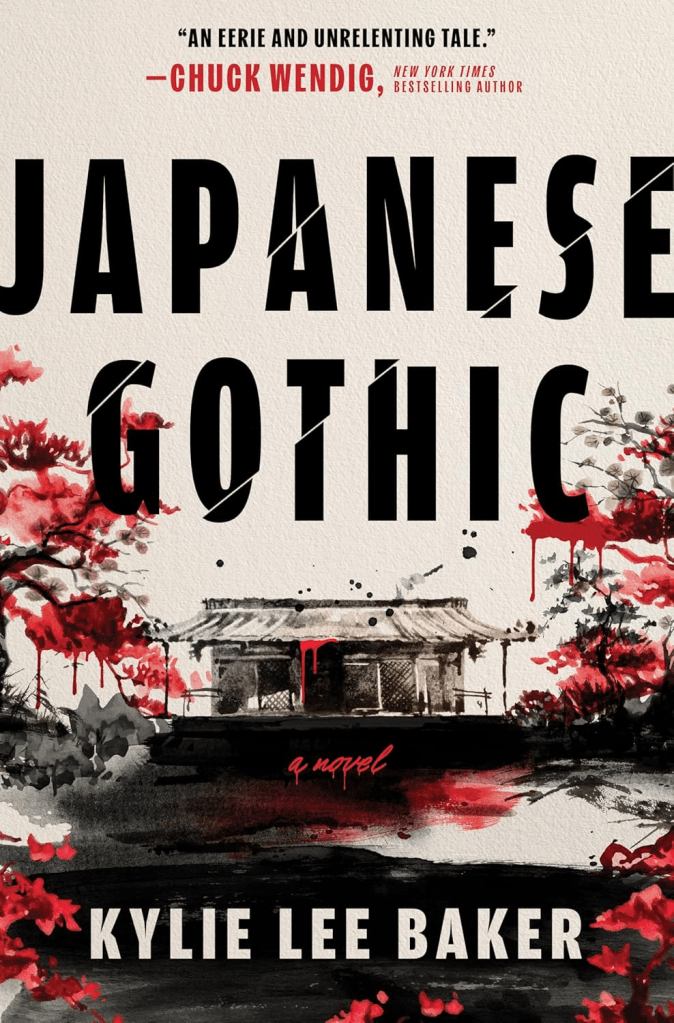






TL;DR: Japanese Gothic is a brine-soaked haunted-house spell: romantic, eerie, and beautifully structured, with a stain-at-the-center metaphor that clings like a scar you cannot scrub out. Kylie Lee Baker braids time-slip dread and folkloric warning beats into a lush, atmospheric read that feels both classic and fresh, then lands a poignant ending that lingers.

The opening sentence of Japanese Gothic tells you there is a man, a murderer, and a stain. It appears three more times before the book is done. This is not an accident. Baker is telling you, from the first page, that the book is about the shape repetition makes. That some things happen and keep happening. That blood dries into wood and stays there, and that the past is not a room you leave. It is a room you occupy without quite understanding that the door has been locked behind you.
Lee Turner is a college student in Chiran, Kagoshima Prefecture, in October of 2026. He has fled New York. The details of why are blurred. He can taste copper when he concentrates, and he has been taking sedatives long enough that food tastes like television static — spinach salad going flat in his mouth, coffee vanishing somewhere between the cup and his tongue. He is staying in a house his father has rented: cedar walls, tobacco varnish, tatami that has darkened from years of light. In the kitchen there is a stain just above eye level, narrow as a tally mark, and the first thing Lee does when he sees it is press his thumb to it and lick.
Sen is in that same house in October of 1877, which means she is in the same house and nowhere near it. The Satsuma Rebellion has ended badly for everyone who fought in it. Her father came home from the war and is still at war. The thing wearing her father’s face keeps her sharpened like a tool: she is permitted to exist insofar as she is useful, insofar as her clean strikes prove something about him. What he proves is not something Baker ever names directly, which is the correct choice.

The house has a door between them. The bedroom window is sometimes a window and sometimes something else. This is the premise of the book: two people in the same structure a century and a half apart, reaching through the architecture toward each other, which turns out to be reaching toward something neither of them expected.
What Baker does extremely well is the texture of damage. Lee’s sensory flatness, the way the world arrives at him partially redacted — this is horror delivered through the body and not through the mind. He does not tell himself he is broken. He eats the salad that tastes like nothing and says it is good so that Hina believes him. The horror of his chapters is not in what happened in New York. It is in the absence. In the space where a smell should be.
Sen’s chapters have the opposite problem in the best way. She is fully in every sensation, blade-sharp, precise about what she can detect and what it means: the smell of charcoal in the wrong season, the color of her father’s shadow on the wall, the sound of his footsteps at a certain hour. She was trained to read the world for threats, and she does, and what she reads keeps being her father. Baker writes violence with the same flat register she uses for everything else, which is exactly where the violence gets its teeth. The scene in the kitchen, where Sen’s father asks her to demonstrate a clean strike on her mother’s outstretched hand, is written in Sen’s voice with a calm that is itself the horror. The parenthetical Baker allows Sen in this moment, so small it barely exists, carries more weight than three pages of interiority would.
The Urashima Tarō inserts, the Japanese folktale about the fisherman who is given a box he must never open and who loses centuries to the sea without knowing it, are placed at structural intervals. A man was, and then he was not, and then time had become something else entirely, and when it was over he had nothing but a box and the warning never to open it. The parallel is not subtle, but Baker never treats it as though it should be. It is there, present, acknowledged. The book knows exactly what it is.

Parts I and III move. The second part, Sen’s backstory assembled in long historical sequences, front-loads the abuse chronology until it becomes, not repetitive exactly, but cumulative in a way that occasionally stalls the present-tense dread. Baker needs the history; the architecture of what made Sen does not function without it. But there are passages in Part II where the book forgets, briefly, that it is also a horror novel. The violence is there. The dread is not, not quite, because the present tension goes slack while the past is assembled. The book earns its ending from this groundwork, but the middle asks for patience that the first part did not condition you to supply.
Baker grew up in Boston and has lived in Atlanta, Salamanca, and Seoul. Her heritage (Japanese, Chinese, and Irish) is not the explanation for this book, but it is part of what makes the 1877 sections resist tourism. She has a BA in Creative Writing from Emory and an MS in Library and Information Science from Simmons, and you can feel both, in different ways. Her YA fantasy novels (The Keeper of Night duology, set largely in Meiji-era Japan) established her as a writer who takes Shinto mythology seriously as structure rather than atmosphere. Her adult debut, Bat Eater and Other Names for Cora Zeng (2025), was horror in a much more compressed key: tighter, uglier, less interested in beauty. Japanese Gothic is the longer argument. It wants to be read slowly. Publishers Weekly gave it a starred review. Library Journal gave it a starred review. Those notices are not wrong.
The thing the book is best at, finally, is fathers. Both Lee and Sen have fathers who love them in the way that buildings love the people inside them: totally, structurally, without mercy. Lee’s father is not monstrous. He is worse. He is the version of a father who loves his son and has made choices Lee still cannot fully see, choices Lee has medicated himself into not knowing. The sedatives are not incidental. They are the story. Sen’s father is monstrous, and Baker knows this, and the horror of his chapters is not that he is a demon but that he was once, briefly, something else. That Sen can still feel the warmth of his approval like weather.
This is where the book lands its actual thesis, quiet and unsettling: the men who shaped us are not gone when we leave them. They are in the house. They are in the walls. When something knocks on the other side of a door between two centuries, you already know what it wants.
Whether that is horror or grief is a question to sit with.

Japanese Gothic by Kylie Lee Baker, published April 14, 2026 by Hanover Square Press.
 The Blog Without a Face
Leave a comment