
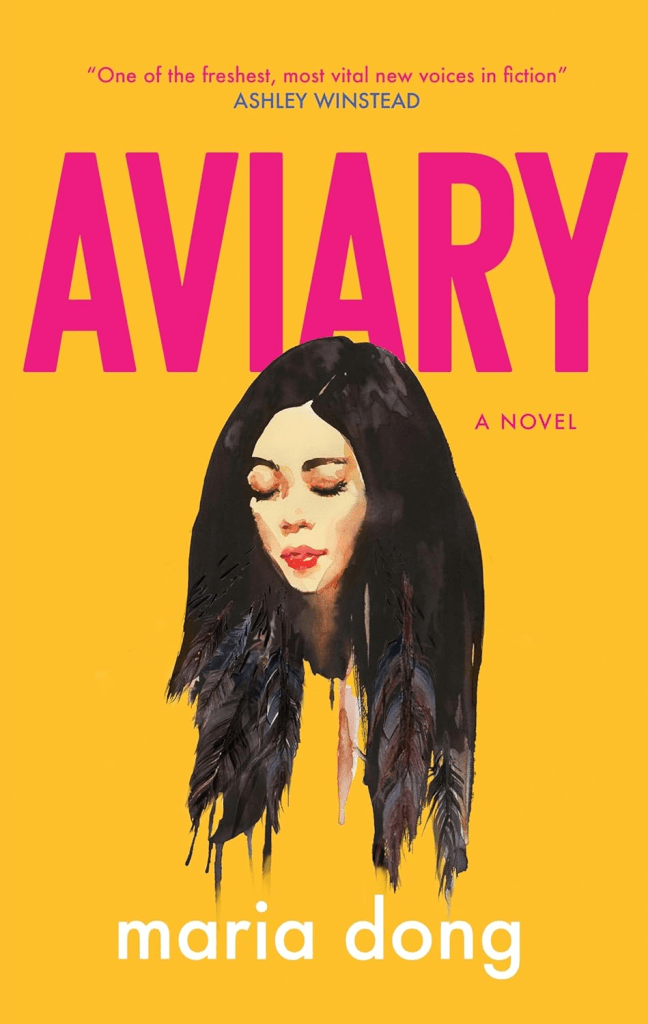






TL;DR: Dong constructs a gilded cage and then makes you smell the metal. Aviary is gothic horror as immigration nightmare as feminist rage, held together by a compulsively readable protagonist: a stateless woman with a dead sister’s passport and a survival instinct so finely tuned it reads like a superpower. The house will stay with you. Hee-Jin will haunt you longer.

The first thing I noticed was the onggi pot. Not the dead body at the door, not the mysterious spines covering her sister’s skin, not the American passport tucked into a sweater pocket like a folded prayer. The pot. Hee-Jin’s mother taught her to keep one inside herself, a clay vessel where feelings go to ferment and die, a place that breathes air in while keeping water out, tight as a secret. Every grief, every terror, every piece of love she wasn’t allowed to want gets dropped in there. The lid goes on. The world keeps moving.
I have been trying, for weeks now, to describe what Maria Dong does in this book, and I keep coming back to that pot. Not because it’s a symbol. Because it’s a survival technology. Because Hee-Jin isn’t broken in the way we’re used to seeing traumatized women be broken in fiction. She is functional in the way that people who have survived terrible things are functional: precisely, relentlessly, with almost no margin for error. And reading her sections of this novel feels like watching someone walk a wire so thin you can’t see it from the ground.
Aviary is, on its surface, a gothic thriller. A stateless Korean woman in her twenties, living in Seoul under someone else’s identity, finds her estranged sister dead at her back door, transformed by something inexplicable into a body covered in spines and drained of teeth, eyes huge and dark as coins. She takes the dead woman’s passport, boards a plane to Pittsburgh, and impersonates her at a remote artist’s mentorship program run by a wealthy man named Shepherd in a white house on a Pennsylvania hill, a house with a giant glass heart on top that catches the light and sends it everywhere at once. She goes because she has no other options. She goes because the table is hot, and if you say it enough times while pressing your hands flat, eventually your skin changes.
The house itself is fantastic. Dong has built something legitimately strange here: a Victorian manor converted into an art installation, the first floor rigged with proximity sensors and hidden gears so the walls respond to the emotional state of the woman who runs it, Callie, the ex-wife who haunts the place because she has nowhere else to go. When Callie’s heart rate spikes, the ceiling shudders. When she’s angry, shutters bang. The house is her body externalized, and it is also, the novel makes clear, her prison. The glass sculpture on the roof, a human heart suspended on metal legs like a specimen, was built from a mold she made with her own hands years before, when she was still capable of making things. Shepherd took it and blew it up to architectural scale while she was unconscious in a hospital bed. The book is full of this kind of violence, the kind dressed in devotion.
Dong’s prose is absolutely gothic. Sentences that accumulate detail the way fear accumulates, slowly, then all at once. The psychomanteum scene, where Hee-Jin is dosed with LSD and floated on a spinning platform while the drugged women around her begin to look wrong in their bodies, each deformation more quietly horrifying than the last, is the kind of sustained hallucinatory writing that reminds you what genre fiction can do when it decides to be literature. I read it twice. I didn’t want to but I did.
Dong has called her work anti-capitalist and feminist, which is accurate but undersells it, the way calling a wound political undersells the blood. She is the author of Liar, Dreamer, Thief, a debut that earned a starred review from Publishers Weekly and built a readership hungry for exactly this kind of psychologically dense, genre-slippery suspense. Her second novel, Psychopomp, went harder into science fiction while staying inside the same thematic obsessions: systems that consume people, the mental health costs of survival, the way capitalism turns bodies into resources. She’s described the origin of that book as miles of highway commutes in the dark, watching what isolation does to a person. Aviary feels like the third point in a triangle she’s been tracing, a Korean American woman writing about women trapped in beautiful structures that exist to extract everything from them until there’s nothing left. The mentorship program at the Petite Sea House is eventually revealed to be something the mirrors these themes. Dong is also a finalist for the Theodore Sturgeon Memorial Award for her short story “In the Beginning of Me, I was a Bird,” and that title does something to you once you understand what Aviary means. What the glass heart means. What it means to be kept somewhere beautiful and airless and called cherished.
What doesn’t always work is Callie. Her point of view alternates with Hee-Jin’s throughout, and the design is smart: Callie is the woman who built this dream before it became what it is, who suspects something is wrong but loves her ex-husband enough to keep explaining it away, and watching her almost-understand the truth is supposed to be its own kind of horror. And it is. But Dong asks us to follow Callie through her longing for Shepherd over many dozens of pages, and eventually that longing starts to feel less like atmospheric tragedy and more like a structural decision in need of an edit. Sometimes it holds. Sometimes you’re checking to see how many pages are left.
The body horror of Hee-Young’s transformation, those spines, those eyes, the mouth full of darkness and a resin ring filed from the shaft behind a painting, is specific enough to feel strange rather than merely decorative. I believed it. But the novel never fully integrates it with the trafficking plot at its center, and by the end I understood what it meant thematically without feeling that the seams were invisible. This is the honest truth about Aviary: it’s a book with more ambition than any single novel can contain, and it says something good about Dong that the excess is the kind that comes from trying to do too much rather than too little.
What it does perfectly is Hee-Jin. Every chapter in her voice is evidence that Dong understands something essential about how the voiceless observe the powerful: how much data you accumulate when no one’s paying attention to you, how fast you learn to read a room when the wrong reading costs you everything. Her desire for Ksenia, the enigmatic Kazakh-Russian woman whose ancestors were Koryo-saram, Koreans exiled to Central Asia by Stalin on ghost trains that smelled of the dying, is written with the specific, helpless clarity of someone who knows wanting something will hurt but cannot stop. I want so badly that I can’t speak, so badly I feel like folding over in my chair. That’s the book’s sentence. That’s what it’s about.
The Korean folklore is a lovely touch. Yu-hwa, daughter of a river god, her lips stretched until she couldn’t speak, exiled by her own father for being wanted by the wrong man. Shim Cheong, who leaps into the ocean as a sacrifice so her blind father can have the rice he promised to a temple. These women appear as epigraphs and as mirrors and as the oldest articulation of what the novel argues: that women’s bodies have always been the currency of other people’s bargains, and that this arrangement has been called beauty, has been called protection, has been called love. The book doesn’t let you forget it. The book will not politely look away.
You will read the final movement of this novel in a single session. I don’t think you’ll have a choice.


 The Blog Without a Face
Leave a comment