
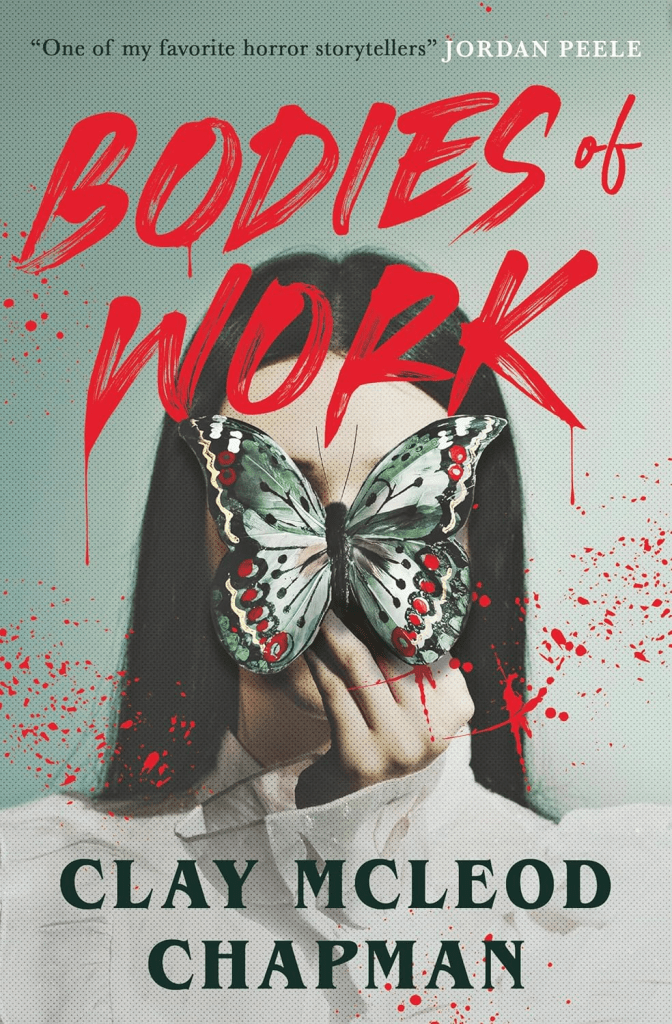





TL;DR: Chapman gives the dead women back their voices, then makes you watch those voices dissolve. Bodies of Work is a tight, unsettling novella that finds its horror not in the scissors but in the catalogues, the coffee can, the Morton Salt Girl whispering from the shelf. Outsider art as true crime. A chorus of the disappeared, narrating their own erasure.

The conceit is the thing. Six women, murdered and dissolved into the imagination of a church janitor in rural Virginia, narrate the story of their killer from inside his skull. They bicker. They correct each other’s timelines. They argue over whose story this is and whether they can trust their own memories, because those memories are fading. They are the chorus and the subject and the archive and the evidence. They are also, by the time Catherine Calvert unlocks the carport apartment and finds what she finds, the ending.
This is Clay McLeod Chapman‘s Bodies of Work, a novella about a killer named Winston Kemper, a self-taught artist and serial murderer modeled, at deliberate remove, on the outsider artist Henry Darger. Darger (1892–1973) was a Chicago janitor who spent decades alone in a rented room producing a 15,145-page illustrated fantasy epic about seven girl warriors in a child-slave rebellion, his walls covered in collage, his manuscript discovered only after his death by his landlords Nathan and Kiyoko Lerner. The man never published anything. Nobody knew. Chapman acknowledges this openly in his afterword: this is not Darger’s story, he writes, and Darger deserves a better one. The disclaimer is important because the book works precisely because of what it refuses to do. It does not use Darger’s actual life as license for anything. It takes the facts, the janitor job, the church, the butcher paper, the department store catalogues clipped of their children, and constructs something fictional from the silences in that record.

The horror of Bodies of Work is the horror of those silences. These women vanish. It happens the way such things happen. Kendra’s Hyundai is held hostage by the mechanic in Warrenton over a four-hundred-dollar repair. The unnamed sixteen-year-old is running from an uncle her mother chose to believe. The woman with the bruised wrists leaves the group home because her husband asked nicely and she pitied him. They each find a church with the lights on. They find Winston. And then, in a phrase that becomes the book’s governing rhythm: he did.
Chapman is very good at the objects. The Chock full o’ Nuts coffee can where Winston keeps his rent. The Smith and Corona typewriter salvaged from a trash pile, its carriage still squealing. The Sears Roebuck and Montgomery Ward catalogues, their pages hollowed of their photographs, glossy chasms where the children used to be. The Morton Salt Girl on the supply-store shelf, speaking to him in a choir of identical cartons. These are the tools of a particular kind of dread, the brand name doing psychological work that description cannot. You do not need to be told what kind of horror a room full of clipped catalogues contains. The clipped catalogues are the horror. The name on the can is the horror.
What Chapman builds with the dead women, detail by detail, without naming the accumulation, is a specific grief about whose stories get told. The women argue over who was murdered first. They correct each other on Winston’s age during a particular year and cannot agree. Their individual confessions, arriving in long breathless runs without paragraph breaks, are all variations on the same abandonment: by men, by systems, by rooms that were supposed to be safe. One of them is losing the thread of her own name. Another holds onto hers by repeating the story out loud, every detail, the lacrosse injury, the Oxycodone, the car speeding away with someone else’s hand where it had no business being, and then the church light through the dark. She says: he did. As if this ending were the only place any of these roads could go.
(This is the most disturbing thing in the book. Not the scissors. The way certainty migrates. The way a story told enough times becomes someone else’s.)
Where Bodies of Work falters is in its embedded fantasy, the battle sequences from Winston’s manuscript that interrupt the novella at intervals. The Butterfly Girls, his warrior children, fight Confederate soldiers and gas-masked armies across poppy fields, all antlers and wing-color and severed jaws. These passages are written in a different register, breathless and purposely overwrought, intentionally pulpy in the way a feverish outsider manuscript might be pulpy. The intention is defensible. The execution gives them too much real estate. The contrast with the flat, controlled outer narrative is the point, but the contrast keeps stopping the book rather than doubling it. The fantasy sequences sit in the story like something from another novella’s binding.
The voices of the dead women blur by design. Chapman wants you to notice the moment when it becomes impossible to tell who is speaking. The blurring is the argument: this is what disappearance looks like from the inside, the self eroding into the collective, your story bleeding into hers. The problem is that the blurring costs emotional traction earlier than it should. The women become most individuated at exactly the moments when they are insisting, to themselves and to each other, on their own particularity. Those moments land. The rest of the time the chorus risks becoming what it is critiquing: interchangeable voices in a killer’s head.
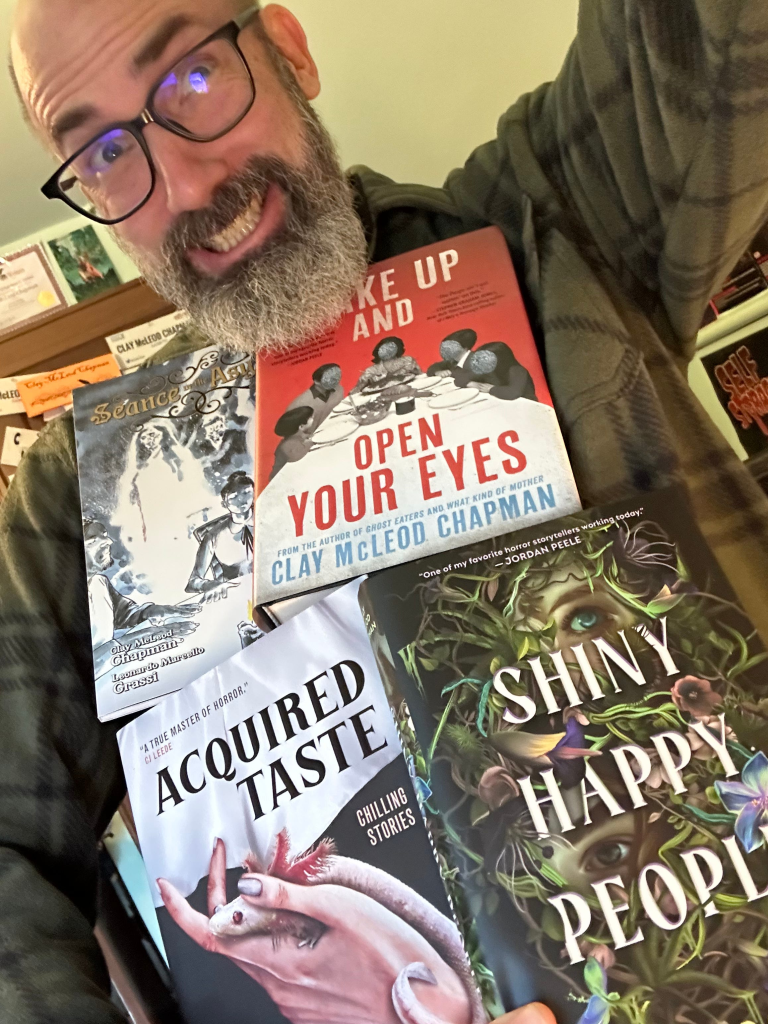
Chapman has been working in horror long enough to know where the bodies are. He built his career in part through The Pumpkin Pie Show, a storytelling performance of his own devising that ran for over two decades in New York and found its audience through sheer force. His novels, beginning with The Remaking in 2019 and accelerating through Whisper Down the Lane, Ghost Eaters, and What Kind of Mother, have established a consistent appetite for the horror of institutional belief, the stories communities tell themselves to avoid seeing what is directly in front of them. The Bram Stoker and Shirley Jackson nominations followed. Bodies of Work is his first novella proper, published by Titan Books, and it carries the compressed, urgent quality of a writer who has learned to say the essential thing and stop. There is very little here that is not doing something. The instincts that serve him in longer form sharpen here rather than diminish.

Bodies of Work by Clay McLeod Chapman, published April 7, 2026 by Titan Books.


 The Blog Without a Face
Leave a comment