
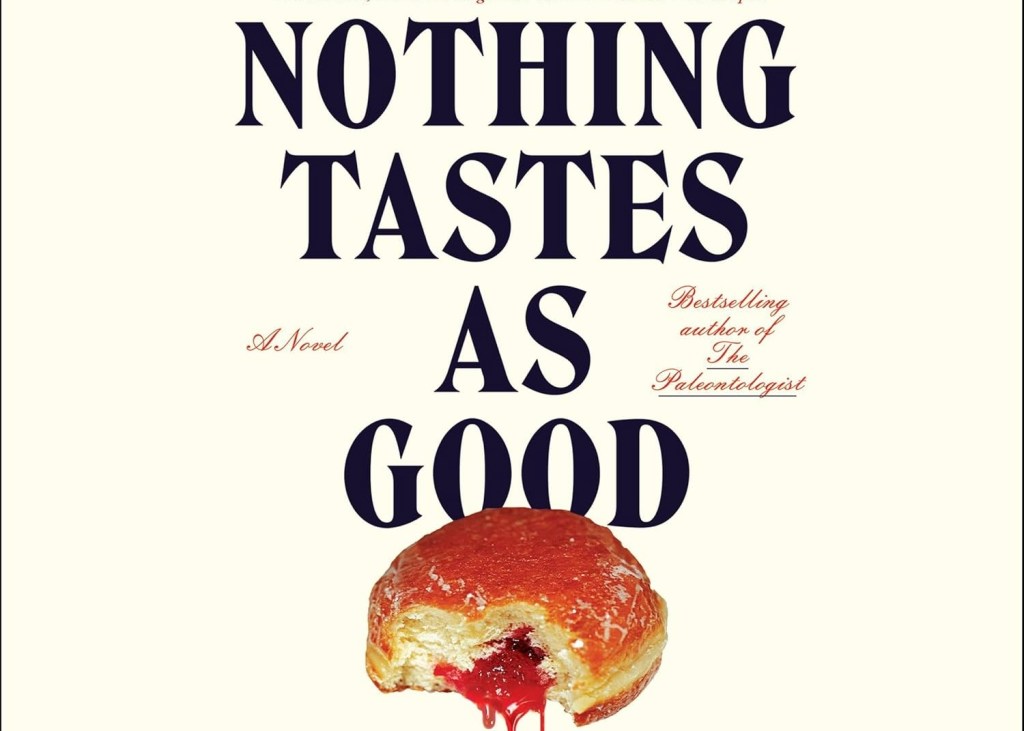
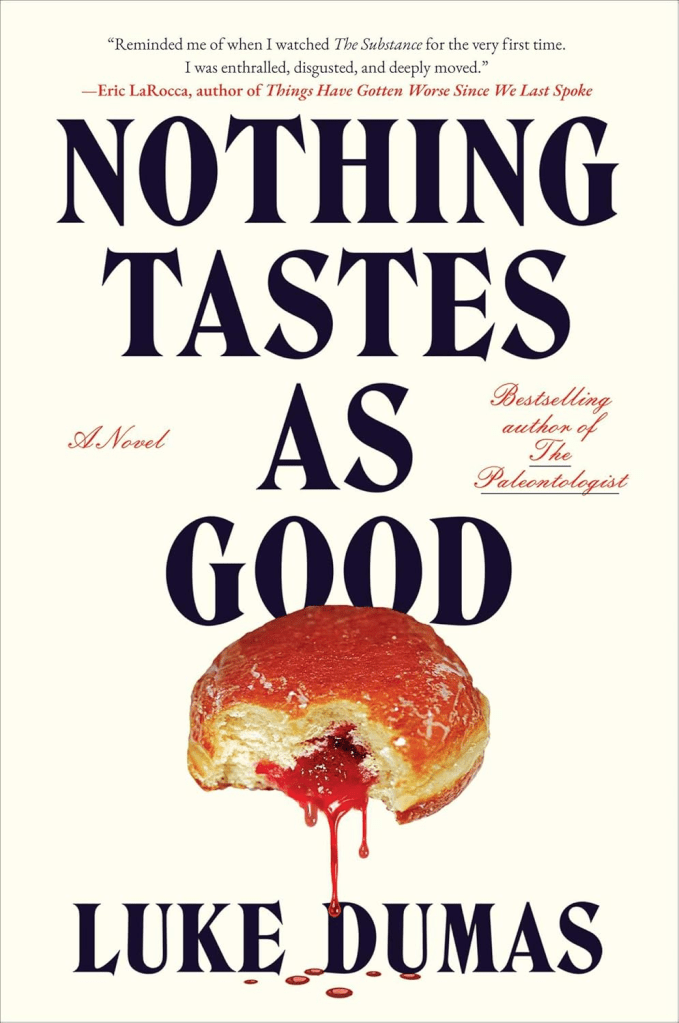







TL;DR: Nothing Tastes as Good is the rare horror novel that justifies its cannibalism. Dumas builds Emmett Truesdale so completely, from the carne asada fries to the CPAP machine to the shame he carries like a second body, that when the Hunger turns monstrous, it feels like the logical conclusion of a life the world has been eating alive for years. Controlled, precise, and genuinely disturbing.

Monstera BioSciences signs its correspondence with a phrase: For the health and happiness of the country. Their founder is a man who describes obesity as a “virulent pestilence,” who compares his drug to the Pfizer-BioNTech Covid vaccine, who speaks of the obese masses with the patient, weary compassion of a man who has been very patient and very weary for a long time. The phrase appears early and often. By the time the novel is finished with it, it sounds like something else entirely.
This is a horror novel structured as a corporate liability investigation. There are blog posts and Instagram captions, health journal entries formatted like spreadsheets, interview transcripts with a guy named Frank Darrow who conducts most of them from parking lots and boats and the noisy interior of a Chuck E. Cheese. There is a pharmaceutical company called Monstera BioSciences (named, their founder will tell you, for the split-leaf philodendron, a plant considered monstrous but capable, with a little TLC, of producing such sweet fruit), and there is a drug called Obexity, and there is a gene therapy component called EmaC-8, and there is a clinical trial participant known throughout the investigative report as no. 82941, whose “acquired taste for human flesh” made national headlines. Dumas assembles his story from the wreckage of what that participant left behind.
His name is Emmett Truesdale. He’s twenty-eight. He works guest services at a Target in Point Loma. His 2008 Ford Taurus has a check-engine light that has been on long enough to burn into his retinas, a broken AC he cannot afford to fix, and a personality he has apparently developed to match both conditions. His hair is neon orange fading to ash brown. He has never weighed less than what you’d politely call substantial, and he has been aware of this fact, with excruciating specificity, since approximately age five.

Dumas renders him completely. This is the gamble on which the novel’s entire structural conceit depends, and Dumas mostly wins it. By the time the Prentice & Darrow report begins assembling its portrait of a man with cannibalistic tendencies, you have spent enough time inside Emmett’s blog (the Cotija’s Cocina Mexicana takeout, the carne asada fries loaded with cheese and guac, the four cups of hot sauce, the CPAP machine he clips off every morning while Bella the chihuahua-spaniel jumps to her feet) that you have to decide which account of the man you trust. The report notes, with characteristic neutrality, that the investigation was commissioned by the company whose drug may have produced the behavior under investigation. The blog does not acknowledge any conflict of interest. Neither does the Instagram.
The horror of the book is not the cannibalism (or not only the cannibalism). It arrives earlier, and keeps coming. It arrives when Emmett’s manager summons him to say that colleagues have noticed he sits down on the job, and that he might think about “an extra lick of deodorant in the morning,” and two teenage associates overhear this and splutter into their hands. It arrives in the clinical trial’s information session, held in a room with plastic toothpick chairs at Monstera’s plate-glass headquarters in the Torrey Preserve, where a cheerful presenter explains that the gene therapy and its activating pharmaceutical will be available, once approved, to anyone who can pay two to three hundred thousand dollars up front, plus fifty to a hundred fifty thousand per year for medication. It arrives in the way the investigative report indexes Emmett’s childhood, his stepfather’s particular cruelties, his father’s alcoholic rages, his mother’s food-as-love and Weight Watchers and then paleo and then Noom, and then concludes, citing comments from Instagram as evidence, that the “unearned notion of victimhood” Emmett espoused represents the real threat to public safety.
The formal conceit earns its place because the form is the argument. This is a novel about who gets to write the story of a fat person’s body, and specifically who benefits when that story turns grotesque. The multi-document structure is the machinery by which Dumas demonstrates that every voice in the novel except Emmett’s (the corporate documents, the FDA letters, the liability report, even eventually the commenters on his Instagram) has a financial or psychological interest in the particular version of Emmett it’s selling. The blog posts and journal entries are his only unmediated record, and even those are not entirely trustworthy, for reasons the novel makes clear.
Luke Dumas is a San Diego native who received his MFA from the University of Edinburgh and spent more than a decade working in nonprofit philanthropy before his debut novel, A History of Fear (2022), arrived with starred reviews from Kirkus and Publishers Weekly and a description from Paul Tremblay involving Gothic tales and claws. His second, The Paleontologist (2023), won the ITW Thriller Award for Best Paperback Original, and reviewers noted that Dumas was unusually good at atmosphere and unusually prone to letting the supernatural elements overwhelm the human ones in the second half. Nothing Tastes as Good is his third, and it reads like a novelist deliberately working in the opposite direction: the horror here stays close to the body, close to the specific texture of a specific life, longer than you might expect, and the supernatural is only identifiable as such well after it has already happened. In his acknowledgments, Dumas names Stephen King’s Thinner as an early influence and Roxane Gay’s Hunger and Lindy West’s Shrill as essential to the project. The book contains, in compressed form, all three of those inheritances, and a few more besides.

There is a stretch of the novel, roughly the first third of Emmett’s clinical trial, as the weight comes off and the Instagram followers accumulate and the job at Target yields a promotion and a man named Aaron re-enters the picture at the Museum of Us, where the book is so invested in Emmett’s incremental social rehabilitation that the horror recedes past the point of tension. You are reading a weight loss journey, which is the point, but the point is established faster than the pages turn. A flashback structure (the Prentice & Darrow investigators learning Emmett’s childhood via interview) intercuts with the present-tense transformation, and the interviews are the stronger material: Emmett’s sister Abby, at a law office in Solana Beach, being steered by a professional neutral party toward the testimony Monstera has already decided it needs; Emmett’s father Lou, belowdecks on a boat in Cabo San Lucas, opening a beer and describing the moment he found eight-year-old Emmett hiding in the pantry, white-faced, holding an empty half gallon of rocky road and sobbing “it was an accident.” That scene does more damage than any of the cannibalism.
The horror is appropriately unsettling. Emmett wakes with blood on his hands. Something happens to someone he knows. He goes somewhere and comes back two hours later and his coworker asks where he’s been and he wipes the red off his shirt and says it’s cocktail sauce, knowing as he says it. He knows before the reader does and doesn’t tell us, which is the right choice. The Hunger (capitalized, distinguished from the body’s ordinary signal for sustenance) has been established as a central fact of Emmett’s psychology across two hundred pages before it becomes a fact of the plot, and when it transforms, the transition is continuous rather than rupture. That continuity is the book’s best move.
What you’re left with, after the book, is not the cannibalism. It’s Emmett in his break room, at the vending machine, watching his own reflection in the glass: his neon hair, his parachute of a shirt, the thing he is about to eat and the shame he is already preparing to carry for eating it. That image is in the first pages. The book does not resolve it. It explains it, and the explanation does not help, and that is precisely the point.
Whether it is horror or satire or a body-horror comedy of manners or a fat memoir with murder in it is a question the book leaves open. It might be asking: does the genre label matter when the content is this specific and this true?

Nothing Tastes as Good by Luke Dumas, published March 31, 2026 by Atria Books.
 The Blog Without a Face
Leave a comment