
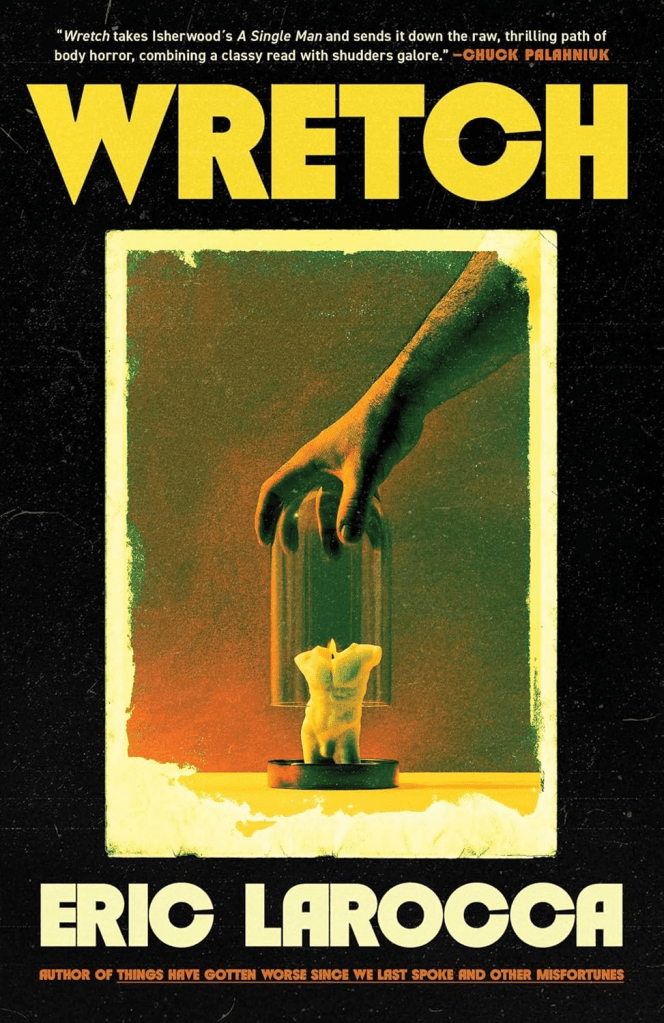




TL;DR: LaRocca writes grief the way a pathologist writes a report: precise, unflinching, with genuine feeling buried beneath the clinical surface. Wretch is an ambitious and occasionally stunning piece of transgressive horror that arrives at its reckoning late and earns it anyway. Porcelain Khaw deserved more of the book that bears his name. So did you.

The entity at the center of Eric LaRocca‘s new novel is called Porcelain Khaw and the name is right. Not an ornament but a description: something finesurfaced and ancient underneath, a vessel that holds other things, something too breakable to trust with anything that matters and yet the place where everything that matters winds up. He sits at the edge of a bed in a windowless room and he waits for the broken to come to him. He is the best thing in this book. He is also, by the old accounting of such failures, barely there.
Wretch, or The Unbecoming of Porcelain Khaw arrives from Saga Press and follows Simeon Link, a gay man in his late thirties approaching forty with the grim reckoning of a man who has run out of reasons to defer it, suicidal in a particular habitual way that has become a kind of companionship, recently gutted by the death of his husband Jonathan, and adrift in a Boston that offers him nothing but an abandoned razor blade on the bathroom counter and the chat rooms of grief forums where strangers congregate to share their damage and, occasionally, to use each other. Into this life falls the Wretches, a grief cult that practices a strange taxonomy of the dead: they photograph inanimate objects and look for their departed in the developed images, faces of the dead appearing in the weave of a trellis, in the curves of a fountain, in the dark wood grain of an armchair. Behind the Wretches is Porcelain Khaw. Behind Porcelain Khaw is something that does not have a name and does not require one.
The novel opens not on Simeon but on a woman named Genevieve, who has come to Porcelain Khaw with a framed photograph of her dead husband, walking a corridor over a carpet swarming with silverreflective beetles, passing through a halfshut door into a room where she is told only that she will have to suffer. It is a lean and coldlooking opening, efficient in its dread, and it establishes the novel’s central mechanism with the clarity of a bell struck once in an empty building. Something is waiting. It has always been waiting. You came to it thinking you had a choice.

The trouble is what surrounds that mechanism. LaRocca writes Simeon from the inside, in the long associative first person that has become his signature register: a sentence that reaches for one metaphor and then reaches for another before the first has settled, that qualifies and circles and softens, that hedges at the level of the clause. There is a kind of accuracy in it for a character who cannot commit to anything, including his own survival. But Simeon wonders too much. He stands in a park with a camera and finds his dead husband’s face in the shadowed vines of a garden trellis and the moment is real and moving and then the prose spends another two pages explaining what it means and the dead man retreats back into the foliage from which he briefly emerged. LaRocca trusts his images. He does not always trust them to stand alone.
The novel is more ambitious than LaRocca’s previous work, threading chat logs and forum posts and a letter from an estranged exwife into the primary narration, and the strongest of these carry real weight. A chat room exchange between Simeon and a stranger operates through the special cruelty of dramatic irony placed at the level of the sentence, each remark landing differently once you understand who is speaking to whom and why. The parenthesis near the end of it, you know enough, lands like a stone dropped from a height. The forum posts are lighter but they function, evidence of other griefstripped lives pressing against the membrane of Simeon’s story. LaRocca knows that horror is larger than its protagonists and this is the strategy by which he demonstrates it.
LaRocca began publishing in earnest in 2021 with Things Have Gotten Worse Since We Last Spoke, a novella that found an audience by making transgressive queer grief tactile and strange, and which earned him Bram Stoker Award nominations and a place in Esquire‘s roster of writers shaping horror’s next golden age. Locus called him one of the strongest and most unique voices in contemporary horror fiction. He is a twice-awarded Splatterpunk winner, a Shirley Jackson Award nominee, and has produced a substantial body of shorter work alongside longer novels including Everything the Darkness Eats and At Dark, I Become Loathsome, the latter optioned for film by Norman Reedus. He lives in Boston, the city where Wretch is set, and the novel’s geography is specific and right: the cold corridors, the grief forums lit by screen in the small hours, the neighborhoods where a man can walk for blocks without encountering anything that does not remind him of who he has lost. The book’s acknowledgments cite Clive Barker, Dennis Cooper, and Chuck Palahniuk as its holy trinity, and the dedication (For Clive and all the exquisite suffering) tells you the frequency LaRocca is broadcasting on. It is a high and demanding frequency. This book meets it in its best moments.
Those moments accumulate, gradually and then without warning, toward an ending that most horror fiction would not attempt with this degree of commitment. The body horror arrives late, and readers accustomed to LaRocca’s more evenly distributed grotesquerie will spend a long middle passage wondering when the reckoning will come. It comes. What it does to Simeon is commensurate with what Simeon has done to the people around him, which is the right kind of justice for a book about grief as appetite, grief as selfishness, grief as something that eats not only the griever but everyone in reach. Whether the ending is earned depends on how generously you read the long approach to it. This reviewer found it mostly earned, and the final image in particular has the quality of something that was always inevitable, a thing that was there from the first pages and simply had to wait for the rest of the book to catch up to it.
This is a book worth reading. It is not a perfect one. The middle slows in the manner of a man standing still while the tide inches toward him, which is precisely one of the novel’s organizing metaphors, and one cannot say with certainty whether this is structural clumsiness or a formal joke this reviewer is too dense to appreciate. Porcelain Khaw deserves more page time than he receives. He is most frightening in the moments when he is present and doing something, and for most of the novel he is off the page being theorized about, which is a different and lesser form of dread. A lesser and more frightening book would have given him more room. The book LaRocca wrote gave the grief more room. That is a reasonable choice. It is also the choice that costs this novel something.
The silver beetles were there from the first pages, crossing a carpet in a windowless house. They are still there at the end.


 The Blog Without a Face
Leave a comment