
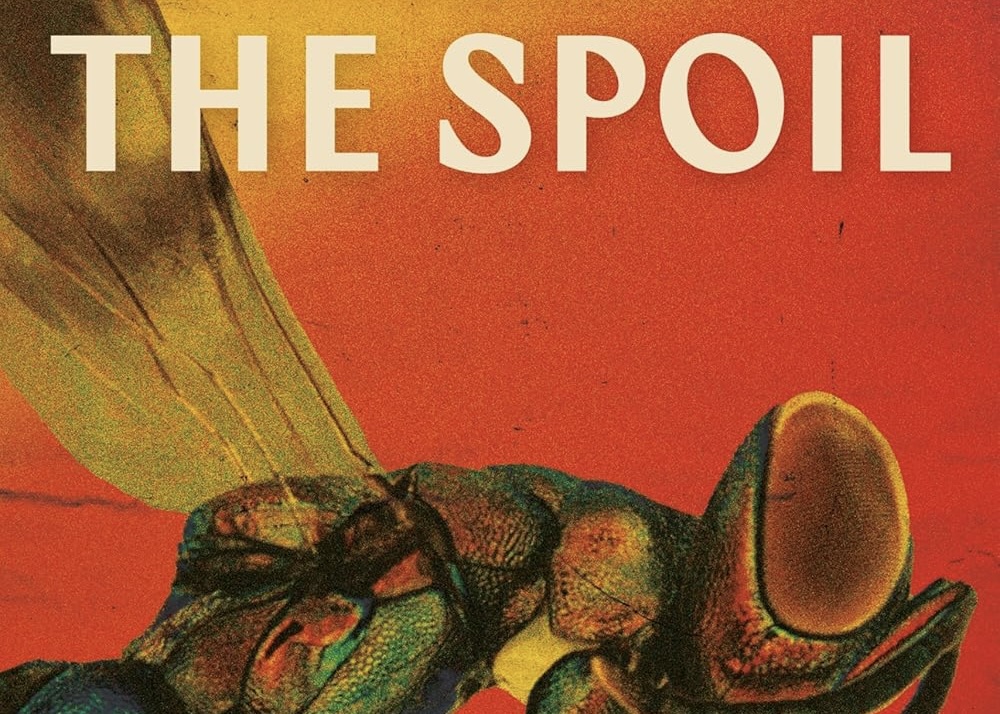
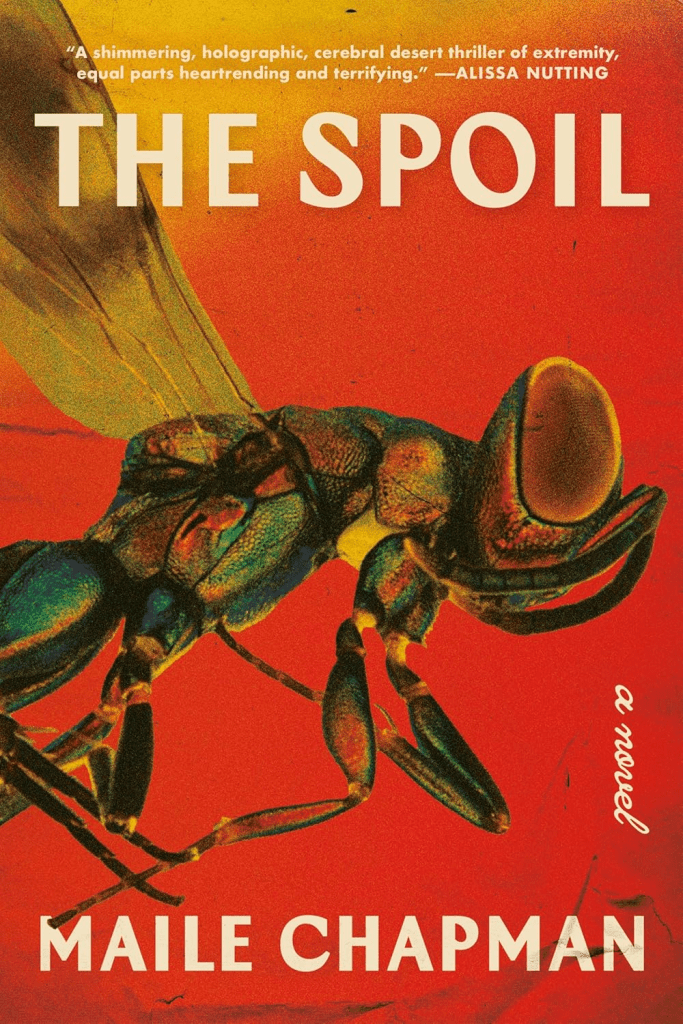






TL;DR: Maile Chapman has written a grief novel disguised as a demon story, or possibly the other way around. Either way, The Spoil gets under your skin through sheer accumulation of dread, of objects, of everything the dead leave behind. Literary horror at its most patient and its most unsettling. Shirley Jackson would recognize the frequency.

The first thing you notice about The Spoil is that it doesn’t seem interested in scaring you. It’s interested in something harder: convincing you that the world has more layers than you’ve been told, and that the rot is already there, under the floor, waiting for a careless foot.
That’s the literal setup of Maile Chapman‘s opening chapter. Young Mandy, a child of the 1970s Pacific Northwest, wanders into a dead neighbor’s abandoned farmhouse and falls through the rotten porch floor. Her leg drops into the root cellar below. She dangles there, assessing the damage, and then something in the dark cups her heel. Closes around her ankle. Tightens. It’s about four pages in and Chapman has already done what most horror novels spend 300 pages trying to accomplish.

The Spoil operates on two timelines: a childhood in a rambling Tacoma split-level, where Mandy and her stepbrother Jeff develop elaborate systems for coexisting with whatever is wrong in the house; and an adult present in Las Vegas, where Mandy is managing her ADHD, tending her mother’s aquariums through a terminal Alzheimer’s decline, and apparently failing to notice that she has dug something out of her dead mother’s stored belongings and set it loose on the neighborhood. That something takes root in TK, the affable semi-retired handyman next door, who has an upcoming surgery and a growing habit of showing up where he shouldn’t. Meanwhile, a more textured and unsettling threat arrives in the form of Sam, a houseguest who quotes alchemical texts and seems to be doing something to Mandy’s conscious mind that she can’t quite perceive or name. The book is interested in possession not just as supernatural phenomenon but as what happens to us slowly, daily, through grief and illness and the accumulated weight of things we haven’t unpacked.
Chapman’s writing is a particular kind of first-person: it moves like ADHD actually moves, associative and darting and pausing on objects with the intensity of someone who knows they should be focusing on something else. The domestic texture is extraordinary. You will come away from this book knowing more than you ever wanted to about enzymatic urine cleaners, aquarium hardscape design, the rewiring of vintage lamps, and how to restore outdoor furniture without stripping the wood. This sounds like it shouldn’t work and it absolutely does. The house is a character. The stuff inside it is a record of everyone who has lived and died and left traces. Chapman is doing something like what Shirley Jackson did: physical space as pressure system, as accumulated biography.
Maile Chapman is from Tacoma, the same landscape where the novel’s childhood sequences are set, and those details carry the weight of firsthand memory: the farm party lines, the brooder houses, the smell of goldenrod, the barn cats flat in the afternoon sun and then streaking alive in the same instant. Her debut, Your Presence Is Requested at Suvanto (Graywolf, 2010), was shortlisted for the Guardian First Book Award and named a finalist for the PEN Center USA literary award. That first book was a dense gothic about a women’s convalescent hospital in 1920s Finland, built on compression and historical atmosphere. Fifteen years is a long gap between novels, and the acknowledgments of The Spoil explain it without sentimentality: caregiving, illness, Covid, a decade of revision. Chapman teaches creative writing at UNLV and has been a fellow at the New York Public Library’s Dorothy and Lewis B. Cullman Center for Scholars and Writers, where the alchemical research that saturates this book’s middle chapters apparently began. She was also, and I say this with full admiration, briefly a kindergarten teacher at a particle physics research facility in Hamburg, Germany. The Spoil is recognizably the work of someone who takes fifteen years because the structure is load-bearing, not because she is precious. Chapman has said she finds it infuriating when horror novels change their rules midway through, and everything about how this book is built reflects that conviction.

What she does best is atmosphere that accumulates rather than announces itself. Consider the moment you understand what Sam has been doing at 3 AM in Mandy’s living room: standing at the fish tank with a tiny jelly jar, filling it from the waterfall outlet of the algae scrubber, drinking it with complete deliberateness, unaware he’s being watched through a gap in the blinds. There is something about the smallness of that glass, the precision of the gesture, that is deeply fucking wrong in a way that resists analysis. It just sits there in your brain. Or the moment Sam mentions casually that a house full of reflective surfaces is a house full of divination tools, and you look back at every dark aquarium Mandy has described in these pages, all that water catching light, and realize you’ve been reading a haunting from the inside without knowing it. Or the thing in the cellar of Mrs. Field’s house. The way it holds on.
The book is not without problems, and the biggest one is length. At 480 pages, The Spoil sags badly in its middle third. The Las Vegas chapters trust Chapman’s observational eye a few chapters too long, and I say that as someone who gives a shit about aquarium hardscape. Mandy’s relationship with her stepbrother Jeff generates real comedy and texture, but the novel then largely exits him, making those long domestic sequences feel like setup for a payoff that gets redirected somewhere else. This is a 350-page book wearing a 480-page coat. It fits, mostly, but you notice the seams.
The ending opens, quietly, like something that was always going to be there when you got to the bottom. It earns what it finds down there by making you understand that what Mandy has been excavating this whole time was never just a demon. It was her mother. It was everything her mother left behind, and everything she couldn’t.
That’s the kind of book this is: one that makes grief feel like archaeology and archaeology feel like horror, and still manages to land somewhere that feels true.

The Spoil by Maile Chapman,
published March 16, 2026 by Graywolf Press.


 The Blog Without a Face
Leave a comment