


TL;DR: Olyoke is a mean little scrapbook of a town that sells its own nightmares back to itself, then acts surprised when the nightmares start shopping. Endwell mashes folklore, internet ephemera, faux-archives, and stage directions into a sticky mythology about preservation, spectacle, and the slow approach of something hot and holy and wrong. It absolutely lands.

This is a Tenebrous Press joint and it has that Tenebrous vibe of “here is your elegant weirdness, now let me bite you with it.” Vincent Endwell is a multidisciplinary artist who originally hails from unceded Onondaga territory in Central New York, and their horror cred is already stamped in places like Dark Horses Magazine, Corvid Queen, and Tenebrous Press’s Your Body is Not Your Body. They write like someone with multiple creative outlets to offload the voltage: music for the raw autobiographical ache, writing for the digested, speculative version that can be sharpened into a blade. You can feel that cross-medium discipline in Olyoke, too. It has the collage brain, the comics sense of framing, and the pianist’s “I hate reading music, so I learned to improvise” swagger. The result is a book that’s formally playful but emotionally serious, a town-sized nightmare assembled out of images, textures, and dread, then pushed into motion like a ritual you can’t unsee.
Calling this “a novel” is accurate in the way calling a haunted mall “a building” is accurate. It’s a mosaic. You’re in and around Olyoke, Tennessee, a town pressed up against marshland and tourist machinery, where people keep trying to preserve things that should not be preserved, and where belief systems start acting like infections. You get specific POV anchors, like Beth-Anne in “The Modeling Resin,” who goes back into a rotting bar and into the gravitational field of a childhood memory, and a whole constellation of voices in documents, transcripts, and threads that orbit the same ugly star. The stakes are not “will the hero win,” they’re “what does this place do to you once it notices you,” and “how far can you go pretending the nightmare is just part of the attraction.”
Endwell keeps changing the delivery method without losing the internal chemistry. The opening “Recovered Document” reads like scripture from a lunatic theology department, all raven-thinkers and proclamations, and it sets the tone: language itself is part of the curse. Then “The Modeling Resin” hits you with contemporary intimacy and dread you can taste. There is a moment where the resin figures click into focus and Beth-Anne hears the line, “They’re just like you,” and it’s so simple, so goddamn predatory, that you feel your spine try to leave your body. Later, “The Wandering Daughter” slides into an online thread about Hailey Land and its wax museum, and Endwell nails that confessional tone where someone is laughing while they are clearly still fucked up about what they saw. “On The Fire” turns into a manifesto about an approaching literal fire and a “Christmas pyramid” model of reality, and it sounds ridiculous right up until it doesn’t, which is the book’s whole trick. Then “Pyramid” becomes a podcast investigation that collapses into stage directions and audience reactions, like you’re listening to a true crime show about a cursed play and then suddenly you’re in the play and the play is in you. That formal pivot is not a gimmick. It’s the same theme wearing a different mask: performance as ritual, entertainment as summoning.
Endwell’s big strength is sentence texture and control of voice. The modern sections are clean, observant, and cruel in that empathetic way. The “document” sections are baroque and feverish, but they stay legible because they’re fueled by obsession, not just vocabulary. The internet bits feel lived-in instead of “hello fellow kids,” and the transcript material is confident enough to be funny without losing menace. Pacing is interesting because the book is both episodic and cumulative. You get these hard jolts of scene-based horror, then longer myth-building passages that feel like walking deeper into the marsh while someone keeps telling you it’s fine, it’s totally fine, look there’s a gift shop. If you hate books that ask you to assemble meaning, you’ll call it indulgent. If you like your horror ambitious and structurally weird, it feels like being handed a box of cursed artifacts and realizing they all belong to the same body.
The aftertaste for me is two threads braided together. One is preservation as violence. Wax, resin, documentation, “local history,” even memory itself, all become ways of trapping something living and calling it care. The other is spectacle, the way a town can turn dread into branding until the dread gets bored and stops pretending. The horror machinery expresses that through replicas that rot, rituals that look like shows, and shows that stop being pretend. The next day, what stuck in my ribs was the question of what Olyoke really is: a place, a machine, or a hungry story that found a town to wear.
Olyoke sits with the books that treat form as part of the haunting, not just a container. It feels like an author planting a flag that says, “I can do folk myth, I can do internet horror, I can do theatrical ritual, and I can make it all rhyme.” If this is where Endwell’s arc is headed, it’s a hell of a mission statement, and it’s memorable in a way that does not wash off.
Excellent and weird as hell. A distinct vision that turns a town into a ritual engine and then feeds it your fingers, lovingly, while it says it’s for preservation.

Read if you crave mosaic horror, dossiers, transcripts, threads, the whole cursed-scrapbook buffet.
Skip if you hate stories that demand you connect dots and trust atmosphere.
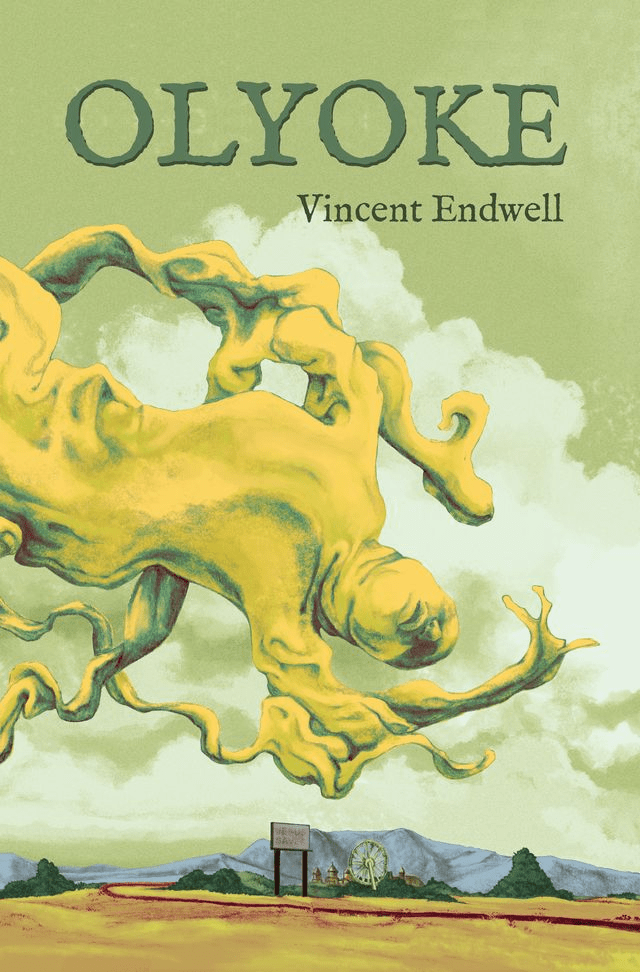
Olyoke by Vincent Endwell,
published March 24, 2026 by Tenebrous Press.
 The Blog Without a Face
Leave a comment