
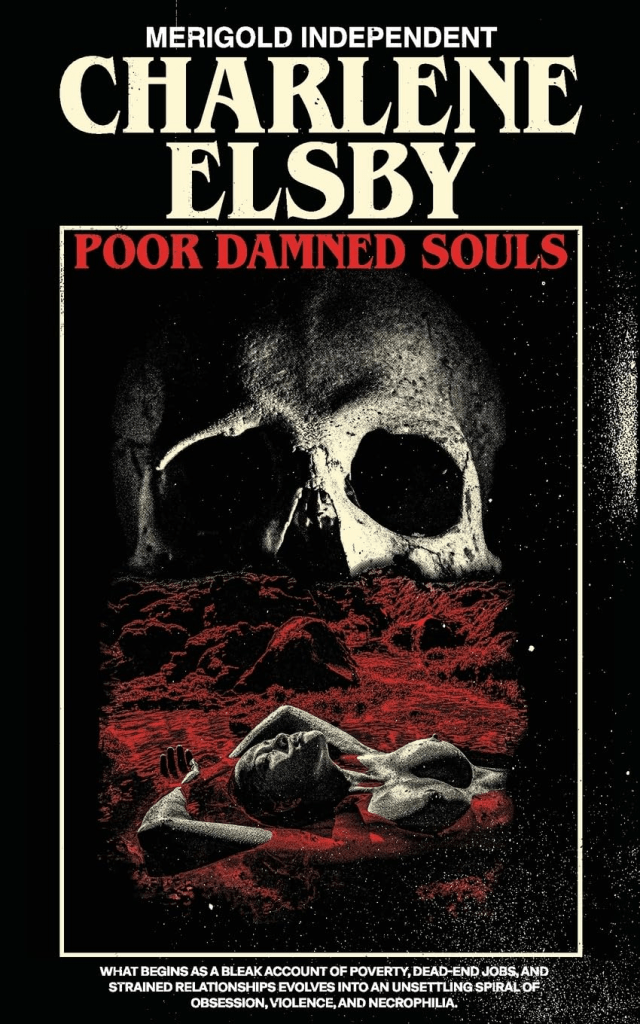






TL;DR: Poor Damned Souls is the working-class horror novel that has no business being this funny or this smart, and Charlene Elsby knows it. A payday loan clerk installs a keylogger on her cheating husband’s computer and finds something worse than an affair. The first two-thirds are nearly perfect. The third act will sort your readership for you. Highly recommended to everyone who survives it.

The first third of Poor Damned Souls is a masterclass in a genre that doesn’t have a name yet. Call it payday loan noir. Call it cheating-husband surveillance thriller. Call it whatever you want, but understand that for a long stretch of this book you are inside the skull of an unnamed woman working the morning shift at a Canadian check-cashing store called The Money Store, and she has just found her husband Scott’s dick on a bondage website, and she is going to handle this with institutional precision. She has access to a “Verification Centre,” which is just a computer in the back where they look people up, and she uses it the way god intended: to compile a dossier on the man she sleeps next to every night. She prints everything. The dick comes first. That feels important.
This is the book’s setup and it is tremendous. The narrator discovers Scott is cheating. She installs a keylogger on his computer using the activation command ALT+DEL+SKANK and waits. She discovers he may have done worse than cheat. She finds a dead woman in the news, a woman named Julia, 34, found in a river, whose folder of intimate pictures lives inside Scott’s laptop under a directory called “Human Resources.” At this point, Elsby is writing something that feels like dark comedy crossed with a procedural crossed with the most specific domestic horror you’ve ever read, and the whole thing crackles because the prose refuses to separate the mundane from the catastrophic. The narrator counts cash with the same methodical voice she uses to plan a murder. She thinks about whether to smoke in the panic room (the bathroom) with the same calm attention she brings to deciding how to disable Scott’s phone. Everything receives exactly as much weight. This is both the book’s greatest strength and, eventually, part of what works against it.

Charlene Elsby is a philosopher by training, formerly the Philosophy Program Director at Purdue University Fort Wayne and now, per her bio, working for the Canadian government, which feels like either a cover story or the most interesting hiring decision a government has ever made. Her debut Hexis established the template she’s been refining ever since: an unnamed woman, an interior monologue of extraordinary density, violence described with the same flat precision as housekeeping, and a philosophical throughline that keeps the whole thing from being mere provocation. Psychros, Musos, Violent Faculties, The Devil Thinks I’m Pretty — she’s been shockingly prolific, and across all of it the voice is consistent: acerbic, funny, ruthless, and philosophically serious about what it means to be a woman living inside systems that will absorb her labor and her body alike. In fact, make sure you check out The Organization Is Here to Support You, one of BWAF’s favorite books from last year.
Poor Damned Souls is the class novel, more explicitly than anything she’s written before. The Money Store is not backdrop. It’s the whole argument. What it means to sell money to the people who can least afford it. What it does to you, the person behind the glass, when you understand the system and still have to run it. This is Elsby’s most grounded book, and in its first two-thirds, her sharpest.
There’s a moment maybe a third of the way through where the narrator is running through the Verification Centre on a customer while simultaneously looking up Julia’s records, trying to connect her to Scott, and she pieces together the contours of Julia’s life from public records: the lease, the restarted social media accounts, the comments on her profile picture. “You look tired. Great, for your age!” The narrator hates Julia with a focus that is also, unmistakably, recognition. This is the texture the book nails. Another scene: the narrator crawling out of bed to check the keylogger, going cylindrical, trying not to jostle the mattress, calculating rotations, committing to a fall she can’t catch. The physical specificity of a woman trying to disappear inside her own apartment. And then: the list of reasons why murder is wrong, which she eventually dissolves in a bowl of water and mashes into pulp. The list is funny. The pulping is funny. What comes after is not.

Here is where we have to talk about the third act, because it is a different book. I’m going to spoil some shit because I think it’s necessary to discuss. The narrator and Scott go to kill Megan together, and what follows is extended, graphic, philosophically structured transgression that Elsby commits to completely and which will lose readers in approximately the same proportion it gains them. I don’t think it’s a failure of nerve. The vivisection scene is doing something: it’s the logical extension of the novel’s argument about what happens when you strip away all the systems that make violence illegible, all the abstractions that let us pretend people aren’t meat. The narrator is looking for the thing inside Megan that Scott wanted. She doesn’t find it, because it isn’t there, and that’s the point. But the explicit content runs long, and the build that made the first two-thirds so propulsive dissipates into something more static.

The voice throughout is worth whatever friction the finale generates. This is a narrator so good you feel robbed when the book ends. She notices things. She’s almost unbearably funny about her own catastrophe and almost unbearably lucid about what the world did to her before she decided to do anything back. If Poor Damned Souls doesn’t quite stick the landing, it’s because the first two-thirds set a standard the bloodbath can’t sustain. But I’d rather read a book that tries for something and wobbles than one that coasts. Elsby is constitutionally incapable of coasting, and that counts for a lot.
Poor Damned Souls by Charlene Elsby,
published March 24, 2026 by Merigold Independent.

 The Blog Without a Face
Leave a comment