




TL;DR: You Did Nothing Wrong is the kind of horror novel that makes you feel watched by your own walls. CG Drews builds dread the way bad relationships build damage: slowly, plausibly, until you can’t remember what normal felt like. A genuinely terrifying adult debut from an author who already knew how darkness worked and has now been given permission to use all of it.

The writing in You Did Nothing Wrong has a quality I can only describe as beautiful rot. CG Drews writes Elodie January the way you’d describe a gorgeous bruise: you keep going back to look at it, to press on it, to see if it still hurts. And it does. Every time. It always fucking does.
Elodie is twenty-two, Australian, newly arrived in a Virginia Victorian with a husband she adores and a six-year-old son she loves the way a black hole loves light: consuming, total, nothing making it out. Jude has never been diagnosed with anything, because Elodie has made sure of that. The old house, meanwhile, seems to have opinions. Bren, kind and golden and renovation-obsessed, is fixing the place up while it breathes in the walls, while it leaves red smears on Elodie’s hands, while Jude whispers that the house is hungry and wants to pull out all his teeth. Whether the house is actually haunted or is simply Elodie’s fracturing mind given architecture, You Did Nothing Wrong holds that ambiguity with an almost cruel control. By the time you know which it is, you’ve already been made complicit in something you didn’t sign up for.

What Drews does with interiority here is extraordinary. We live in Elodie’s head so completely that her rationalizations start to sound like reason. There’s a scene where she stands at the nursery keyhole listening to Jude whisper to something inside the walls, and she doesn’t open the door. You understand exactly why she doesn’t. That’s the horror of it: the understanding. Another moment that I’m still thinking about: Jude’s little Popsicle-stick house, red-painted and half-collapsed, crushed in Elodie’s grip as she carries it to the trash. You feel the weight of that in your chest like a door slamming shut. And the scene at the after-school care center, where Jude has made a pipe-cleaner figure of himself and a pipe-cleaner figure of his mother and then stomped on the latter with six-year-old absoluteness, while looking her right in the eye. I put the book down after that one. Not because it’s a cheap shock. Because the pain in it is so specific and real, the awful bidirectional wound of a parent and child who cannot reach each other, and the novel never flinches from the fact that both of them are bleeding.
Drews has been building toward this book for years, working from a YA foundation that already pushed hard at the boundaries of what the genre would permit. Their debut A Thousand Perfect Notes came out in 2018, followed by The Boy Who Steals Houses, which scored a nomination for the 2020 CILIP Carnegie Medal and a CBCA Honour Award in Australia. Don’t Let the Forest In broke them into wider territory, hitting the New York Times bestseller list and taking the Barnes and Noble 2025 YA Book Award, with a 2025 Carnegie Medal nomination alongside it. Hazelthorn followed in late 2025 before Drews made the leap to adult horror with You Did Nothing Wrong. The move isn’t a total departure in temperament; Drews has always written dark, and their YA work has always strained against softer genre conventions. But this book operates with a latitude their prior work never had: in body horror, in moral darkness, in the willingness to sit inside a protagonist who does genuinely terrible things without ever offering the reader an emergency exit. The acknowledgments end, pointedly, with this sentence: “If you were once the autistic child, you did nothing wrong.” It is the most important sentence in the book, and it reframes everything that came before it.
Jude is unmistakably autistic, though Elodie has never allowed the word anywhere near him. The meltdowns, the sensory overwhelm, the way he lines up his wooden animals for hours, the love of games as a scaffolding for a world that doesn’t otherwise cohere. And Elodie has, with obsessive ferocity, hidden this from everyone, including any professional who might help him. Her protection of Jude is real. Her need to control Jude is also real. Drews refuses to let those two things cancel each other out, and that refusal is where the book does its most serious work. The wallpaper in his nursery, little foxes and hedgehogs in tidy jackets that he traces with his fingers each night before sleep. The way the house seems to tighten its hold on Elodie in the rooms she least expects. The light fixture that drops inches from where she was standing and leaves a wet black mouth in the ceiling, looking down like it’s disappointed. This is a book that understands dread is not a jump scare but a texture, something that coats the back of your tongue and stays there through every domestic scene, every attempt at normalcy, every lie Elodie tells herself about the kind of mother she is or is going to be.
The pacing is immaculate in the first two-thirds and only slightly winded in the middle, where the flashback chapters labeled in years do necessary work but occasionally release pressure the main timeline has spent chapters building. It’s a real nitpick in a novel that otherwise manages the twin mechanics of domestic horror and psychological collapse with genuine skill. The prose can get lush to the point of almost too much, which is a matter of taste but worth flagging for readers who prefer their horror leaner.
This is adult horror that takes the architecture of the genre, the hungry house, the things in the walls, and uses it to construct something about inherited wreckage, the violence inside love, and who gets to be seen as a child who did nothing wrong. By the time the novel asks that question directly, you’ve already been sitting with your answer for pages. You knew before you were ready to know. That’s the whole trick. That’s the whole point.

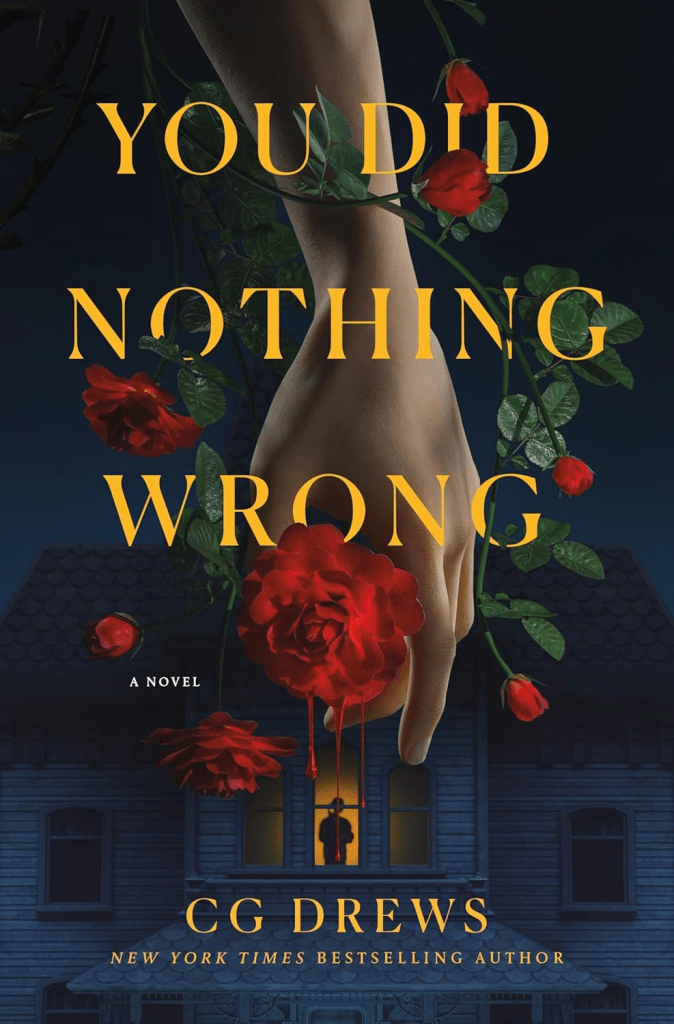
You Did Nothing Wrong by C.G. Drews,
published March 10, 2026 by St. Martin’s Press.
 The Blog Without a Face
Leave a comment