
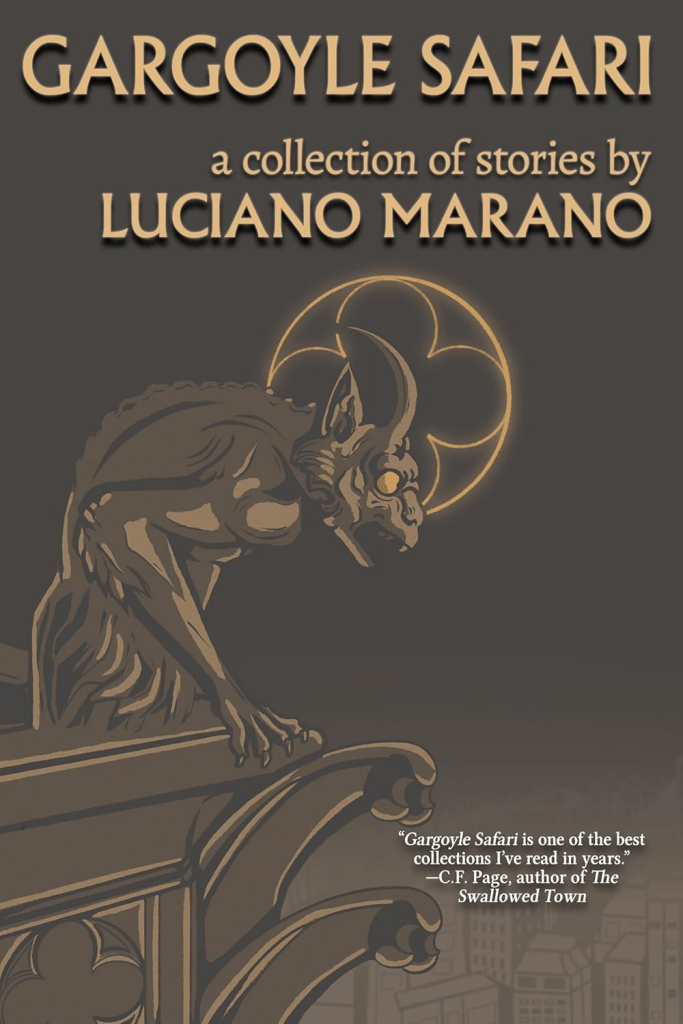



TL;DR: Gargoyle Safari is what happens when a journalist’s eye, a horror nerd’s obsession, and a barely restrained feral energy collide at full speed. Marano can make you cry over a dying criminal, gag at celluloid intestines, and question your Instagram habits in the same sitting. This is a debut that bites and doesn’t let go.

In the title story of this collection, a witch named Leiko, having just been drugged and sucker-punched by the man she once loved, wakes up on a collapsing rooftop above a burning city and thinks, “We truly are on shaky ground here,” and then starts cackling at her own joke. That’s the energy of this collection. The ground is always giving way, the monsters are always closing in, and somebody is usually laughing, because what the hell else are you going to do?
Luciano Marano‘s debut collection gathers fourteen pieces that range across subgenres like a jukebox loaded with everything from delta blues to death metal. Social media horror told through Instagram photo descriptions. Splatterpunk road romance between queer outlaws fleeing a murder into a cult’s blood ritual. A prose poem narrated by the shotgun Hemingway used to kill himself. The tonal swings are massive, mostly intentional, and the fact that it holds together at all is a minor miracle of voice.

The opening story, “The Mythologization of Tymber Prescott in Five Selected Photos,” is a goddamn stunner. It maps the disintegration of a young influencer through five social media posts, described in the clinical, slightly reverential tone of a true crime retrospective. The horror sneaks in through details: a symmetrical bruise resembling a symbol, eyes darkening from green to black, fingernails grown long and ragged. By the final image, you feel like you’ve been scrolling through something you shouldn’t have seen. It mimics the sensation of watching a real person unravel online, unable to look away and unable to help.
Marano came to fiction by an unusual route. A Navy veteran from rural western Pennsylvania, he served as a Mass Communication Specialist before earning a photography degree at the Art Institute of Seattle. His first fiction appeared in the extreme horror anthology DOA III in 2017, alongside Jack Ketchum and Edward Lee, which is a hell of a debut neighborhood. His journalism earned him Feature Writer of the Year twice from the Washington Newspaper Publishers Association, and that eye for detail shows up constantly here. Before this collection, he published the werewolf novella trilogy The Ambush Moon Cycle through Raven Tale and Humbug, a noir riff on A Christmas Carol, through Crystal Lake. His short work has appeared in Nightscript, PseudoPod, and The Best New Weird Horror, which reprinted the Tymber Prescott story after it won the 2022 Brave New Weird Award. What’s striking is the range: he’s not a splatterpunk guy who occasionally gets literary, or a quiet horror writer who sometimes gets nasty. He seems committed to doing both, sometimes in the same paragraph.

The collection’s biggest flex is its refusal to repeat itself. “Struggle as You Will to Rise” is told entirely in the voice of a man visiting his girlfriend’s comatose husband, reading him King novels while casually describing how he’s systematically destroying the man’s family. It peels back layers of sociopathy until you realize you’re reading something truly vile, made worse by the narrator’s chatty self-amusement. “‘Till the Road Runs Out” goes the opposite direction: a love story between Hicks, a career criminal pushing forty, and Dakota, the young man he saved in prison. It’s violent and profane and shamelessly romantic, and when Hicks bleeds out in the passenger seat while Dakota screams at him to hold on, my chest got tight. You believe these people because they want specific, concrete things.

“Flickering Dusk of the Video God” is where the recurring obsession with monsters as cultural artifacts gets its most inventive treatment. A washed-up B-movie director returns to find his dead father’s video store has become the center of a cult worshipping something that manifests through VHS static. The prose mimics analog degradation: tracking lines in the narrator’s vision, reality stretching like warped tape. A woman who’s been “rewound” by the Video God has celluloid for guts. When he stabs her and film-strip entrails come unspooling out, it’s the kind of image you either love or throw the book for. I loved it.
There are weaker entries. “Shotgun Sunset” is too brief to do much beyond demonstrate Marano can write a pretty sentence. “Gobble,” about activists breaking into a genetically modified turkey farm, shifts from satire to carnage so abruptly you’re not sure what to feel. But then “My Eyes Are Closed to Your Light” hits, and it’s so fucking good it makes you forgive the uneven spots. Stacey, a former student hunting for her vanished writing professor in caves beneath a crumbling cemetery, is brilliant and ruthless, a woman whose worship of a man’s talent is inseparable from her plan to consume it. The refrain of “Salinger had Joyce Maynard / Kerouac had Edie Parker” accumulates weight until it sounds less like literary reference and more like a predator’s prayer.
The closing story, “Love Is a Ghost You See With Your Heart,” alternates between a writer’s nonfiction essay about horror and a domestic ghost story narrated by someone who murdered their spouse, keeping you guessing which voice is real until they collapse into each other. It’s metatextual in a way that could be insufferable but feels earned, because by that point Marano has spent the entire collection asking the same question: what do we need our monsters for?
His answer, stated outright in the title story’s final line, is that we need them badly. The gargoyles on the buildings, the creatures in the static, the black dogs running alongside the truck at midnight. Take them away and we become the worst versions of ourselves. Not a new idea, but he prosecutes it with so much energy and craft and genuine affection for the genre that it feels vital anyway. A confident, occasionally messy collection from a writer who has more to say. I’ll be listening.

Gargoyle Safari by Luciano Marano,
published February 12, 2026 by JournalStone.
 The Blog Without a Face
Leave a comment