


TL;DR: A sticky, swampy Southern nightmare where grief, bad history, and cursed honey make an island full of people start digging like their brains got hijacked. When it’s cooking, it’s got big, gnarly set pieces and wicked folklore juice. When it’s not, it over-explains its own magic and burns momentum right when you want it to go feral.

J. H. Markert is a novelist/screenwriter out of Louisville, Kentucky and has one foot in thriller propulsion and one in old-school genre showmanship, plus a whole other career writing historical fiction under his real name. This book even flags his split-brain bibliography up front: the J. H. Markert shelf (Spider to the Fly, Sleep Tight, Mister Lullaby, The Nightmare Man, etc.) alongside the James Markert titles (What Blooms From Dust, The Angels’ Share, and more). Dig sits right in that lane: commercial-forward pacing with a folkloric underworld you can smell in the air.
The setup rules. Crow Island is the kind of place where the trees feel like they’re listening, and everybody’s got one eye on the swamp and the other on whatever fresh hell the past left behind. Years ago, Jericho Dodd, a troubled kid with a history of “off,” took an axe to a Fourth of July parade and wrecked a dozen lives. Now Reverend Thomas Dodd is dead, missing a hand, and his last message is basically “DIG,” which is the least comforting voicemail a dead man can leave. His older son, Nate, gets yanked back to the island, and the whole community starts spiraling into a shared compulsion: holes in yards, floors torn up, people acting like the dirt is whispering their names. Amy Barnes, the local historian with her own grief crater, starts connecting dots between the island’s violent history, the honey economy, and something called Lalaland, a nightmare-world bleeding through.

The imagery and the folkloric mechanics when Markert stops narrating and starts summoning is what can fucking hook you. The honey house is a perfect “do not go in there” location, all storybook paint on the outside and cosmic rot behind the door. The Boo Hag lore gets deployed with creepy specificity, down to the kid-talk version that’s both adorable and unsettling: “Boo Hags sneak around during the day wearing somebody’s skin,” which is the kind of sentence that should come with a free therapy coupon. And then the book has the audacity to drop a full-on unicorn into the third act, not as a cute wink but as a violently useful mythic weapon, horn-first, ripping into a Boo Hag like a fantasy freight train. It’s ridiculous. It’s awesome. It’s also a good example of Dig’s whole vibe: fearless imagery stapled to a plot that sometimes feels like it’s stopping to explain the stapler.
The best sequence, hands down, is the late-game convergence at the Dodd House when everything goes loud and wrong: bees, blue bottles, gunfire, and the human villain going full skin-mask psycho. The payoff lands in a satisfying way when Blue Bottles weaponizes the bees like they’re a personal choir of judgment and Mitchell McBride gets absolutely wrecked, swarmed, suffocated, and dropped. That’s a great horror kill: specific, myth-rooted, and mean as hell.
Where it slips into “average” territory is the constant need to underline its own lore. Dig has a habit of pausing for explanation right when the tension is climbing the wall. The multi-POV approach keeps things moving, but it also creates a “committee meeting” feel sometimes, like the book is staging a PowerPoint on why the island is cursed instead of letting you feel it in your bones. There are moments where characters talk like they’re trying to convince you the premise makes sense, not each other. The result is a story that’s rarely boring, but often less sharp than it wants to be.

This is a grief engine disguised as a creature-feature folk nightmare. People on Crow Island are haunted by what they lost, what they survived, and what they’re afraid they might be capable of. The digging reads like obsession and trauma made literal: you keep clawing at the past because you think there’s an answer down there, and maybe there is, but it’s also going to fuck you up. You’re left with that “everything is wrong” feeling Amy names when she talks about Lalaland.
Dig feels like a bridge between Markert’s “boundary-thinning nightmare world” interests (this book literally names and maps the other side) and his Southern-history instincts, with Crow Island’s economy and violence tied to cycles of extraction and blood. It’s not a standout banger for me, but it’s got enough sticky originality and a couple of genuinely great “what the fuck” moments to keep it from being forgettable.
Big folklore swings and a killer third act, but it over-explains the magic and dulls its own teeth.

Read if you want swamp-soaked folklore and cursed-local-history dread; you like “small town goes feral” plots with escalating weirdness.
Skip if you need tight lore with minimal explanation dumps; you want subtle horror instead of big, messy, loud set pieces.
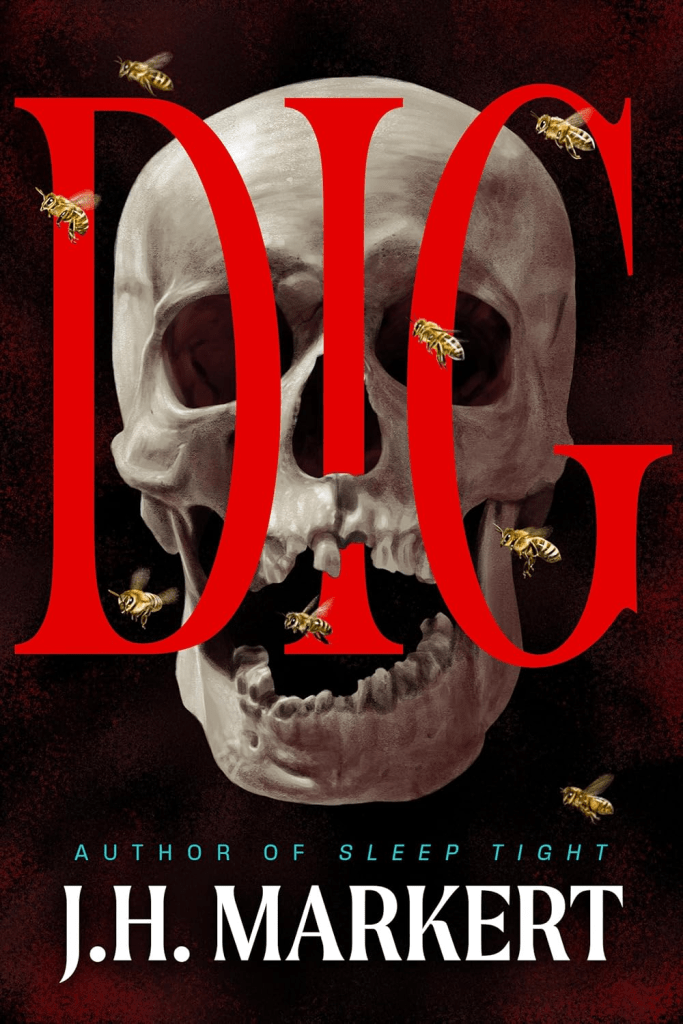
Dig by J. H. Markert,
published March 24, 2026 by Crooked Lane Books.

 The Blog Without a Face
Leave a comment