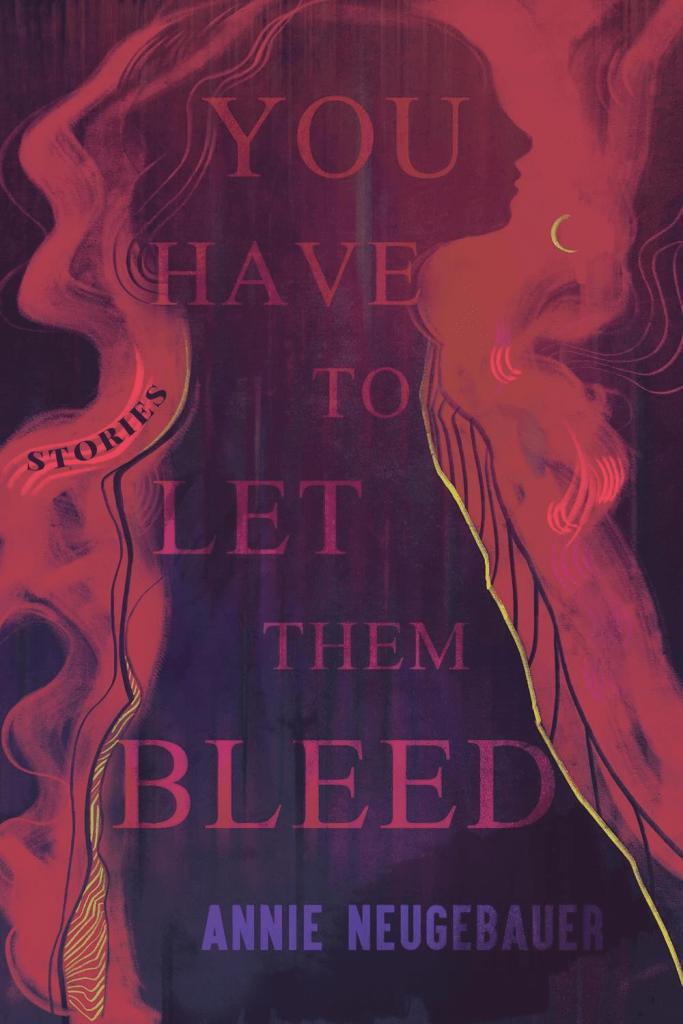






TL;DR: Neugebauer writes domestic horror like a scalpel disguised as a wooden spoon: familiar surfaces, wrong notes underneath, and a cut you don’t feel until you’re already bleeding. You Have to Let Them Bleed is the debut collection of someone who spent two decades getting good before asking anyone to notice. It shows, in the best possible way.

Annie Neugebauer spent nearly two decades building toward this. Not in the grinding-against-the-wall sense, but in the deliberate accumulation of a writer who understood that the short story is a serious form and decided to get good at it before anything else. Then, in the same compressed stretch of time, she published her debut novella, The Extra, which landed a Wall Street Journal rave and comparisons to John Carpenter’s The Thing, alongside this collection, You Have to Let Them Bleed, from Bad Hand Books. Two debut books, simultaneously, both arriving fully formed. That is not what it looks like when someone got lucky. That is what it looks like when someone was ready long before the industry figured it out.
You Have to Let Them Bleed collects nineteen stories and a sequence of eight short color poems that frame the whole enterprise. A figure called The Shadowling Collector stalks the night, gathering dark and beautiful creatures into shadowboxes organized by color. The color poems appear between stories like exhibit labels in a museum you can’t quite find the exit to. It’s an elegant container for a varied collection, and it earns its own atmosphere independently of anything it introduces. The stories themselves span body horror, folk horror, literary homage, survival horror, and at least one thing that resists whatever category you try to throw at it. Underneath all of that, the collection is really about familiar things with a wrong note in them: a marriage, a kitchen drawer, a pelt on a fence, a howl in the woods that is almost a wolf but isn’t quite.

Neugebauer writes like someone who started in poetry and never fully left. Her prose is controlled in the way expensive things are controlled: nothing loose, nothing wasted, but capable of warmth when it matters. She’s particularly good at the physical detail that carries enormous weight. The exact sound of skin splitting in “Hide” (softer than cracking an egg, harder than fabric, closest to cleaving a watermelon) is described with such precision that you feel it before you’ve decided to. The silence in “What Throat,” when the wolves stop howling because something worse is nearby and the woods hold their breath around a woman stranded in a tree, is built entirely through withholding. Neugebauer understands implication like a musician understands the rest. The scary thing is what isn’t making sound.
Some images from this collection are going to live rent-free in my head forever. “What Throat” centers on an entity that mimics sounds: wolf calls that are almost right but wrong in some way that the body detects before the brain catches up, laughter from something without lips to shape it. The story sits alongside a parallel narrative of three people trapped in a cabin with wolves outside, waiting for a thing that has so far sounded like a child crying, a kitten purring, a chainsaw, and a babbling brook. That the two threads never explicitly meet is exactly correct. Then there’s “Churn the Unturning Tide,” which reads like a pleasant water aerobics class right up until a group of older women in a wave pool begin pressuring a young instructor to eat a tarantula they’ve fished from the water — their voices made of, and I’m quoting nothing because I’ll never do it justice, smoke and moonlight and a lifetime of corrosion. It is very funny and very disturbing and I still don’t entirely know how Neugebauer pulled it off. “The Little Drawer Full of Chaos” is a domestic horror story about a kitchen junk drawer that is somehow generating entropy in the household around it, up to and including the narrator vomiting up what appears to be shrapnel, and it gets under the skin the way only domestic horror can, which is quietly and then all at once. And “Zanders the Magnificent” is the story I’ll argue with people about: a sex offender trying to stay clean after prison, clown makeup that keeps manifesting on his face each night regardless of whether he applied it, handled with a moral seriousness that doesn’t flinch and doesn’t excuse anything and is frankly the most unsettling damn thing in a collection full of unsettling things.
Neugebauer is a Texas-based writer, University of Texas at Austin alumna, and two-time Bram Stoker Award-nominated short story author who spent years building a body of work across more than a hundred publications, including Cemetery Dance, Black Static, Apex, and the Year’s Best Hardcore Horror anthologies. She served as a columnist and instructor for LitReactor and Writer Unboxed for years, earned honorable mentions in Ellen Datlow‘s Best Horror of the Year series, and received recommendations for the Locus and Shirley Jackson Awards. The Stoker nomination for “So Sings the Siren,” which closes this collection, predates the book itself and functions as a kind of preview, a proof of concept that the industry was beginning to notice what she’d been doing all along. The Wall Street Journal’s praise for The Extra called it nearly perfect and a showcase for unbearable slow-boiling tension, which tracks. What You Have to Let Them Bleed makes clear is that none of this came from nowhere. The short fiction has been doing its job for years. This is its monument.

The collection is uneven in the way most collections are uneven, which is to say it would be suspicious if it weren’t. A few stories feel like they’re just finding momentum when they end. “The Pelt,” which follows the slow paranoid dissolution of a marriage through the lens of an unidentifiable animal hide left on a ranch fence in rural Texas, is a story I wanted considerably more of. When it cuts out, I felt something like deprivation. That’s not a compliment I hand out easily. The color poems are lovely on their own terms, precise and weird and tonally immaculate, but used as repeated breaks between stories, they can function like pulling off the highway. It takes a moment to get back up to speed each time, and in a collection this varied, the momentum is doing real work.
“So Sings the Siren” closes the book, and it lands hard. It’s a story about what it costs to make something true, to let the art out of your body where it can be seen and judged and used against you. I won’t say more than that. But it reframes the title in a way that sticks, and it answers something the collection has been circling the whole time. You have to let them bleed. The shadowlings. The stories. Whatever it is inside you that needs to come out. Neugebauer has clearly known this for years. The evidence is in every page.

You Have to Let Them Bleed by Annie Neugebauer, published March 17, 2026 by Bad Hand Books.
 The Blog Without a Face
Leave a comment