
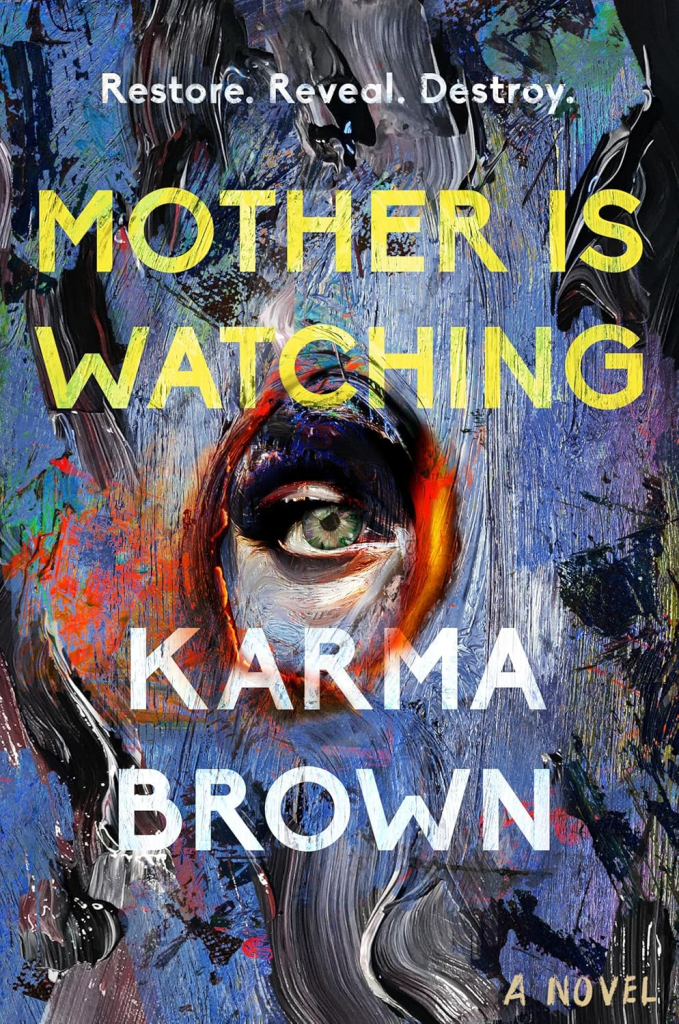




TL;DR: A near-future haunted-art paranoia spiral where conservation work, maternal grief, and “helpful” surveillance systems fuse into one sweaty, invasive nightmare. It’s got genuinely creepy object-horror and strong procedural texture, but it can spin its wheels midstream and over-explain its sharpest ideas, so it lands more as solidly unsettling than truly skin-crawling.

The book kicks the door in with a nightmare you can smell: an artist in a hot room, music on, brush hovering, and the sudden sick realization that the eyes on the canvas are wrong because they’re not hers. It’s the kind of opening that promises you a greasy, uncanny object and the human mess around it. And for stretches, Mother Is Watching delivers that exact itch: a haunted-workroom vibe where dread comes from looking too closely, cleaning too carefully, wanting something back so badly you start making bargains you swear you’re not making.
We spend most of the novel with Tilly, an art conservator in Savannah working at the Georgia Institute for Art, a world that has slid into a near-future normal after fires and a “Great Flood” pushed museums toward virtual experiences. She’s smart, exhausted, and running on the jittery battery life of modern motherhood, which in this setting also has a distinctly programmatic, monitored edge. Her voice is first-person, intimate and breathy in a way that fits the story’s central pressure. She is constantly thinking like a professional and feeling like a person whose skin is too tight. The opening prologue is third-person and brutal, then the book settles into Tilly’s close interiority. That contrast works. It gives the haunting a history, then forces you to live inside the present-tense rationalizations.
Tilly receives an unexpected, massive climate-crated shipment at the lab, along with an audio message and a pile of secrecy. The piece turns out to be connected to Charlotte Leclerc, an infamous, half-myth artist whose work is rumored, rare, and contaminated in more ways than one. Tilly gets pulled into an obsessive conservation project in a high-security room, while her home life and her sense of control start fraying in small, mean increments. The novel then tightens a loop between art, motherhood, and surveillance, and asks what happens when grief finds a new doorway.
The writing is strongest when it stays in the hands-on details. Brown clearly enjoys the procedural texture: solvent testing, cautious brushing, the way conservators “read” damage and layers like a crime scene that also happens to be sacred. The painting itself (its scale, its soot-blackened surface, what gets revealed beneath) becomes a stage for horror that’s more interesting than jumpy. This is not a book that relies on constant stingers. It prefers the slow violation of the impossible becoming practical. A thing shifts. A recording doesn’t show what you swear you saw. Damage behaves wrong. The dread lives in that tiny professional pivot from “this is hard” to “this is not how matter works.”
Where it wobbles is pacing and repetition. The first half has strong forward motion because the premise is so inherently propulsive: mysterious shipment, high-security room, NDA vibes, and Tilly’s brain doing that panicked math of “how do I do this job and still be a mother and still be a person.” But the middle can sag into cycling anxieties and re-laying track you already feel underfoot. Tilly’s internal spirals are emotionally credible, yet the narrative sometimes leans on them as a substitute for escalation. You can feel the book wanting to be both a procedural and a paranoia spiral, and it doesn’t always braid those modes cleanly. When it’s on, the tension ratchets via concrete intrusions. When it’s off, it circles.
Character work is a mixed bag. Tilly is drawn with believable contradictions: competent but self-doubting, tender but prickly, trying to be ethical while also hungry for answers. Her relationships, especially the push-pull between professional secrecy and domestic transparency, have good friction. Dialogue generally feels like people who love each other but are tired and scared, which is the most realistic kind of love. Still, some supporting players function more as pressure valves than fully dimensional people. They move the plot, reflect themes, deliver a nudge, then fade back. That’s not fatal, but it contributes to the “good idea, not fully landed” feeling.
The setting is one of the best components, partly because it’s not just wallpaper. Savannah is rendered with a sense of pace and heat, and the larger world’s climate-shift backdrop is integrated into the art economy and daily life in a way that feels thought through. The recurring motifs are smartly chosen: moths and wings, eyes and watching, the body as material, the home as monitored space. The imagery is at its creepiest when it stays sensory and specific: soot, buckled canvas, delicate organic fragments, the unnerving intimacy of “care” that can become control.
Dread mechanics here are basically a three-part machine. First: bureaucratic secrecy (the audio card, the NDA, the private collector energy) that isolates Tilly and makes her choices feel claustrophobic. Second: the painting as a reactive object, a thing that doesn’t behave like an object should, which turns routine conservation into a haunted ritual. Third: the motherhood layer, where “support” systems and social expectations feel like soft coercion, and Tilly’s exhaustion becomes a lever the world can pull. The horror lands best when those three gears click at once, when what’s happening at work leaks into the logic of home.
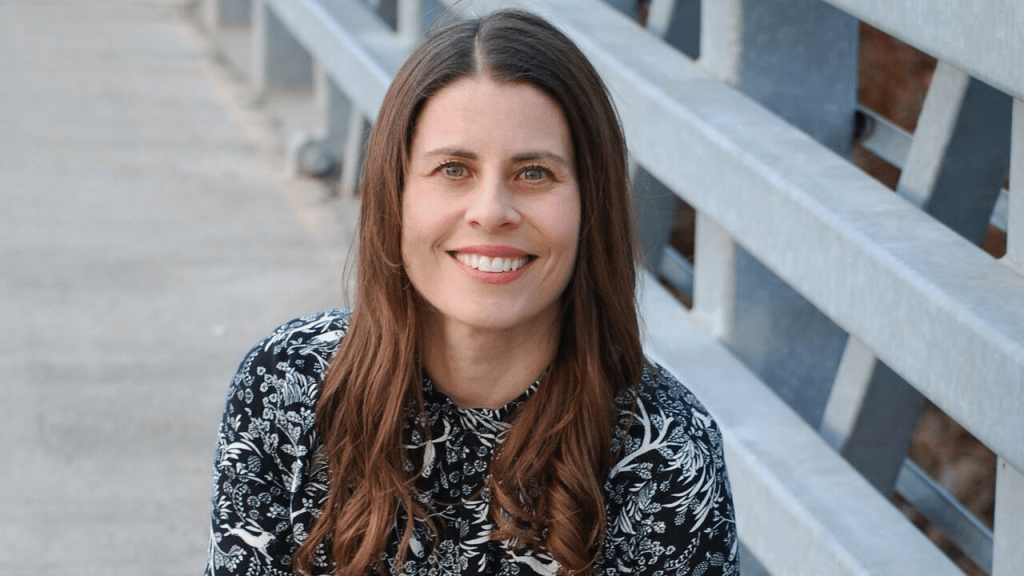
It’s worth pausing on who Karma Brown is, because this book reads like a deliberate lane change. Brown is best known for contemporary and book-club-leaning fiction like Recipe for a Perfect Wife, plus earlier novels such as Come Away with Me, The Choices We Make, In This Moment, and The Life Lucy Knew. She also wrote a nonfiction time-and-life management book, The 4% Fix, and her background includes award-winning journalism, which tracks with how cleanly she handles research-y texture and workplace detail. In other words, Mother Is Watching feels like a mid-career novelist taking a sharper, darker swing and bringing a polished toolkit with her. The interesting shift is tonal: the sentence-level readability and emotional accessibility stay, but the subject matter turns dark, and the book’s big preoccupation becomes bodily autonomy and the ways “care” can be weaponized. If you’ve read her earlier work, you can feel familiar concerns (women boxed in by expectation, domestic roles as pressure cookers) re-engineered into horror machinery.
There’s a genuinely good “moments” run in this novel, where you can feel the potential. The hush of a secure lab room as Tilly prepares to uncover something she’s been warned about. The uncanny twitch of a detail in a recording that should be inert. The delicate, almost beautiful grossness of organic materials intersecting with fine art, like nature deciding to crawl back into the frame. And the way domestic scenes get a faint, wrong sheen, as if the air in the house has started listening.
Mother Is Watching is about grief’s appetite, and how motherhood gets framed as sanctified while being surveilled, commodified, and disciplined. It’s about the seductive lie that control equals safety, and the darker truth that control is often just fear in a blazer. It’s also about art as a kind of resurrection attempt, the desire to preserve and restore turning into the desire to undo, to retrieve, to reverse time’s only real rule. The scariest parts aren’t the supernatural flare-ups. They’re the moments where Tilly’s world offers her a “supportive” path that quietly narrows into a corridor.
The ending goes for confrontation rather than ambiguity. It wants resolution, a sense that choices have consequences, and that the haunting isn’t just vibes, it’s a problem with an agenda. For me, that is partly satisfying and partly over-explicated. Some readers will love the decisiveness. I wanted a bit more restraint, a little more room for the horror to echo instead of stating its thesis aloud.
If you’re here for a slick, readable, near-future maternal dystopia with art-world procedures and a supernatural object that behaves badly, you might rate this higher than I did. The book is very easy to keep turning pages on, and it has several sequences that are flat-out creepy. My hang-ups are mostly about the mid-book wheel-spinning and a few thematic beats that feel reiterated rather than sharpened.

Read if you want haunted art plus “helpful” motherhood systems that feel like a velvet-gloved hand on your throat.
Skip if you hate procedural detail and get itchy when a premise is strong but the middle takes a few laps around the block.
Mother Is Watching by Karma Brown,
published March 17, 2026 by Dutton.


 The Blog Without a Face
Leave a comment