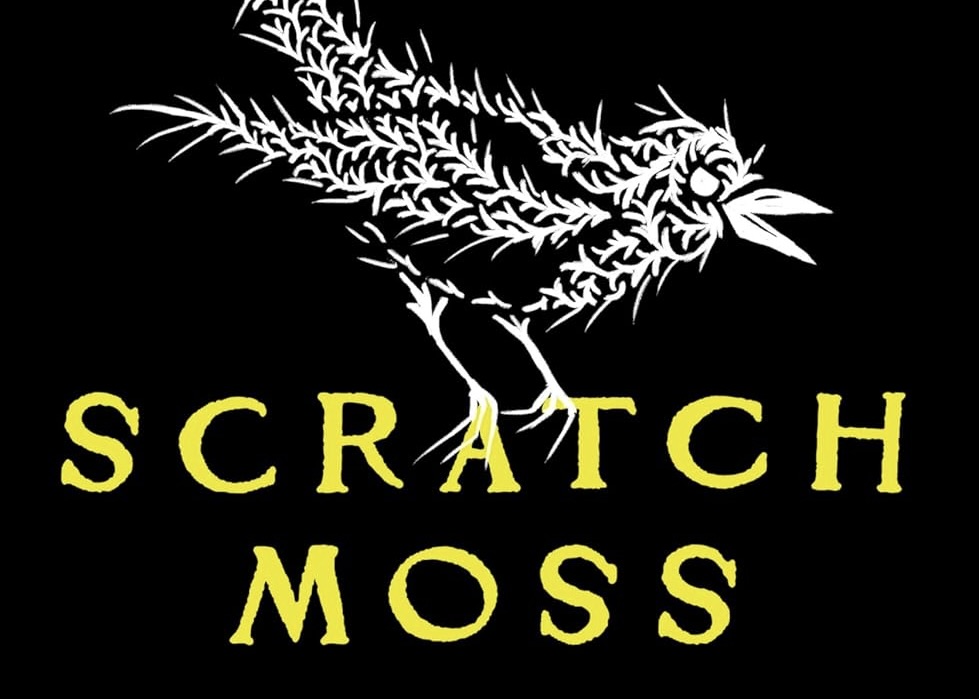
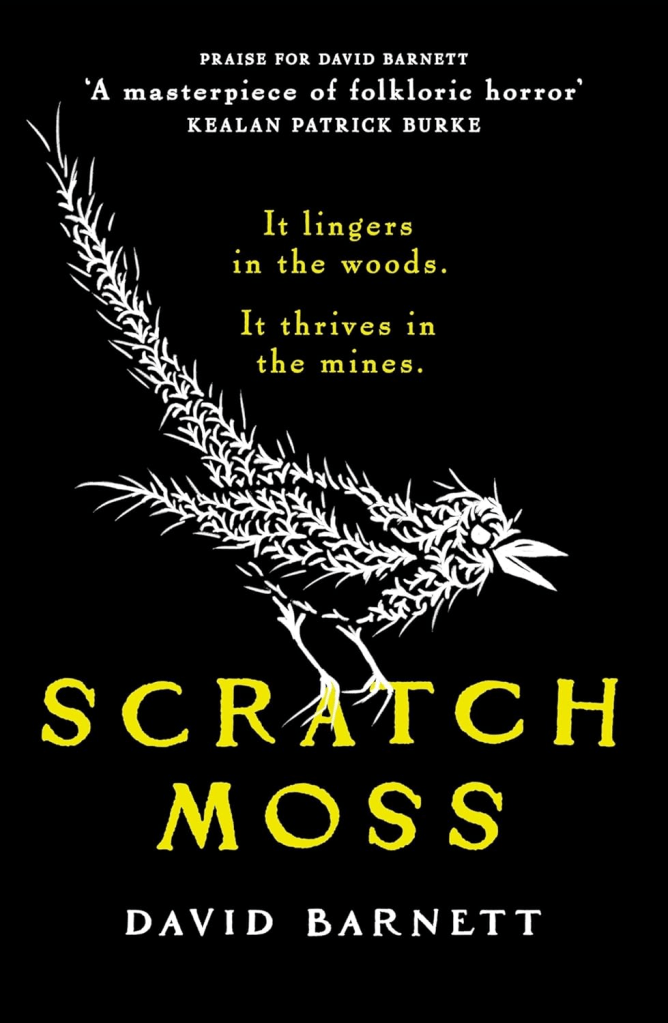




TL;DR: Scratch Moss is industrial folk horror at its filthy, furious best. David Barnett rips the genre out of its rural comfort zone and buries it in a coalfield, proving that the scariest thing in any community isn’t the ancient god under the earth but the neighbors who decided the price was worth paying. Confident, angry, and genuinely haunting. Read it.

There’s a moment early in Scratch Moss where Joe Collier, a washed-up literary novelist coming home for his father’s funeral, reprimands himself for drafting opening lines in his head. “Stop dreaming up first lines,” he thinks. “You’re not going home to write a book.” David Barnett, thankfully, has no such hesitation, and he opens his third folk horror novel with a chapter so thick with foreboding you can practically taste the coal dust. This is a book about a place that doesn’t want you, and the terrible shit that happens when you show up anyway.
Joe, fifty-three, divorced, career circling the drain, returns to Scratch Moss, a dying ex-mining community wedged between Warrington and Wigan that other towns seem to physically recoil from. His dad Terry died in prison after a life sentence for kicking a man to death. The whole town thinks Terry was a hero. Within days of arriving, Joe’s mum kills herself in a manner so spectacularly horrible I had to set the book down and stare at a wall. Straw effigies are appearing in an abandoned church. The local weirdo is muttering about an entity called Red Clogs. Something dormant for forty years is waking up under the earth, and it is hungry, and it wants children.

What Barnett is actually writing about, beneath the folk horror apparatus, is sacrifice. Who gets sacrificed so communities can prosper, and the moral calculus people perform to look away. The mine gave Scratch Moss everything, but the god sleeping in the coal seam demanded a price: one child a year, taken by whoever carried the spirit’s essence. For over a century, the town decided this was acceptable. That’s the real horror, not the ancient earth-god but the collective shrug. Barnett draws explicit parallels to mining itself, to men destroying their lungs for a paycheck, to Thatcher gutting the coalfields. It’s not subtle, but it earns its anger.
The prose is sturdy and propulsive, more workmanlike than lyrical, which suits the material. Barnett writes with the confidence of someone who grew up in these streets and knows exactly how a flat-vowelled dialect settles back onto you the second you walk through your mum’s front door. He’s especially good at domestic texture: the cracked teapot from a holiday decades ago, Angel Delight in the fridge, a carpet pattern with a face hidden in it that terrified young Joe. These details aren’t decoration. They’re load-bearing.
Barnett is a journalist, comic book writer, and novelist based in West Yorkshire who came to folk horror sideways. He’d published commercial fiction under the name David M. Barnett, including Calling Major Tom, and written comics for DC’s Sandman Universe line and 2000AD. His first folk horror outing, Withered Hill (2024), earned a Best Horror Novel shortlist nomination at the British Fantasy Awards. Scuttler’s Cove followed in 2025, shifting to a coastal setting where wealthy outsiders collide with something ancient. With Scratch Moss, the third standalone in a shared universe, Barnett set out to test whether folk horror could work in an industrial setting, drawing on his childhood in Ince, outside Wigan, where he played on slag heaps and heard local legends about a blood-soaked bogeyman called Red Clogs. A fourth novel, Twisted Pike, is due later this year. The trajectory is clear: each book pushes the subgenre somewhere new, and this is the most ambitious of the three.

The book’s boldest structural move is its five timelines, leapfrogging from 2025 back through 1985, 1945, 1905, and 1865. Each era has its own register: Victorian melodrama, Jamesian ecclesiastical horror, angry social realism during the pit closures. The 1985 sections, told through thirteen-year-old Joe and his father Terry, are the emotional core. Joe’s summer with Ellen Dowd, the girl he never stopped thinking about, is as affecting as anything in the horror chapters. Pacing sags when the timelines multiply and you’re getting another iteration of the same revelation (Red Clogs is real, the town is complicit), but the cumulative effect is powerful.
Ellen Dowd is the book’s secret weapon: funny, sharp, the kind of woman who clocked her abusive husband with a coal shovel and can deconstruct your novel’s shitty ending over bad rosé. Joe is convincing as a man who spent his adult life running from where he came from. Where characterization falters is late in the book, when Joe’s possession by Red Clogs turns him from a person into a vessel and the internal struggle gets told more than dramatized.

But the ending. The ending is the best thing Barnett has written. It commits fully: Joe descending into the mine shaft with paraffin and a Zippo, Marillion in his headphones, choosing to end what should have been ended 160 years ago. It’s sacrificial, earned, and threads together generational duty and working-class solidarity in a final act that’s almost unbearably sad but feels exactly right. Then the epilogue pulls back to show the community scattered and a stranger at Ellen’s door, suggesting the fight isn’t over. Both complete and open.
Scratch Moss is too long, its middle timelines sometimes feel redundant, and it occasionally explains themes the story is already communicating. But goddamn, it’s a confident book. Barnett has figured out something most folk horror writers haven’t: the genre doesn’t need wicker men or remote islands. It just needs a community that made a deal it can’t get out of, and someone willing to pay the fucking bill.

Scratch Moss by David Barnett,
published March 5, 2026 by Canelo.


 The Blog Without a Face
Leave a comment