
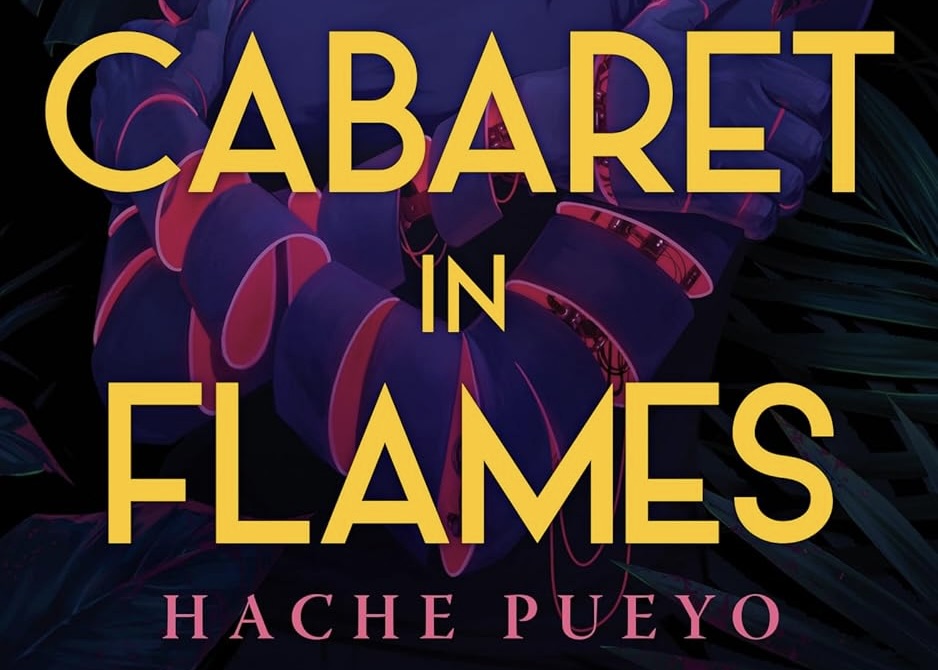
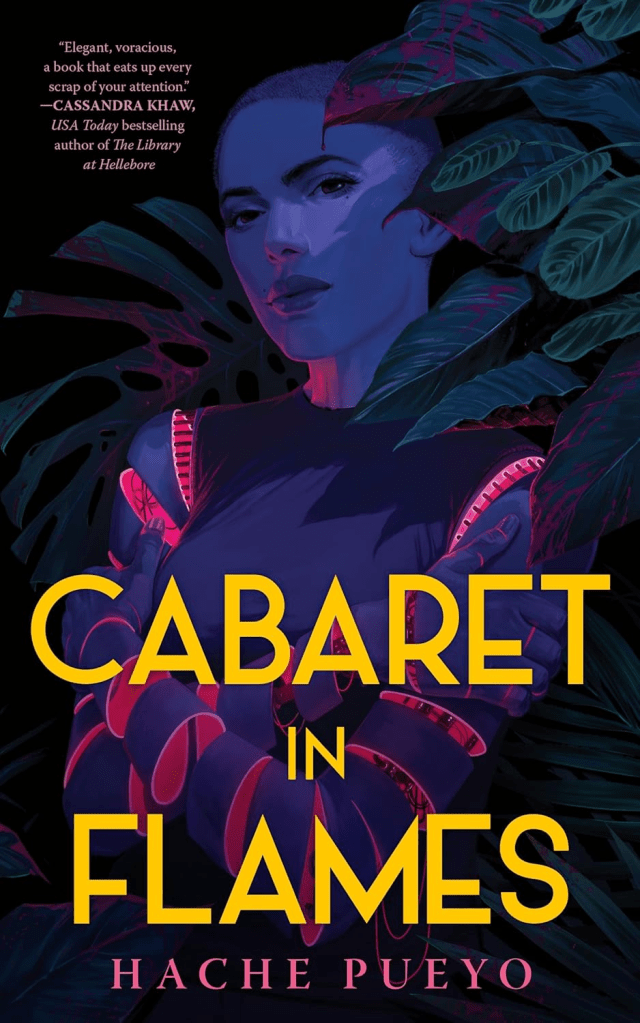





TL;DR: Hache Pueyo writes about monsters who eat people and people who survive being eaten, and she makes both sides feel unbearably real. Cabaret in Flames is sensory, savage, and surprisingly tender, a novella bursting at its seams with a novel’s worth of ambition. The prose alone is worth the price of admission.

There’s a moment early in Cabaret in Flames where Ariadne, a woman whose arms and legs were eaten off her body as a child, casually checks a drawer for a dose of carfentanil strong enough to drop an elephant. Not because she’s afraid. Because she’s practical. She’s alone with a creature twice her size who could kill her before she registered the movement, and her first instinct is to locate the nearest chemical advantage. That beat tells you everything about this book and the woman at its center: she is not asking for your sympathy, she is managing the situation, and she has been managing situations like this for a very long time.
Hache Pueyo‘s novella is set in an alternate Brazil under authoritarian curfew, where guls, a species of flesh-eating humanoids with rows of fangs and centuries of lifespan, coexist uneasily with people. Ariadne runs a medical clinic for guls inherited from Erik, the doctor who rescued her as a child, built her prosthetic limbs, and vanished. When Quaint, a tattooed, centuries-old charmer claiming to be Erik’s oldest friend, shows up at her door, they’re pulled into a search leading to Cabaré, a glittering elite club in Rio where gul power brokers gather and old sins fester.
The prose is goddamn gorgeous. Pueyo writes with a sensory density that makes you feel the humidity, the dried blood on an undershirt, the texture of synthetic skin being rolled over a prosthetic arm. She does brutality and tenderness in the same paragraph without tonal whiplash, which is harder than it looks. The whole book reads like it was written by someone who thinks in color and fabric and the weight of a ring on a finger, and that material attention grounds a world that could easily float into abstraction.
What Pueyo is really writing about, underneath the fangs, is the long non-linear aftermath of childhood sexual abuse. Ariadne was kept by a gul called Minotauro from an age so young she can’t remember life before him. Her escape attempts are narrated in a chapter that hit me like a freight train: climbing out a window at ten and being returned by a helpful neighbor, drugging her captor at eleven and reaching freedom only to realize she didn’t know a single street name. The book understands that survival doesn’t look heroic from the inside. It looks like dissociation, like craving touch from people who remind you of your abuser, like hating the man who saved you because he gave you a life you never asked for.
Pueyo is an Argentine-Brazilian writer and translator who’s been building a reputation in speculative fiction for nearly a decade, publishing short stories as H. Pueyo in F&SF, Clarkesworld, and Strange Horizons. She won an Otherwise Fellowship for her work with gender in speculative fiction, and her debut novella But Not Too Bold, a sapphic gothic monster romance from Tordotcom in 2025, earned a starred Publishers Weekly review comparing her to Carmen Maria Machado (it was also one of our favorites of 2025). Cabaret in Flames originated as a shorter piece in Brazilian Portuguese for Mafagafo Revista before expanding into this English-language edition, and in a recent interview with Ginger Nuts of Horror, Pueyo described the labyrinth as an organic way to conceptualize traumatic memory: intricate, circular, a structure you walk through endlessly before the path clears. That’s basically a thesis statement for this book. She knows exactly what stories she wants to tell and she’s getting sharper with every outing.
The characters are the engine. Ariadne is prickly, controlled, occasionally vicious in a way her history earns completely. Quaint could be insufferable in lesser hands, but Pueyo gives him real contradictions: the blood on his clothes after feeding, the failed marriage he discusses with genuine warmth, the alertness of someone who’s watched a lot of people die. Their dynamic works because neither is saving the other, and the book is honest about the ways their attraction is a little fucked up.
Where it stumbles: pacing. At around 160 pages, this novella is doing the heavy lifting of a novel. The worldbuilding is so rich and the political backdrop so compelling, with its curfews and death squads and a president whose death scrolls across the television in the final pages, that the compressed format leaves too many threads as sketches. The Cabaré itself goes by so fast you barely sit in its atmosphere. Secondary characters arrive, do their work, and recede before they breathe.
But the dread earns its keep on two frequencies. There’s the physical horror of guls, which Pueyo handles with restraint. Then there’s the psychological architecture: Ariadne’s memories of the yellow house surfacing in fragments, triggered by a word or the unbuckling of a belt, interrupting the present tense the way traumatic recall actually works. A scene where she mentally shoves memories into an imaginary trunk, knowing the blood will eventually leak, doesn’t feel like metaphor. It feels like a coping mechanism someone uses. And the scene where she begs Quaint to touch her because she refuses to let her abuser’s hands be the only ones her body remembers is one of the most devastating things I’ve read this year. Furious, tender, and it made me want to set the book down for a moment.
Cabaret in Flames is a gorgeous, ambitious, slightly overstuffed novella that needed either thirty fewer pages of worldbuilding or a hundred and fifty more of everything. But Pueyo writes with such ferocious precision about bodies and damage and the stubborn persistence of wanting to be alive that the flaws feel minor. I want to see what happens when she gets a full novel’s worth of room.

Cabaret in Flames by Hache Pueyo,
published March 10, 2026 by Titan Books.


 The Blog Without a Face
Leave a comment