



TL;DR: The Midnight Muse is a sweaty, fungus-breathed love letter to heavy music and the creative impulse, where inspiration shows up like a drug dealer with spores under its nails. It lands hard on atmosphere and “oh no, the woods are listening” dread, even if the mystery occasionally over-explains itself and the middle stretch loops a bit before the final plunge.

Jo Kaplan comes into this one with a track record for marrying emotional damage to the supernatural in a way that feels intimate instead of theme-park spooky. She’s the Shirley Jackson Award-nominated author of It Will Just Be Us (a modern Gothic/haunted-house slow poison) and When the Night Bells Ring, and she’s also got deep short-fiction roots, which you can feel in how she builds set pieces like compact nightmares with clean punchlines. The Midnight Muse reads like a pivot from “the house is haunted” to “the ecosystem is haunted and it has a fucking opinion about your art,” but the obsession with place and the way trauma clings to architecture is very much her thing.
Harlow Sorenson’s life got cracked years ago when her best friend Brynn Werner, the fierce heart of metal band Queen Carrion, disappeared into the woods surrounding a cabin in Oregon’s Umpqua National Forest. The disappearance is tied, at least in rumor and in Harlow’s guilt-soaked memory, to a notorious show at the Wonder Room where a song called “Midnight Ritual” seemed to punch a hole in reality and trigger a mass panic. Now Harlow is older, rawer, and trying to stay functional, and the past comes back with muddy boots and a mycelial grin. She wants answers about Brynn, about the song, and about the thing Brynn called her “muse,” while the forest and the people circling the story keep insisting the dead collect in low places.
Kaplan commits to the core metaphor like a band that refuses to play the radio edit. Creativity here is not a cute lightning bolt. It’s compulsion. It’s insomnia. It’s the seductive voice that tells you, hey, just one more measure, one more revision, one more little ritual, and then you’ll finally be whole. The horror doesn’t just dress that up, it literalizes it. The woods feel wired into the art, like the land itself is a mixing board, and the “muse” is less a Greek lady with a lyre and more a hungry presence that feeds you melodies and expects payment. Some scenes hit with that delicious, specific musician-terror: the way a song can feel bigger than the people playing it, the way performance can turn communal, ecstatic, and then suddenly violent, like the room has tipped sideways.
Kaplan’s craft is strongest when she leans into texture. Her prose tends toward clean, readable lines with sharp sensory hooks, and she’s great at making environments feel alive without writing purple fog poetry about it. The Wonder Room, the cabin, the wet rot-smell of the forest, the sense of something breathing just under the floor of the world, it’s all vivid as hell. Structurally, she also plays with voice in a way that mostly works: you get grounded character perspective, but also these colder, stranger intrusions that feel like the book itself is getting colonized. There are faux-document touches and mythmaking bits that echo true-crime and music-lore culture, and those are fun as shit because they mirror how fans turn tragedy into legend.
Where it stumbles, and isn’t quite “shut up, everyone, read this immediately,” is pacing and explanation. The middle section can churn in place as characters circle the same questions, and the narrative sometimes pauses to unpack its own lore a little too neatly. Ironically, for a novel about the unknowable engine of inspiration, it occasionally wants to label and diagram the monster. There’s also a mild imbalance between emotional intensity and forward motion: Harlow’s interior life feels real and earned, but there are stretches where you can feel the book rehearsing dread rather than escalating it. The payoff does deliver some satisfying, gnarly momentum, but you might wish a few scenes had been trimmed like an overlong jam session that needed a producer to say, “Guys. Love you. Wrap it the fuck up.”

The themes that linger are grief and ownership. Grief for a friend, yes, but also grief for the person you were before the door cracked open. And ownership in the sense of: who owns art once it’s out in the world? Who gets to profit off a legend? Who gets to be consumed by it? The horror machinery expresses this through contamination and devotion. The muse is an addiction wearing an occult mask. The forest is a witness that does not give a shit about your closure. It’s damp and metallic, like you left a venue at 2 a.m., your ears ringing, and you’re not sure if the ringing is tinnitus or the world quietly humming your name.
The Midnight Muse fits nicely along other eco-horror and sporror entries, but it brings a distinct angle by welding that to metal mythology and the ugly sweetness of artistic compulsion. In Kaplan’s own arc, it feels like she’s expanding from Gothic architecture to ecological architecture, from haunted houses to haunted habitats, without losing her grip on character pain.
Sharp atmosphere, a killer central metaphor, and some genuinely creepy set pieces, even if the story occasionally over-talks its own mystery and loses a little blood pressure in the middle before the finale kicks the door in.
Read if band-lore horror, cursed-song vibes, music-as-ritual energy; wet-forest dread, fungus imagery, nature that feels predatory; messy friendship guilt, obsession, and psychological unraveling.
Skip if you need tight, brisk pacing with zero mid-book wandering; you hate “documentary” or legend-building interludes; you want the supernatural kept ambiguous, not increasingly explained.
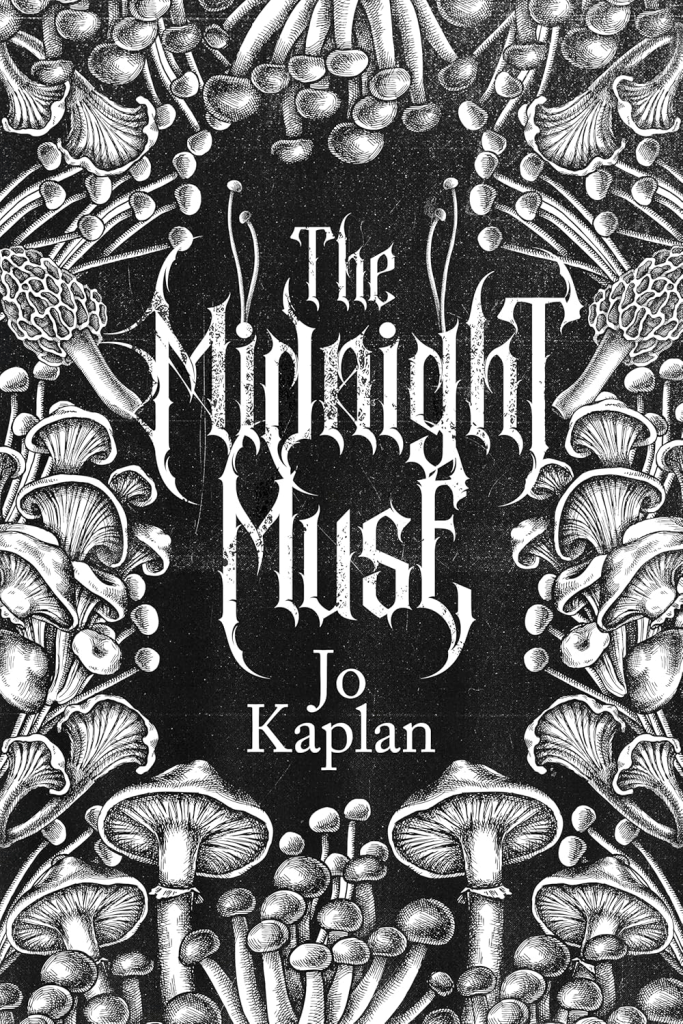
Midnight Muse by Jo Kaplan,
published March 10, 2026 by CLASH Books.
 The Blog Without a Face
Leave a comment