
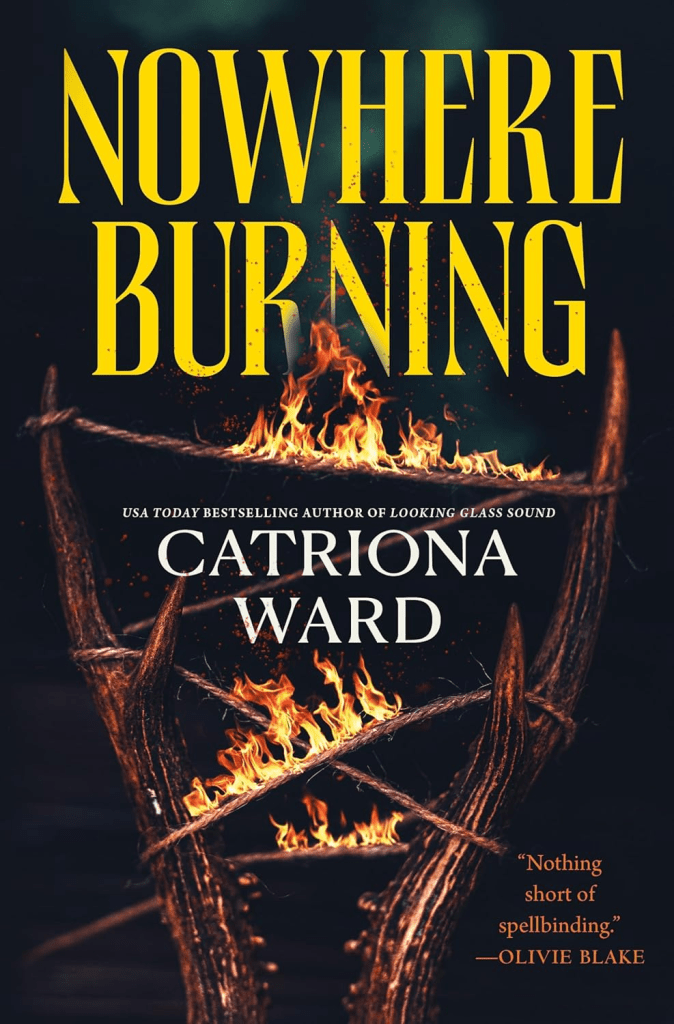





TL;DR: Catriona Ward’s Nowhere Burning is a ferocious, myth-soaked standout: part survival nightmare, part cult legend, part true-crime appetite turned toxic. It’s tense, tender, and vicious in the same breath, with set pieces that hit hard and a setting that feels alive, hungry, and impossible to escape. A compulsive read that burns long after you finish.

The thing about Nowhere is that it doesn’t just want you to visit. It wants you to believe. It wants your attention like a warm mouth wants breath. This is standout-tier Catriona Ward: ambitious structure, ugly tenderness, and a setting that feels like a myth somebody left too close to a forest fire.
Two abused siblings (Riley and Oliver) run from a brutal guardian and follow a strange map toward Nowhere, a hidden valley in the Rockies linked to a burned estate once owned by movie star Leaf Winham, while a parallel thread follows a documentary crew tugging at the legend of “the Nowhere children,” a runaway cult myth that may be true, may be copycat, or may be something worse. Those threads don’t just alternate for fun, but collide in a way that makes the book feel like it’s building a bonfire out of story itself.
This is a two-engine novel, and Ward is really damn good at running both at once. Engine one is survival: Riley is a ferocious teenage caretaker, smart enough to lie with her whole body, angry enough to keep moving, and exhausted enough to make choices that feel like realism, not genre convenience. The early sections with Cousin are brutally effective because they’re mundane. It’s deprivation, rules, punishment, that dead-eyed “I’m helping you” cruelty that makes kids learn to live like mice. When Noon appears at the window offering directions to “Nowhere,” it reads like an urban legend walking into a locked house. Riley’s decision to go is not “adventure,” it’s triage. And Ward makes the wilderness trek feel physical with altitude, hunger, cold, fear, the constant math of how long a kid can keep going.
Engine two is mythmaking: the documentary thread, with Marc and Kimble, is where Ward gets to do her favorite move, which is asking how a story becomes a parasite. The Nowhere myth has movie-star gravity, cult rumor, and the kind of true-crime hunger that makes people treat human suffering like a series to binge. The book keeps tightening the vice: are the “Nowhere children” real victims, real predators, or a story the town tells itself so it can keep living next to a crime scene without going insane? Ward’s answer is: yes. Also, the mountains don’t give a shit what you call it.
Riley’s sections are close and intimate, with a sharp, defensive humor that feels like a weapon she made herself. Marc and Kimble’s sections have a cooler observational distance, and Linus’s sections give you the big mythic backstory pulse, like a campfire tale told by someone still tasting smoke. The reliability is strategically wobbly, but not in a cheap “gotcha twist” way. It’s more that everyone is walking around with trauma goggles on, and Nowhere actively encourages that. The tonal consistency holds even when the book shifts modes, which is not easy when you’re juggling child abuse realism, wilderness survival, and cult folklore.
The chapters are built to keep you moving, but Ward also understands when to linger on the dread instead of sprinting past it. You get a steady drip of reveals about Leaf Winham, the fire, the gate, and what “blood in the land” actually means in practice. The middle tightens. The book’s big set pieces hit like hammer blows: the initial flight, the mountain encounter that turns horrifying in a second, the first real sight of Nowhere’s valley, the gates with their ugly trophies, the burned house squatting like a charred spider in the trees, and the rituals that make you realize this place is not a safe haven so much as a beautiful trap.
Riley is a classic Ward protagonist: intelligent, damaged, stubborn, and deeply loving in a way that hurts to watch. Her relationship with Oliver is the emotional spine, and it’s not sentimental. It’s desperate. It’s messy. It’s the kind of sibling bond forged by being the only witnesses to each other’s lives. Noon, Cal, and the other Nowhere kids are written with a mix of tenderness and menace that feels honest: these are kids building a society out of scraps, and scraps cut. They can be generous, and they can be ruthless. They can be sincere, and they can be indoctrinated. And the adults around the Nowhere myth are not “villains” so much as a chorus of complicity, fear, and opportunism.
Ward writes the Rockies like they’re alive and mildly offended by human plans. The sensory detail is thick: smoke, lilac, damp earth, blood-metal tang, the high clean light that makes everything feel too real. The object motifs are memorable and specific: the directions on paper, the locket, the Ferris wheel carcass, the gate, the little gestures of “worship,” the weird ecology of food and hunger and debt. Nowhere itself feels like a story wearing geography as a costume. It’s a valley that behaves like a mind.
The horror of the book is a mix of blunt violence and slow dread. Ward shows enough to make you flinch, but she’s better at what happens after: the psychological aftermath, the way a decision stays in your body, the way a community builds rituals to survive what it can’t process. The documentary thread especially nails the ugliness of “investigation as appetite,” where chasing a story becomes a moral rot. There’s a moment when you can feel the characters realizing they may be feeding the thing they’re trying to expose, and it’s deliciously grim.
Catriona Ward’s career has been defined by structural boldness and narrative misdirection that’s rooted in character trauma. The Bram Stoker Awards site notes her breakout with The Last House on Needless Street, including major award recognition and shortlistings that reflect how often her work crosses horror, suspense, and literary modes. In other words: Ward is in her lane here, but the lane is a mountain road in fog and she’s still driving like a maniac.
Under the scares, this is about childhood as captivity, and about stories as both rescue and infection. It’s about the way kids build belief systems to survive adults, the way towns build legends to avoid responsibility, and the way an audience builds monsters by refusing to stop watching. It’s also about “home” as a hungry word. Everyone in this book is trying to get home, and Nowhere offers a version of home that comes with conditions, rituals, and a price tag paid in flesh.
The intensity is monolithic, and the mythic machinery is so strong that occasionally you can feel the novel steering the symbolism into place. It’s not sloppy. It’s purposeful. But it sometimes reads more like a sustained incantation than a perfectly modulated engine. That’s a trade I’m happy to make, because the book is doing something ambitious and it actually sticks the landing emotionally.
If you want a straight thriller with clean answers and a neat villain, this will feel too haunted, too layered, too interested in how belief warps reality. But if you like survival horror braided with cult myth and true-crime appetite, and you want a book that can be tender and vicious in the same chapter, Nowhere Burning is absolutely a standout.

Read if you want a page-turner that still gets under the skin and stays there like smoke.
Skip if you prefer your horror quiet and minimal instead of intense and myth-heavy.
Nowhere Burning by Catriona Ward,
published February 24, 2026 by Tor Nightfire.
 The Blog Without a Face
Leave a comment