
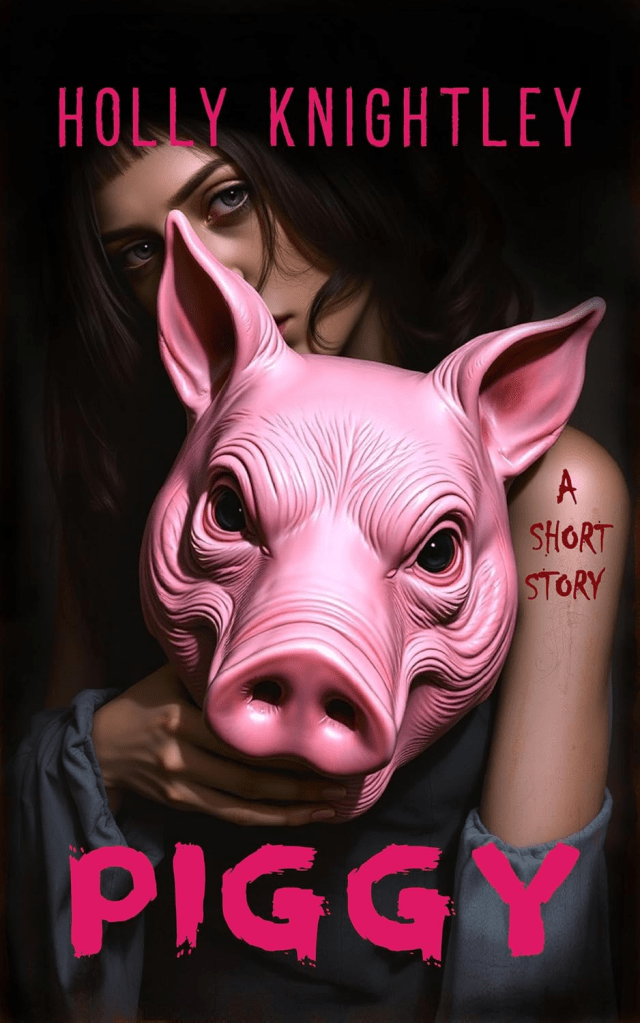





TL;DR: A fast, pulpy “nursery rhyme but make it stalking” short that sets up a fun hook, then overexplains its way into a twisty domestic blowout. When it leans into the pig-and-wolf motif and small-town paranoia, it’s tasty as hell. When it tries to be clever, it starts stepping on rakes and making you watch.

Holly Knightley is a New Jersey–based author who writes supernatural suspense and psychological horror with a strong “dark humor in the middle of the dread” streak, often centering character flaws and moral gray zones rather than spotless heroes. She’s outspoken about Edgar Allan Poe as a primary influence, describing herself as a Poe fanatic who has read his complete works multiple times and participates in a monthly Poe book club (“Poe Unplugged”). She frames her work as character-driven, interested in people’s flaws and the messy push-pull of right vs. wrong, and she likes to salt the dread with dark humor that can still make you grin while everything goes to shit. Piggy absolutely commits to that “flaws up front” approach, because our narrator, Alley Faye, lives by routine and narrates with blunt, anxious specificity about being autistic and needing her days to click into place. That part is genuinely the book’s best engine. The story keeps asking: what happens when the universe starts fucking with your rituals on purpose?
Alley and her cop fiancé Blake walk the same loop at Batsto Village every day. Alley is pregnant with twins, the wedding is close, and her ex Billy still lingers around the park in his food-truck orbit. Then Alley finds a defaced five-dollar bill with a piggish warning that frames greed like an invitation. After a death in their small circle, similar pig-and-wolf messages keep showing up, and what starts as “some asshole kid prank” curdles into “someone is watching our schedule.”
I dig the commitment to the fairy-tale scaffolding. The repeated “HERE PIGGY, PIGGY, PIGGY” menace is goofy in concept, but it works because it keeps landing in mundane places, like money on the ground and sympathy cards, which makes it feel intimate and invasive. I also liked the way the story uses Alley’s routine as both comfort and trap. The park loop, the familiar faces, the predictable walk home, all of it becomes a map for a stalker. That’s a clean horror idea. Same with the pig “cop” insult angle when the targeting starts to look like it’s aimed at Blake specifically.
But the craft is where this one slides into “average.” The prose is readable and moves, and the first-person voice has a chatty, confessional rhythm that fits a quick thriller. It also leans hard on telling you what to feel, then telling you again, then underlining it in all caps like it’s trying to win a bar argument. The dialogue can get sitcom-snappy (sometimes fun), but it also turns into long explanatory speeches right when tension should be tightening. There are moments where characters behave like they’re auditioning for a twist, not like people. And the autism portrayal, while heartfelt, sometimes gets used as a convenient plot lever: Alley’s “quirks” are both her identity and a narrative excuse to delay, misread, or hyper-connect dots whenever the story needs it. That’s a tricky line, and Piggy wobbles on it.
The back half goes full melodrama-thriller, and I mean that with mixed affection. There’s a wedding-night escalation, family secrets, a knife, and a lot of shouting in a kitchen while motivations get dumped like a suitcase. It is not boring, but it is messy. The story wants paranoia, abuse-of-power ugliness, and “love makes you complicit” all at once. It kind of lands those themes, but it does it with a blunt instrument. When a late clue shows up literally written out like a reminder, it’s a creepy beat, but it also feels like the author poking you in the ribs going, “GET IT? GET IT??”
Thematically, the strongest thread is control, who has it, who loses it, and who gets hurt when it slips. “Greed” is the big word, but it’s not just money-greed, it’s possession-greed: wanting a person, wanting a life, wanting the world to behave. The aftertaste is uneasy in a good way: the sense that safety can be a story you tell yourself until it becomes your whole damn house.
This feels like a quick-hit suspense short built to be devoured in one sitting, closer to popcorn dread than a standout. Of course, this is the first installation of Knightley’s Knightmare Hour series. It’s got a couple sticky images and one genuinely uncomfortable emotional premise, but it doesn’t refine them enough to be memorable beyond the last page’s punch.
A solid “kept me turning pages” premise with some fun pig-wolf nastiness, but the execution is clunky, the character work is broad, and the big swings land with a splat instead of a bite.
Read if you want a bite-sized thriller with fairy-tale framing and escalating “someone’s watching me” dread.
Skip if you want nuanced mental health and disability writing instead of genre-utility shorthand.
Piggy by Holly Knightley,
published February 15, 2026.
 The Blog Without a Face
Leave a comment