
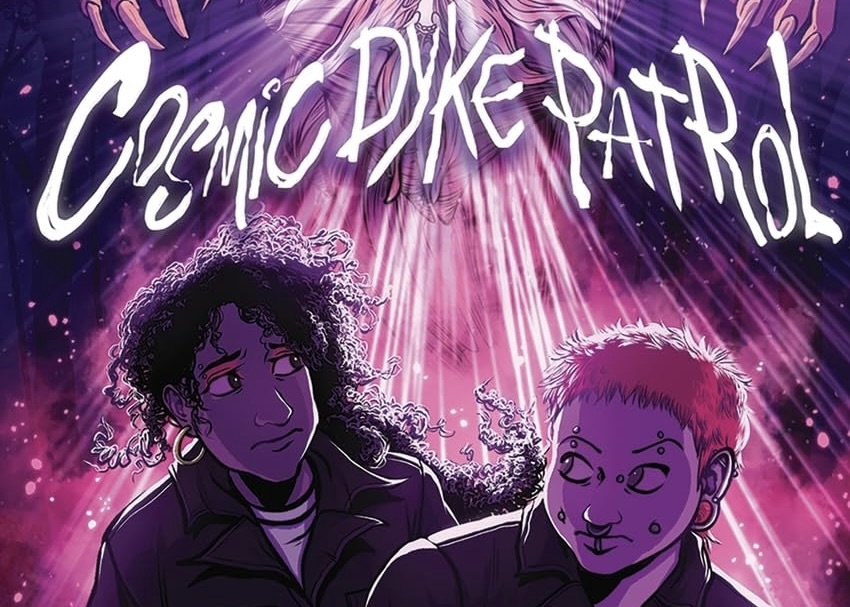
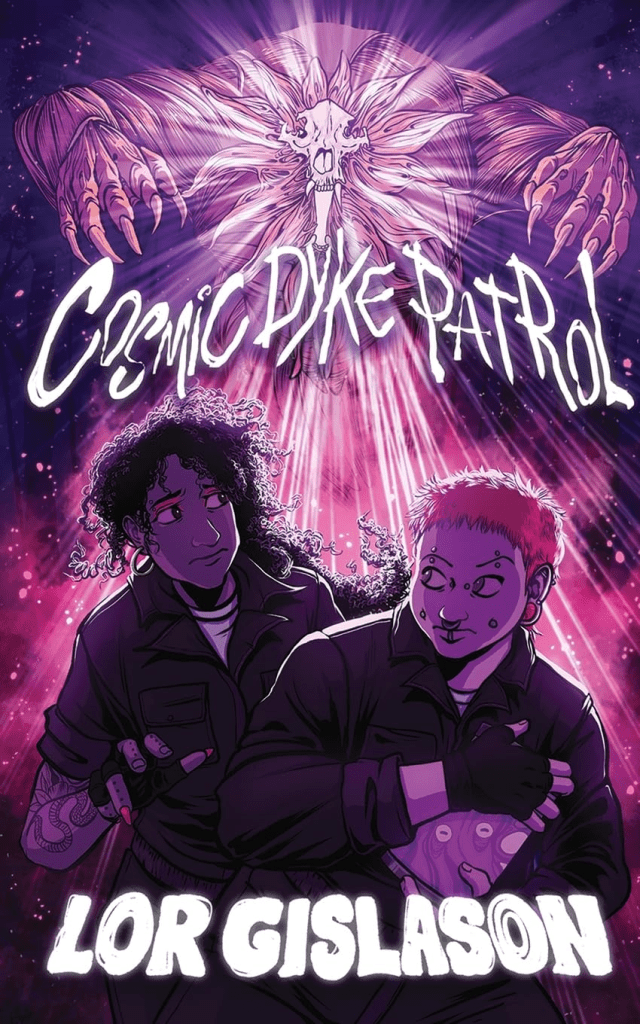




TL;DR: Queer, horny, heartfelt, and absolutely soaked in goo, Cosmic Dyke Patrol is the rare “romantic body-horror action adventure” that actually delivers: feral host-and-creature symbiosis, brutal set pieces, and cosmic pests that don’t play nice. It sticks the landing with found-family tenderness without sterilizing the weird or sanding off the gore.

Lor Gislason (they/he) is a non-binary writer who’s been very explicit, across interviews and their own site, about centering body horror and writing from a neurodivergent perspective, with a taste for “goopy” transformation that is not just gross-out but identity-adjacent. Their earlier work includes the novella Inside Out and editorial work like Bound in Flesh: An Anthology of Trans Body Horror, which positions them squarely in the modern queer body-horror lane where embodiment is both weapon and theme. Interviews with the Horror Writers Association and Deep Cuts underline the same through-line: a commitment to bodily transgression, a fondness for cosmic dread, and a pragmatic, craft-forward approach to making extreme imagery emotionally meaningful. That background shows up here as confidence with viscera and an insistence that intimacy and horror can share the same page without cancelling each other out. If you’re looking for why this book feels so comfortable being horny, heartfelt, and disgusting in the same breath, the answer is: this author has been building toward exactly this blend.
This book opens like your life is already on fire and the landlord is asking for rent anyway. Harriett is face-down in the dirt, leg absolutely trashed, staring up at a swirling storm and a flayed-skull Bear Thing trying to chew through an occult barrier while her partner Mars is unconscious nearby. She looks at the situation, takes inventory, and offers the only scientific conclusion available: “This fucking sucks.” It’s a perfect mission statement for a novel that is, in equal parts, romantic, horny, gross, and weirdly tender about the people who keep choosing each other in the middle of cosmic garbage.

The premise, once the book rewinds and starts laying track, is delightfully direct. Stevie has a house problem, except the “rats in the walls” era escalates into floating orbs, strange activity, and green mush creeping out from under the washer. Their mom Kathy dismisses them with the kind of disdain that could sandblast paint. So Stevie calls a service that sounds fake as hell and turns out to be real: Out Of This World Pest Control, run by two punky, queer women in battered coveralls who do not blink at the phrase “portal in your basement.” Haz (Harriett) and Mars (Marcy) show up with gear, ritual know-how, and the weary confidence of people who have seen the universe do grosser things than your laundry room.
The book’s biggest win is that it actually delivers what it promises on the tin. “Romantic body horror action adventure” is not jacket-copy spice here. The creature mechanics are feral, specific, and consistently used as story fuel. Kezi, the entity that becomes central, is not a vague “mysterious presence.” It’s a living, communicating being with needs, humor, and an unnerving kind of innocence that makes the gross parts feel even grosser, because you keep being reminded there is a personhood in the slime. The symbiosis angle is where the goop becomes emotionally legible: healing that feels like assimilation, intimacy that is literal invasion, identity bleed that reads as both gift and risk. When the book goes for it, it fucking goes for it.
Structurally, it’s multi-POV. You get close third-person sections anchored in Stevie’s anxiety and guarded hope, Haz’s competence-with-cracks, and Mars’s layered mix of swagger, exhaustion, and responsibility. Then Kezi’s voice enters as its own flavor, with a linguistic cadence that makes you feel the translation process happening in real time. It’s an effective way to make “alien” feel less like tentacles and more like cognition. The POV rotation also helps the romance land, because the attraction between Haz and Mars is not just told to you; it’s reinforced by how each of them watches the other under stress, how banter turns into caretaking, and how the physicality of the job keeps forcing them into moments that are half adrenaline, half devotion.

The book sets a hook with that Sunday-night disaster and then earns its way back there through escalating encounters, each one nudging the stakes up without feeling like a videogame level select. Scene selection stays practical: investigations, circles, containment attempts, fights, aftermath, regrouping, then back into the mess. If there’s a soft spot, it’s that the “charming found family” register is genuinely charming, which means the narrative sometimes chooses warmth in moments where a colder book would twist the knife. That is also, to be fair, the point. This is not misery tourism. It wants the tenderness.
The horror is satisfyingly physical. A lot of modern “creature” books either go full fog-machine vibes or full splatter with no rhythm. This one has rhythm. It builds dread by making the rules feel concrete, then showing you the cost of those rules in motion. When things attack, the action reads as spatially clear. When things heal, it’s not clean magic; it’s biology-adjacent, messy, and a little violating even when it’s saving someone. The “eldritch” element isn’t just a word slapped on a monster, either. The dimension-hopping concept is treated like a weird ecology. Something slips through, it tries to survive, it adapts, it feeds, it changes the environment, and then the environment fights back.
Underneath the gore and flirtation, the book is really about chosen family as an active practice. Stevie is someone who has been trained, by Kathy and by history, to expect dismissal, and the plot keeps testing whether they can accept care without bracing for the bill. Haz and Mars are professionals, sure, but the story keeps peeling back the way “helping” becomes personal when you keep showing up. Kezi, oddly, becomes the book’s clearest embodiment of that theme: a being who survives through connection, who learns love through exchange, who makes the line between “monster” and “member of the household” feel uncomfortably thin.

If you want a ruthless gut-punch that leaves everyone spiritually flayed, this is not that book. It’s too invested in charm, in recovery, in the small domestic beats that make the big cosmic beats matter. But if you want queer romantic body horror that is unashamedly horny and unashamedly heartfelt while still getting truly nasty with its creature logic and set pieces, Cosmic Dyke Patrol is a fucking good time. It’s the rare “action adventure” horror that doesn’t turn the horror into seasoning. The goo stays on the plate, the feelings stay in the body, and the ending manages to be soft without pretending the universe is.

Read if you want queer romantic body horror that’s actually body horror: symbiosis, healing-as-invasion, identity bleed, and goo that earns its screen time.
Skip if you prefer slow-burn atmospheric dread over kinetic fights and escalating weird encounters.
Cosmic Dyke Patrol by Lor Gislason,
published February 10, 2026 by Ghoulish Books.

 The Blog Without a Face
Leave a comment