



TL;DR: Free for All is sleek, corporate-bright dystopian horror where sanctioned combat gets packaged as feel-good civic ritual, and the real monster is the system’s calm, smiling efficiency. It lands, mainly because Horvath’s clean staging, broadcast-style pacing, and sterile palette make every hit feel like a product demo for violence, perfect for readers who like satirical, procedural dread more than gore-first chaos.

Patrick Horvath’s visual language in Free for All is basically a dare: bright, clean color fields and calmly outlined faces that look like they were designed to sell you vitamins, and then a hard cut to sanctioned cruelty presented as entertainment you can casually snack on. The line is crisp, the palette is often soft-to-sterile, and the whole thing has this quietly sick “everything is functioning as intended” vibe. It is not splatterpunk chaos. It is the horror of a well-lit system that knows exactly what it is doing and calls it community.
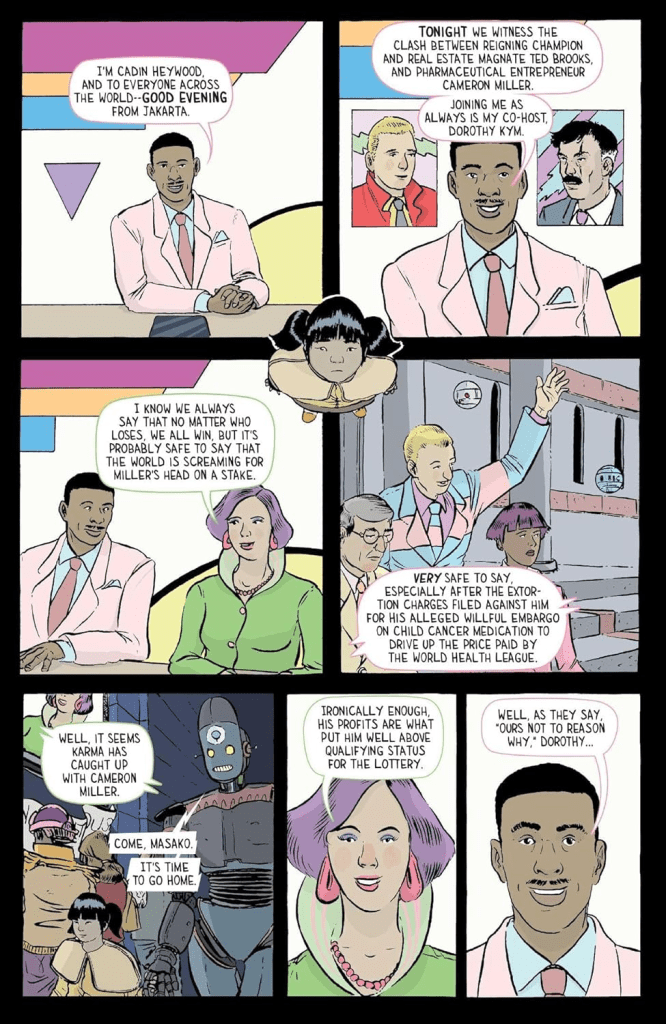
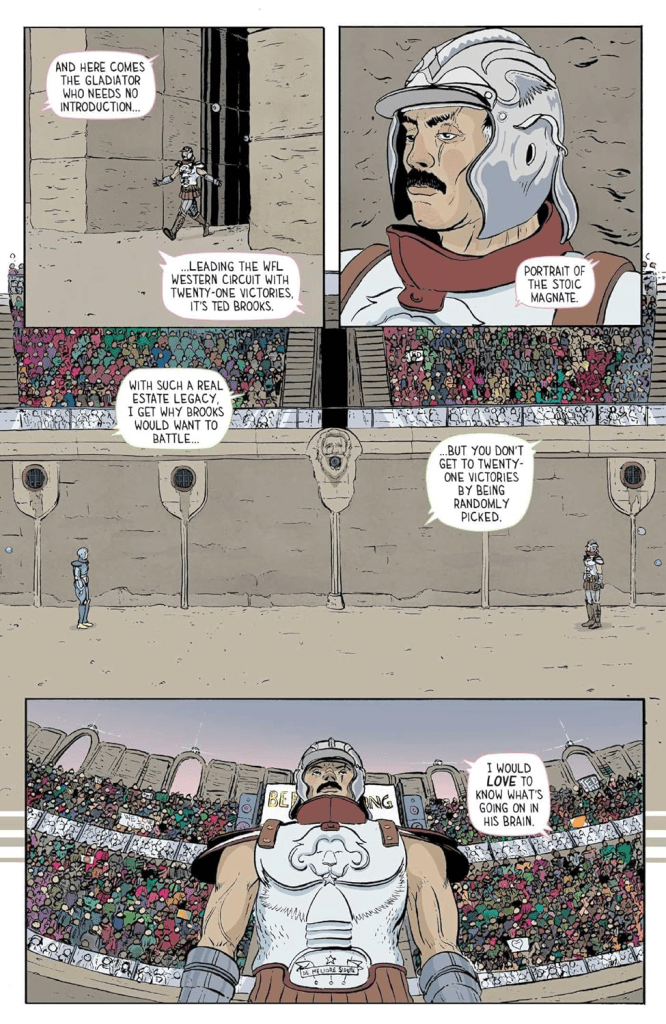
This is a world with a wildly popular, televised combat spectacle called “Free for All,” where a reigning champion faces an opponent selected through a lottery-like mechanism, and the culture around it is ravenous. The opening frames it as global entertainment, complete with hosts and crowd commentary, and the story quickly starts widening into the machinery around the fights: money, reputation laundering, and the strange emotional economy of a society that chants for dismemberment like it’s karaoke. The champion Ted Brooks is treated like a stoic institution, while other characters are pulled into the orbit of the arena whether they want it or not.
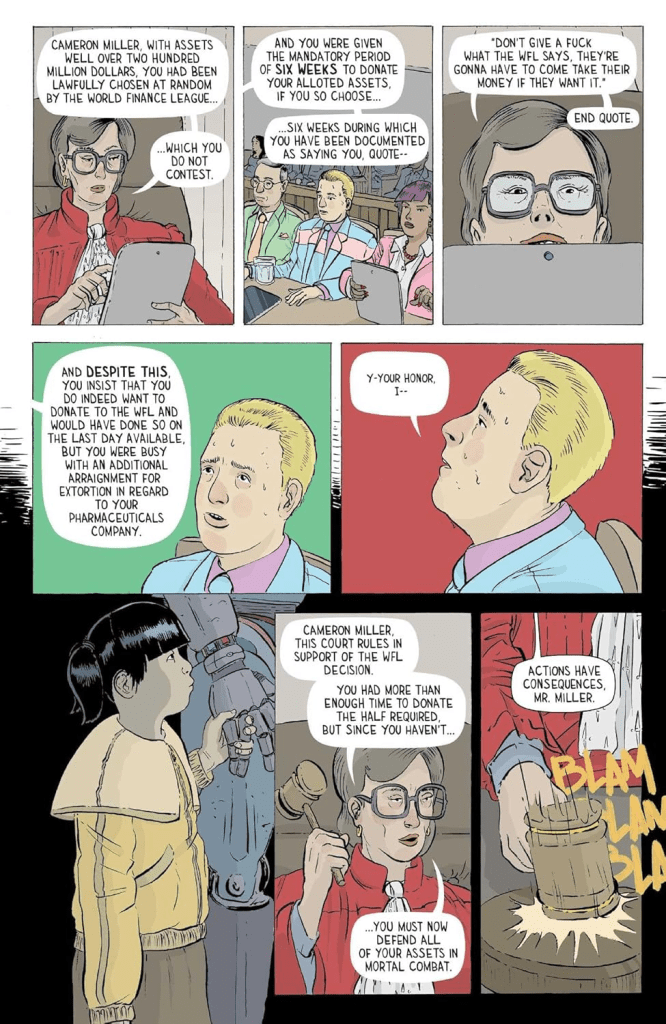
Horvath is very good at paneling that behaves like broadcast rhythm without feeling like you’re reading a fake TV script. Early pages bounce between tidy “talking head” boxes, crowd reactions, and big establishing shots of the arena that let you feel the scale of the spectacle. Then, when he wants tension, he starts weaponizing the page turn. A siren call, a pause, a drop. A rule explained, then a reveal of what that rule actually means in practice. There’s a particular nastiness in how the book compresses and decompresses time: a moment that should be huge gets flattened into a couple of blunt panels, while the waiting, the anticipation, the audience’s appetite, gets stretched just enough to make you feel complicit for leaning in.
Readability and staging are a real strength. Even when the arena is full of bodies, signage, and noise, you always know where you are and what the fighters are doing. Horvath’s figures carry emotion through posture more than melodramatic facial contortions. Ted’s “portrait of the stoic magnate” face reads as a practiced mask. Other characters, when they’re alone or caught off-guard, look softer, smaller, or just plain tired in a way that sticks. Spatial coherence holds in action beats too. When someone runs, you feel the distance. When something drops into play, you understand the geometry and the risk. It is clean storytelling, which makes the moral grime stand out harder.
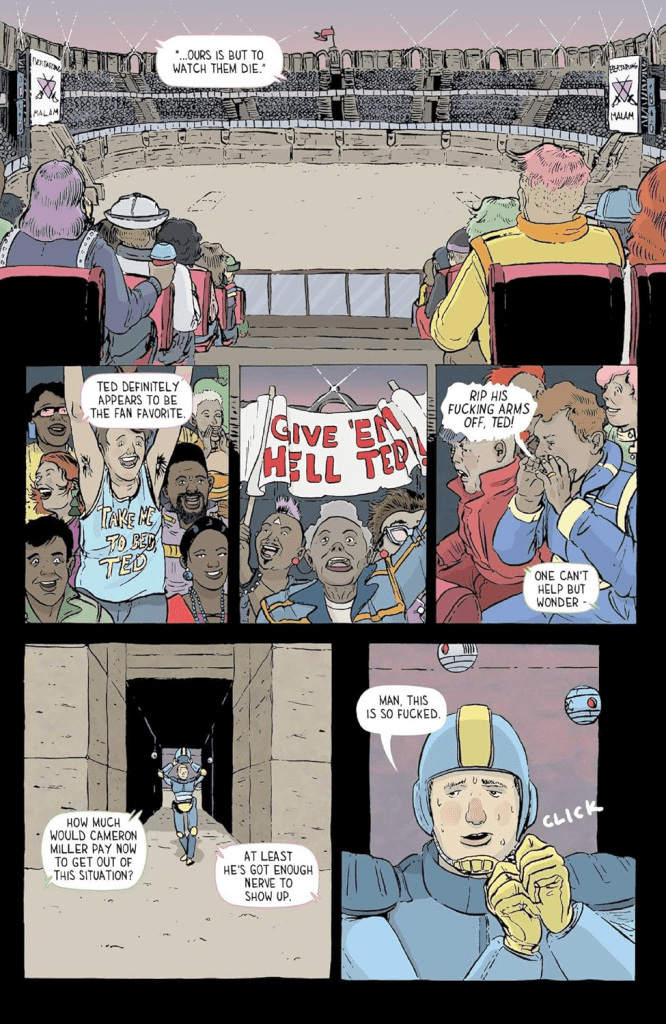
Lettering and sound design do a lot of heavy lifting without becoming obnoxious. Balloon density is generally controlled, and when the crowd gets loud, the book lets that loudness become part of the visual architecture. Big, blunt SFX like the extended siren call, the amplified announcer voice, and the smaller tactile noises (a “click,” a mechanical “fwoosh”) create a layered soundscape that feels both comic-booky and unsettlingly procedural. Dialogue “sounds” like a world that has normalized atrocity. Even the banter has that polished, public-facing cadence, like everyone learned how to speak in press releases and chants.
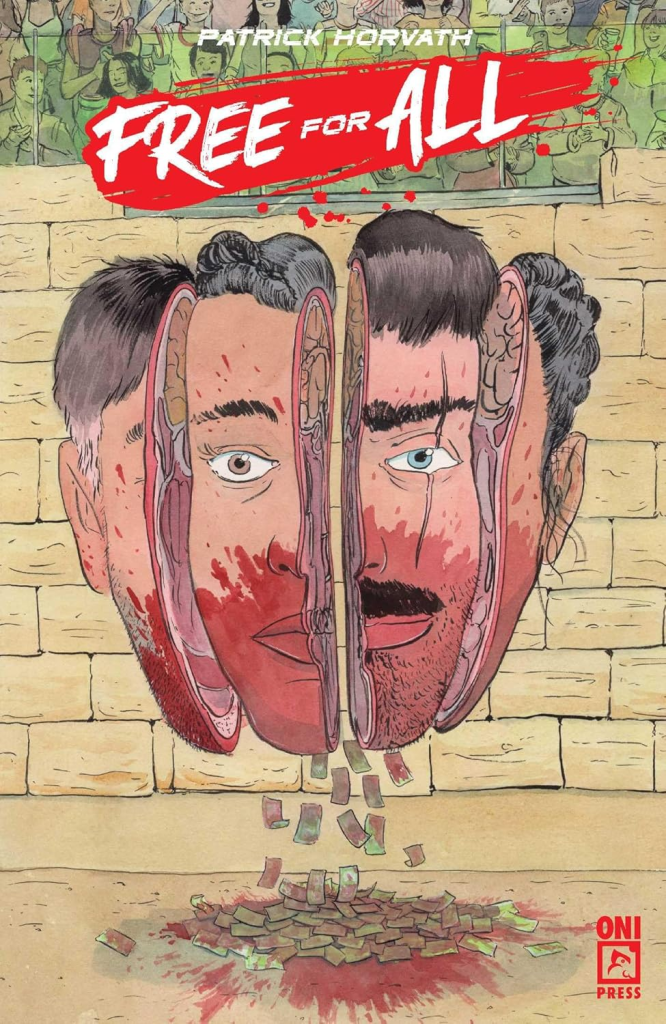
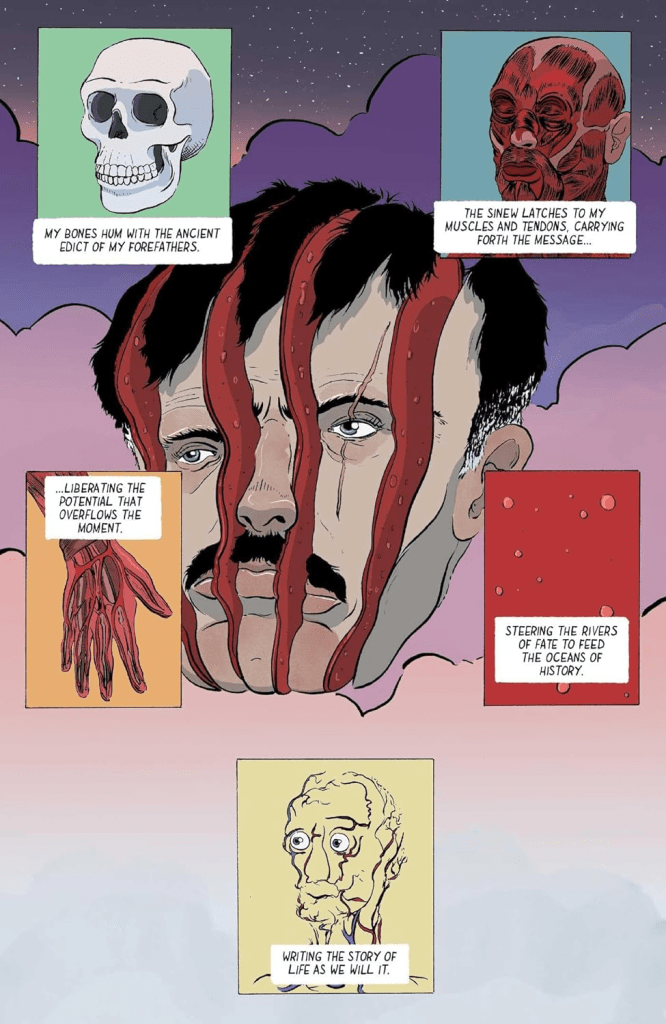
Color and ink choices are doing something sly. A lot of the book lives in pastels and muted tones that evoke corporate interiors, broadcast graphics, and the weirdly comforting aesthetics of consumer tech. Then Horvath drops in stark negative space when it matters, like isolating figures against deep black to make a confrontation feel like it’s happening in a void, not a stadium. There are also these jarring, symbolic insertions, anatomical imagery and stark icons that interrupt the literal surface of the narrative. They function like intrusive thoughts made visible, which is exactly the right formal move for a story about violence being packaged as meaning. Texture is used sparingly, so when you get something like blood-like splatter in the margins of the book’s framing materials, it reads as a stain on the presentation, not just “cool gore.”
The dread mechanics are mostly social and procedural, and that’s why it works. The book is constantly reminding you that the fight is not an accident. It is scheduled, commentated, monetized, and cheered. Tension comes from rules you can hear clicking into place. The siren that delivers “weapons” is funny in a bleak way, because it turns brutality into a game show, and the crowd reacts exactly like they’re watching someone open a mystery box. Cross-cutting away from the arena into quieter, controlled spaces is another pressure tool. When a character is told, with calm efficiency, that their next week is now defined by being selected, the horror is the casualness of it. The world has systems for this. It has language for it. It has metrics for your emotions about it.
Violence is smartly calibrated. Horvath knows when to show impact and when to make you sit in the build-up instead. A lot of the nastiest feeling moments come from what’s implied by the crowd’s desire and the show’s framing, not just from anatomy on display. When the book does lean into the physicality, it tends to emphasize bodies as fragile objects inside armor and ritual, not as superhero meat that can take endless punishment. That choice keeps the stakes human, even when the culture around the arena is trying to turn bodies into content.
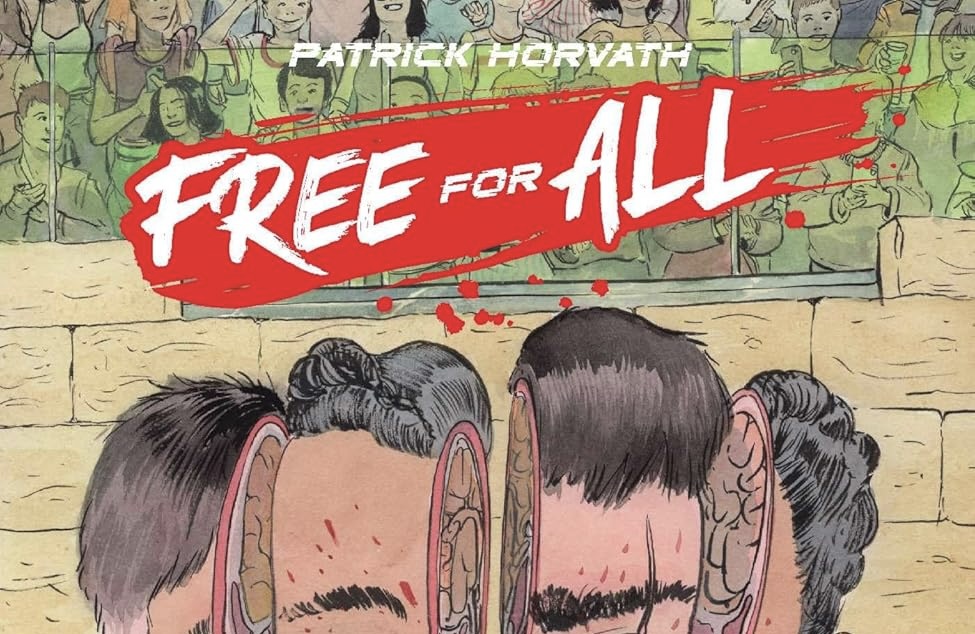
There are also a handful of images and tonal turns that stick like burrs without needing to spoil anything. The arena itself has this grotesque “monument” quality, including a carved, speaker-mouthed face that makes the announcements feel like they’re coming from the wall of the world. The recurring split-head, icon-and-anatomy imagery reads like a manifesto and a diagnosis at once. A sterile “meditation cycle” setup plays like self-care as sedation, a sleek little coffin for your feelings. And the crowd, god, the crowd, shown as a mosaic of expressions, signs, and tablet-lit reactions, becomes its own monster, smiling and screaming in the same breath.
Underneath the spectacle, Free for All is about righteous violence as a hobby and a moral escape hatch. It takes aim at the fantasy that brutality becomes pure if you tell yourself the target “deserves it,” and it pokes at how easily people outsource their conscience to a system that gives them permission. There’s a thread about power, money, and narrative control, too. Who gets framed as champion, who gets framed as villain, and how the story the public consumes is engineered so nobody has to feel responsible, only entertained.
Sometimes the book’s commentary is so cleanly articulated that it edges toward on-the-nose, especially when characters speak in the polished language of the world’s ideology. That can feel intentional, like part of the satire, but it occasionally flattens the messiness that would make certain emotional turns hit even harder. Also, if you’re allergic to stories where the “mechanism” is the main character, and you want deep, intimate interiority for everyone on the board, you might find the coldness a little distancing.
If you love dystopian horror that reads like a glossy brochure with blood under the laminate, this will absolutely be your shit. If you like combat staged with clear geography and real consequence, plus a moral argument baked into the formal choices, you’ll have a good time. If you want maximal gore and nonstop escalation, you may find Horvath more interested in the cultural rot than in topping himself with bigger splashes every page, and that is not a flaw, but it is a preference.

Read if you want dystopian horror that looks like a wellness brochure and feels like a moral paper cut that won’t stop bleeding.
Skip if you need big character interiority and messy emotional catharsis more than a cold, procedural nightmare.
Written and Illustrated by Patrick Horvath.
Published February 10, 2026 by Oni Press.
 The Blog Without a Face
Leave a comment