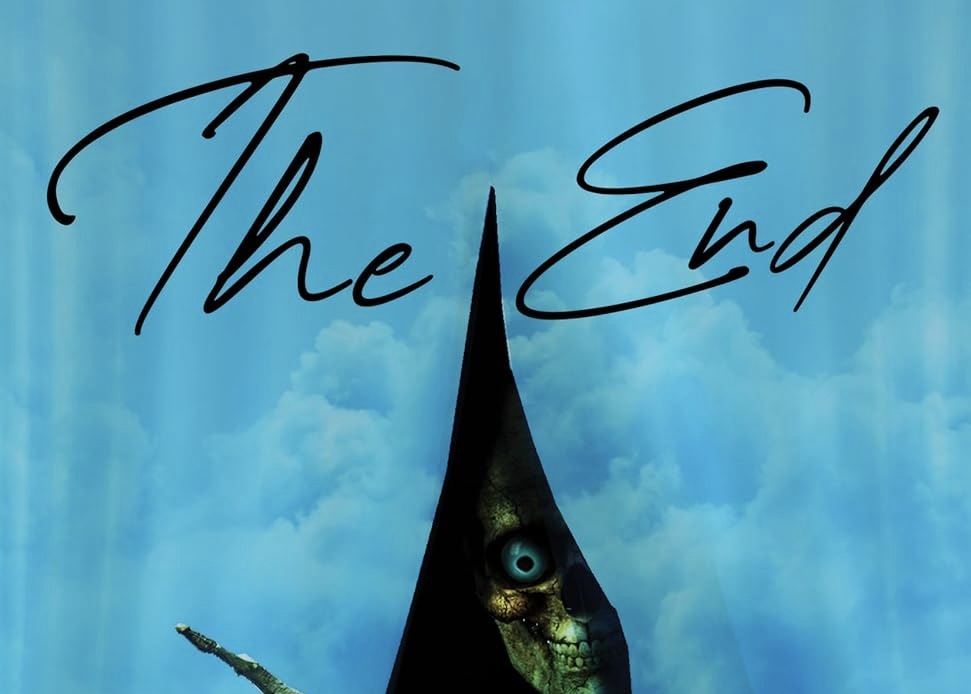




TL;DR: The End is a glitchy, grief-soaked techno-horror road trip where dead girlfriends, haunted books, and weirdos with philosophies collide in some legitimately beautiful ways. It also chases its own tail too long, but if you can handle some bloat, this is a smart, ambitious, occasionally confusing mindfuck worth your time.

Cosco is an award-winning author and filmmaker who came up through the American Film Institute and cut his teeth in Hollywood before pivoting to prose, bringing with him a taste for psychologically intense, darkly satirical, impossible-to-ignore stories that live in the overlap of horror and speculative fiction. You can feel the film-school DNA all over this thing, from the cold open at the cabin to the way set pieces build like big-budget sequences.
Eli is a VR storyteller whose life implodes when his girlfriend Selene walks naked out onto a frozen lake at their “reset” cabin retreat and drowns beneath the ice, leaving him screaming on the shore with her body just out of reach. Grief curdles into obsession: with the immersive AI systems he builds, with Sal (a humanoid built from Selene’s work) and with The Material World, a cult novel whose copies start changing only for him, spitting out timecodes and strange illustrations that seem to know his life. Those encoded messages drag him into the orbit of Barrett, a doomsday philosopher, and Judith, a Holloway scholar, sending the group on a storm-lashed, plague-water-soaked pilgrimage through print shops, flooded cities, and apocalyptic signals toward something that might be God, code, or both.

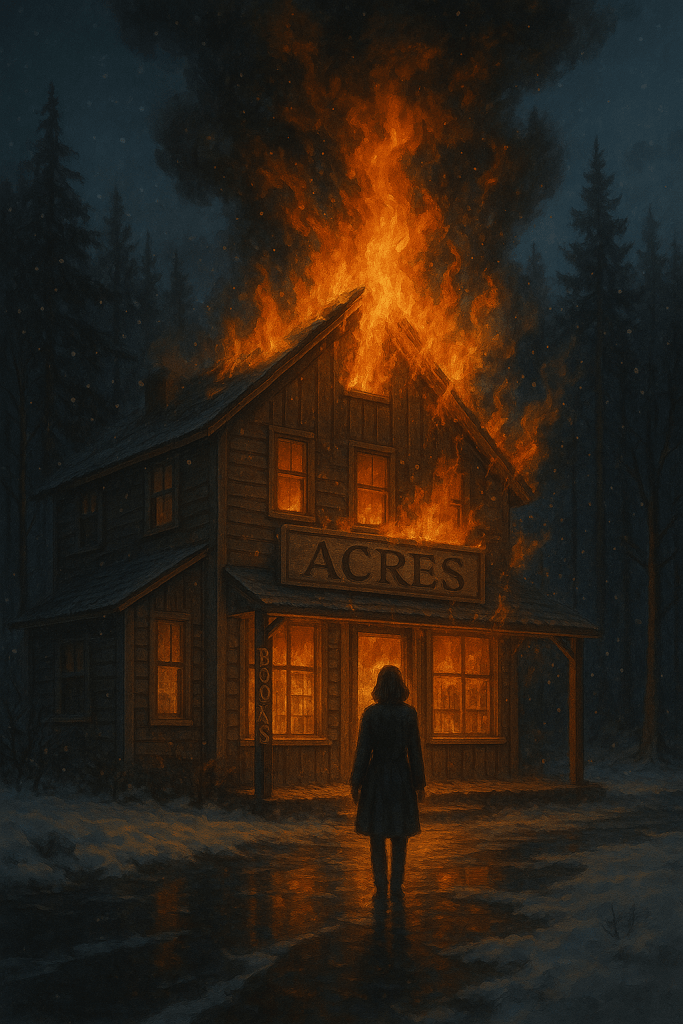
When this book hits, it fucking hits. The opening stretch at Emerald Lake is brutal and gorgeous, from the fox at the bench to the time-lapse camera quietly recording Selene’s silent walk onto the ice and her body hanging just below the surface like a porcelain doll preserved in black water. the-end Later, the novel keeps finding sharply specific images: Eli packing up Selene’s storage unit, carefully crating Sal’s dismantled body like a buried friend while a scarf that still smells like her finally cracks him open; the floor “going transparent” at dinner so he sees her corpse watching from beneath the boards; the print shop sequence where they dive through a flood of ink, loose pages swirling around them like dead fish made of language. The recurring device of The Material World physically changing – new timecodes, new drawings, the sense that the book is literally updating itself in the wild – is a very cool, very creepy riff on haunted media.
Cosco writes like a guy who has watched a lot of movies and then got possessed by his own Final Draft file. The prose is intensely visual, built around precise blocking and sensory beats: the hum of hospital fluorescents while Eli stares “through” the wall; the way VR environments dissolve into polygons when the headset lifts; storm scenes that feel like the Pacific Coast Highway is actively trying to murder them. Dialogue tends to be crisp and character-revealing, especially between Eli and Selene, who oscillate between tenderness and quiet emotional violence in ways that feel uncomfortably real. The downside is that the book is in love with its own vibe. Internal monologue loops. Big symbolic images sometimes show up three times too many. There are stretches where the narrative is essentially just Eli staring at a screen or a page while the text tells you how obliterated he feels. It is good writing, but it is a lot of writing, and occasionally the pacing just stalls out in a puddle of its own significance. For a 6/10, that is the core problem: the signal is strong, but the noise is loud.
The main theme here is grief as a language, not a puzzle. Late in the book Eli admits that grief is “a dialect of absence, of memory and ache, and only the broken can ever really learn how to read it,” which is the kind of line that would be insufferable if the novel hadn’t spent hundreds of pages earning it. The horror engine is built around the urge to decode everything: code, stories, synchronicities, altered books, VR ghosts. Eli, Selene, Judith, and Barrett keep chasing patterns that promise meaning and instead drag them through hell. There is also a quieter, more intimate thread about father-hunger and identity: Selene secretly modeling Sal on the face of the long-absent dad she only knows from a single photograph, then compulsively reading to see if some anonymous writer out there is actually him talking to her. the-end That shit lingers. The aftertaste is a mix of melancholy and awe, like finishing a really good cult movie at 2 a.m. and wondering if you just saw something profound or if you are just tired and sad.
In the current wave of AI and techno-horror, The End sits in the lane where emotional horror meets speculative metaphysics. It is less splattery than your usual “rogue AI kills us all” story and more interested in how people use machines, stories, and patterns to cope with loss and cosmic indifference. Cosco is clearly swinging for something big and sacred here, and even when the book gets self-indulgent, it feels like a sincere attempt to weld VR dread, cult-lit mystery, and intimate relationship drama into one sprawling narrative.

This is an ambitious, sometimes stunning novel that occasionally disappears up its own ass, but if you are down for a grief-soaked, glitchy, the-universe-is-talking-to-me ride, it is absolutely worth wading through the extra pages of beautiful, existential shit.
Read if you love media-about-media stuff in the House of Leaves, Annihilation, Black Mirror vein, with a side of apocalyptic weird religion.
Skip if you require your cosmic horror to either go full monster movie or stay grounded. This hangs out in the ambiguous middle and will absolutely drive you nuts if that is not your thing.
The End by Adam Cosco,
published December 6, 2025.
 The Blog Without a Face
Leave a comment