
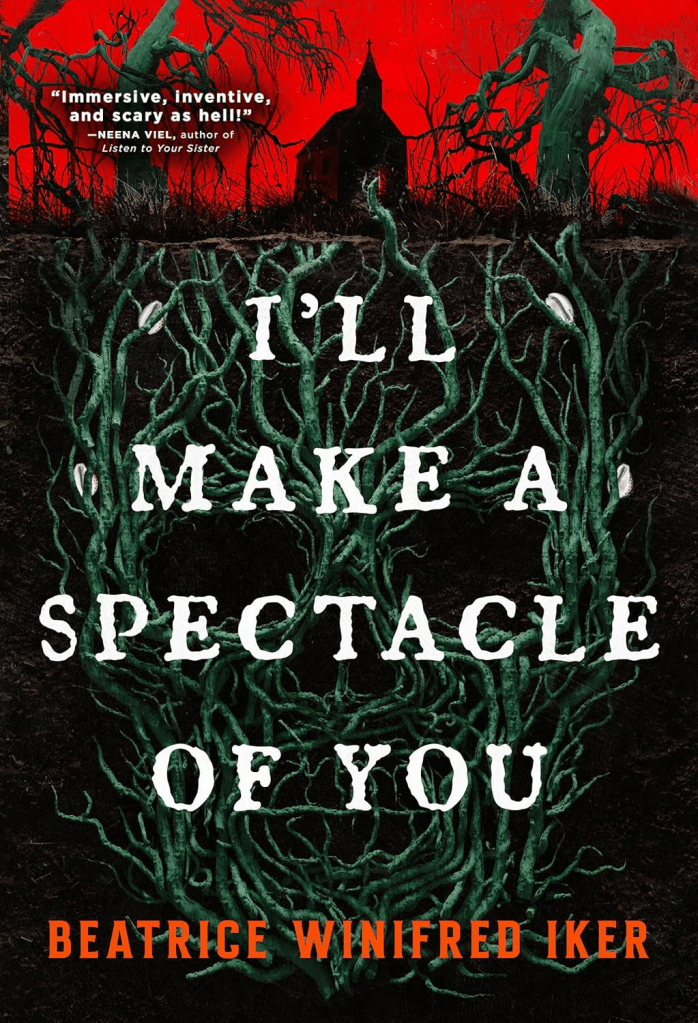


TL;DR: A Black Appalachian dark-academia folk horror about the bloody cost of “safety” for a historically Black college. The conjure, campus drama, and demon-in-the-woods stuff absolutely hit, even if the middle third sags and some reveals land with more info-dump than gut punch. Good, not a new gospel.

Beatrice Winifred Iker comes into this one with serious genre bona fides. They are a southern Appalachian writer and tarot reader, a cohost of the Afronauts podcast that highlights Black speculative fiction, and a Voodoonauts fellow and Ignyte/Rhysling finalist; this debut basically smashes all of that into one big haunted thesis project. You can feel the comfort with both horror and Black SFF community spaces on every page. I’ll Make a Spectacle of You is very much a “hello, here’s my whole deal” book, and when it works, it feels like watching a new voice kick the doors in.
At the center is Zora Robinson, a queer archivist and budding historian who grew up marinating in East Tennessee Black history and Hoodoo. She lands at Bricksbury Mountain College, the country’s first HBCU tucked in the Appalachian hills, to write a thesis on the spiritual history of “Affrilachia.” The normal breaks when Zora starts having visions tied to an old disappearance, stumbles into a secret society of “Keepers,” and learns that Bricksbury’s legendary safety is powered by a literal demon guardian known as the Beast that lives out in the Woodlands and demands regular sacrifice. The stakes are brutally clear: the Beast is coming due again, Zora’s estranged sister Jasmine is on the chopping block, and Zora has to decide whether to expose the truth, break the pact, or throw herself on the altar to save the people she loves.
Iker binds three things that do not always share space nicely: Black church life, backwoods conjure, and campus prestige politics. The dual timeline with Amias Crawfoot, the nineteenth-century cofounder who begged God for protection and got a demon instead, gives the book a theological spine. His sections, with the fox sacrifices and the horror creeping in through Bible verses and footnotes, are quiet and deeply fucked up in ways that feel historically grounded instead of edgy for its own sake. On the other side you have Zora’s present-day Bricksbury, full of big nerd energy, messy grad-student crushes, and Conjure Nights in the woods. The campus feels lived-in and specific, not just “I changed the serial numbers on Yale.” When the book is firing, it nails that sweet spot where the history is legitimately fascinating and then you turn a corner and oh shit, someone is very literally getting eaten by the consequences of that history.

The writing leans lush and sensory, heavy on humidity, roots, and the weird weight of old churches and courthouse squares. Iker likes long sentences that spool out like kudzu and then snap shut on an image. The alternating POVs between Zora and Amias mostly work; Amias’s voice has this stiff, almost sermon-like quality that sells his piety and his self-delusion, while Zora’s chapters are more conversational and salty. Dialog among the grad-student crew feels contemporary without trying too hard; there are a few quippy lines that sound like Twitter, but for the most part it reads like actual anxious twenty-somethings trying to be brilliant while barely holding their shit together. Where the craft stumbles is pacing. The first third is a slow, deliberate burn that I liked, but the middle gets bogged down in repeated research scenes and lore exposition, and the final act leans on explaining the cosmology instead of just letting the horror barrel forward. You can feel the book trying to keep every thread in play and losing a bit of momentum while it juggles.
Underneath the demon foxes and secret rituals, this is a book about the cost of protection, especially for Black communities in violently racist landscapes. Bricksbury’s whole deal is safety: safe education, safe campus, safe little bubble away from the shitstorm of the outside world. The horror is the reveal that this safety is literally paid for with Black bodies, chosen through a logic that echoes both Christian sacrificial language and the ugliest parts of American history. Zora’s arc wrestles hard with the question: is a cursed sanctuary better than no sanctuary at all, and who gets to decide that? The final stretch, with Zora’s letter and her choice to take Jasmine’s place, lands more in bittersweet tragedy than cheer-for-the-monster catharsis. It leaves an aftertaste that is equal parts grief and stubborn hope, like the book is asking whether you’d bleed for your people and side-eyeing the institutions that assume your answer is automatically yes.
Spectacle sits in that growing niche of Black folk horror and dark academia that includes stuff like campus-set reckonings with racist histories and haunted HBCUs, but it feels more rooted in Appalachian specificity than most of its peers. It is not, for me, a top-tier banger of the year, yet it is absolutely a statement debut that will have people watching whatever Iker does next.
A good, ambitious, often gripping folk-academic horror that swings big at the cost of safety and mostly lands, even if the structure and pacing keep it from being truly spectacular.

Read if you want Black Appalachian folk horror that actually knows the history instead of just slapping kudzu on the cover.
Skip if you bounce off lore-heavy worldbuilding and multi-page explanations of who sacrificed what to which entity.
I’ll Make a Spectacle of You by Beatrice Winifred Iker,
published November 18, 2025 by Run For It.

 The Blog Without a Face
Leave a comment