

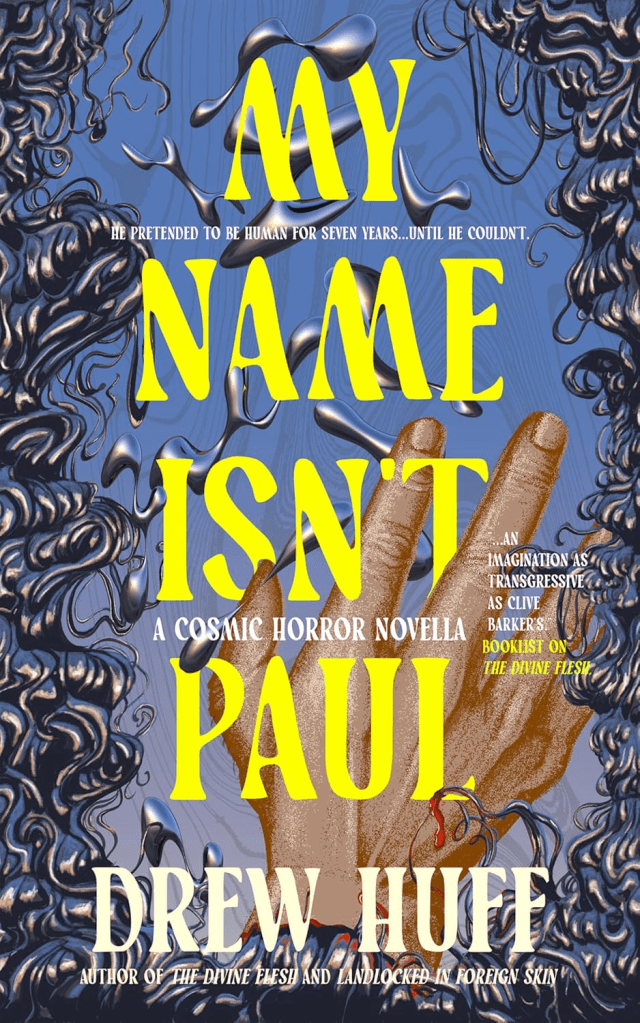





TL;DR: A filthy-smart cosmic horror novella about a Mirror Person trying to be human while his species’ heat cycle says absolutely not. Gritty voice, tight pacing, and themes of identity, relapse, and weaponized empathy. Ties neatly into The Divine Flesh’s shared world without feeling like homework. Read it.

Drew Huff has been quietly climbing the indie horror food chain by serving hot plates of body horror with a side of heartbreak. If you read The Divine Flesh earlier this year, you know the deal: fearless, freaky, and emotionally flammable fiction about addiction, identity, and the meat we drag around while trying not to implode. The new one, My Name Isn’t Paul, is a cosmic horror novella that proves Huff isn’t a one-hit splatter. They’re building a connected world and, more importantly, a signature voice that makes you feel gross and seen at the same time.
Paul Cattaneo is not Paul Cattaneo. He’s a Mirror Person wearing Paul like a rental tux. Mirror People are silvery wasp-things made of empathy filaments who live in human skins, pick up emotions like radio stations, and every seven-to-ten years go into murderous heat. Paul has been trying to be good. The clock says otherwise. What follows is a grit-under-the-nails cosmic horror spiral through blue-collar America, found family of fellow not-humans, and the kind of choices that taste like ash. It’s intimate, fast, and more about the sick ache of identity than about tentacles yanking you into the sky.

Huff is doing a shared-universe thing without turning it into a Marvel bag of quips. The Divine Flesh follows Jennifer, host to a flesh-bending goddess who does miracles with a serial-killer’s art supplies. That book already brushed the Mirror People and their chrome-egg reproduction economy, plus the small-town powder keg where meth, grief, and monsters share a cul-de-sac. My Name Isn’t Paul rotates the camera and says: forget the demigoddess, let’s live inside the bug-soul that wants to be a person. You can feel the same geography, the same outlaw ecosystem, and the same moral hazards linking the books in chewy, upsetting ways that reward readers who’ve read both. It’s one world, two horrors: ecstatic meat and empathetic parasites. Deliciously foul.
This thing is a blender set to liquefy: blue-collar cosmic horror, grief therapy, and a meditation on names. Paul’s denial of his real bug-name is the whole point. Names are masks, and masks are survival gear. The Mirror People’s empathy filaments are a nasty-clever symbol for codependence: they literally pump feelings into you until you smile. Found family is both salvation and trap. Heat is addiction dressed in chitin. And that skinsuit shtick isn’t just a gross visual. It’s the immigrant problem, the closet problem, the working-class problem, the “I didn’t choose this body or this town or this goddamn history” problem, all Frankensteined into a pulp engine. Huff’s style is viciously readable: slangy, funny, and mean in that protective way people get when they grew up on cigarettes and disappointment. They spike their poetry with grease and cussing, then stick the lyricism straight into the vein.
- Originality: Mirror People aren’t your grandpa’s Lovecraftian calamari. They’re empathic predators whose deadliest weapon is forced good vibes. That’s both fresh and psychologically nasty. Also, framing cosmic horror around union-jacket reality and family reunions at a memorial for a man the larvae ate from the inside is one hell of a flex. Fresh as hell.
- Pacing: Tight. Chapters snap. Scenes slam. You never sit in exposition soup. The book knows it’s a novella and fights at its weight class. There’s forward pressure from page one and a steady ramp of dread toward the inevitable meltdown when heat hits. This is highway horror with your check-engine light blinking.
- Character development: Paul is a walking contradiction you root for even when he’s lying to himself like a champ. John O’Malley is the friend you love who makes you complicit. The sibling cluster Axa/Nolix/Vox are equal parts cult and family, which… yeah, that’s family. Huff sketches them in grease pencil and you still feel the warmth of their breath when they close in.
- Scare factor: The book crawls. Think existential panic that smells like old beer and hot radiator fluid. The grotesque is there, but the scariest moments are emotional chokeholds: forced happiness, hunger you can’t ethically feed, and the certainty that the worst thing about you is coming back in seven-to-ten years with teeth. Content warnings are numerous and well sign-posted for a reason.
My Name Isn’t Paul asks whether changing your shape counts as changing your self. Paul has convinced himself that gratitude and performance equal identity. He’s wrong, but not in a smug-author way. Huff lets him wrestle, lets him lose, and still gives him tenderness. The Mirror People’s heat cycle reads like the relapse cycle in recovery: you can white-knuckle it, you can plan, but if you don’t connect with people who actually get it, the beast wins. The novella’s nastiest insight is that community is both cure and contagion. You need the swarm to survive, but the swarm needs you to surrender. The choice keeps rotting in your pocket like a peach you forgot you were carrying. Also, the ethics of “pick a dying meat-parent to minimize harm” is grim, pragmatic horror at its best. The Divine Flesh had ecstasy and annihilation, a god whispering I love you while remaking your bones. Paul’s book has shame and denial, a family saying just be happy while your skin crawls. They are the same problem from two ends of hell’s hallway.

Huff’s dialogue slaps like a screen door in a windstorm. The set pieces look simple on the surface, then you realize they’re doing three jobs at once: worldbuilding, character torque, and thematic shivving. The opening pages slam you with the Lincoln, the wasp spray, and the red-blue lights while Paul clicks the cap like a rosary he’s too pissed to pray. That’s economical and mean and I love it. The prose has texture: metal, spit, cheap beer, gravel, a lot of cigarettes. If you like your cosmic with cornbread, here’s dinner.
No real gripes. More like a heads-up: if you crave lore dumps and star-maps of the Mirror People’s original dimension, tough luck. Huff writes like a bar fight. You get the story, not a wiki. Personally I prefer that, but completists might twitch.
Huff’s doing something special. The Divine Flesh cracked the sky with blasphemous tenderness. My Name Isn’t Paul crawls out of the ditch, spits blood, and asks if love counts when you’re not the person wearing your face. It’s brutal, fast, and sincerely fucked up in service of something honest. Read it, you cowards.

Recommended for: Readers who like their cosmic horror served with Marlboros, meat-sweats, and tender emotional devastation. Fans of weird biology, found families that might eat you, and blue-collar apocalypse vibes.
Not recommended for: Folks who think empathy can’t be creepy, who need their monsters to have tentacles and Latin names, or anyone allergic to profanity, parasites, and the idea that happiness can be a weapon.
My Name Isn’t Paul by Drew Huff, published November 18, 2025



 The Blog Without a Face
Leave a comment