

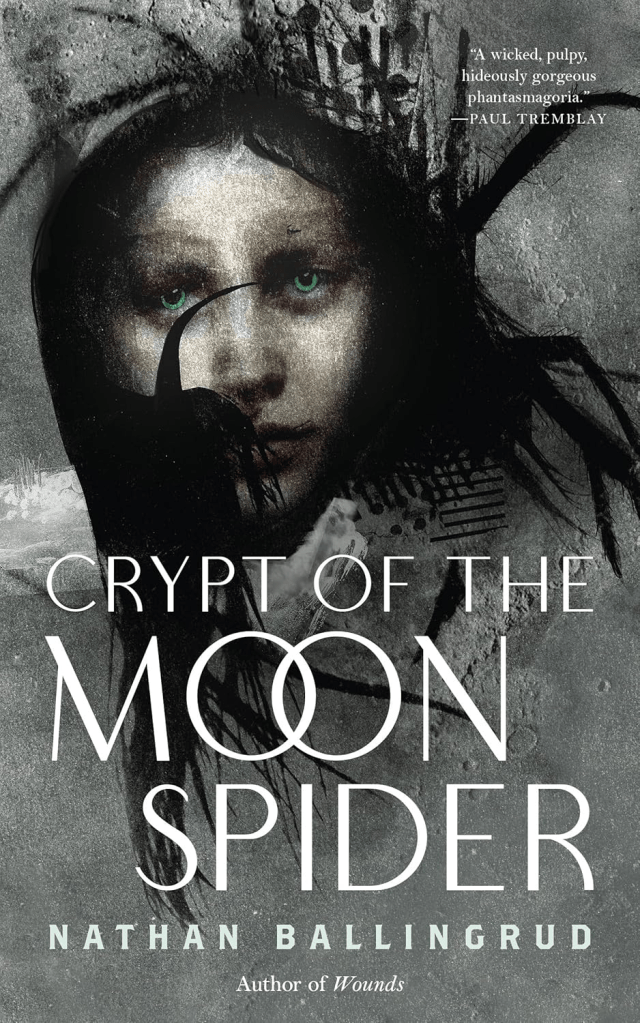








TL;DR: Ballingrud straps Gothic asylum horror to a rocket and crash-lands it in a web-choked lunar forest. It’s furious, tender, and nasty in all the right ways. Great characters, nasty procedures, and a thesis about power carving its initials into your skull. I loved it, the moon hated it.

Pulled this sucker off the shelf from last year because it’s the first installation of Nathan Ballingrud‘s Lunar Gothic Trilogy. The second, Cathedral of the Drowned, was just released with our review HERE. Ballingrud is one of the modern weird’s ringers. He wrote the stone-cold classic collection North American Lake Monsters, which became Hulu’s anthology series Monsterland. He also wrote The Visible Filth, adapted into the film Wounds, and the dust-red retro SF novel The Strange, a Locus Award finalist. He’s a two-time Shirley Jackson Award winner with a trophy shelf that makes most horror writers sigh into their coffee. In other words, he’s got range, he’s got chops, and he’s dangerous in the best way.
Set in an alt-history 1920s where people commute to the moon like it’s Omaha with lower gravity, Crypt of the Moon Spider follows Veronica Brinkley, a woman consigned by her coiffed ghoul of a husband to the Barrowfield Home for Treatment of the Melancholy. Barrowfield sits on the moon’s dark side, ringed by web-draped forests and haunted by the legacy of the Alabaster Scholars, ascetic keepers of the late, possibly psychic Moon Spider. Veronica meets Dr. Barrington Cull, who promises to “scoop out what’s rotten” in the brain and “stitch something better into its place” using lunar spider silk. There are orderlies with meat-hook vibes, a Scholar named Soma who is much more than a set piece, and whispers of patients vanishing into the forest. What unfolds is a jailbreak from the cages of medicine, marriage, and memory, played out under a sky that feels like a skull with all the lights still on.
Ballingrud builds a Gothic asylum in low gravity and then loads it with live ammo: misogyny dressed as science, the medicalization of sadness, colonial plunder rewritten as miracle cure. Spider silk as neural conductor is a great pulp idea that he milks for dread and metaphor. When you lace a mind with webbing, who holds the threads? The book is obsessed with consent and control. Husbands sign forms. Doctors sign orders. Priests in alabaster robes sign your fate in a language you can’t read. The forest outside Barrowfield is all whispering silk and suggestion, a literal net cast over the wild, and a figurative one cast over the self.

The Moon Spider is dead, yet it animates everything, a god fossil driving a new religion of treatment. That’s a killer symbol for how old power structures rot but keep ruling us. The altar is the operating table. The sacrament is suture. And the prayer is whatever you can hum through sewn lips.
Ballingrud’s sentences flex. One moment they’re quiet, humane, and observant. Next moment they split your scalp with a glinting surgical hook. He toggles from hushed melancholy to full body horror with rude efficiency. You never feel safe. The worldbuilding is sly and frugal. Rather than dumping lore, he lets a throwaway detail do the heavy lifting. The result is an atmosphere that feels thick enough to wade through. The moon breathes. The halls sweat. The forest whispers. And yeah, when the surgical drape drops and you see brain and silk in the same frame, it’s gross in the way you secretly wanted.
Originality. Lunar-Gothic asylum horror with spider-silk neurosurgery and a death-cult of scientists is not your everyday casserole. You can spot lineages (a little Cronenberg body horror, a little cosmic-decadent Peake, a pinch of Ligotti’s corporate-occult) but the fusion is Ballingrud’s. The book takes the hoary “send the wife to the sanitarium” trope and shoots it into orbit, then lets it molt into something stranger.
Pacing. This is a novella that sprints like it stole something. Chapters have the clean, punchy rhythm of a pulp serial, but the scenes breathe. The center stretch, where Veronica cycles through treatment, blackout, and revelation, keeps ratcheting without feeling like a ride operator is jamming the lever. When the lights go out and the knives come out, the book hits that sweet spot between nightmare momentum and surgical clarity. You will be tempted to read it in one sitting, thankful you do not currently own a hand mirror.
Character work. Veronica rules. She starts coded as the “sad wife” archetype and keeps refusing to stay in the box. Her remembered childhood is tender and sinister in the exact proportion required to make the later violations land with a thud. Dr. Cull is a perfect monster of modernity, soft-spoken, visionary, the kind of man who calls cruelty a breakthrough and expects applause. Charlie “Grub” Duchamp is all bad vibes and inconvenient honesty. Bentley, the fellow patient, breaks your heart and then makes you brace for the worst. And Soma the Scholar floats at the edge of the frame like a holy rumor with blood on its sleeves.
Scare factor. It’s sick-scary. The most upsetting images aren’t the spiders; they’re the institutional rituals. A shaved head. A sheet lifted. A voice sewn shut. Horror here is procedural. Sign in. Lie still. Wake changed. The set pieces deliver, too (the blackout corridor attack is a vicious little aria) but what lingers is the book’s moral chill: the steely confidence of people who think they’re helping as they ruin you.

The novella is a case study in how power colonizes the intimate. A dead god gets repurposed as start-up tech. Male authority rebrands despair as defect. Religion swaps vestments with medicine. And the bodily self turns into territory, crossed by borders you didn’t consent to. Ballingrud is not subtle about this, thank the moon. The fury is baked into the architecture.
Yet he gives the book a melancholic hum, a weird broken lullaby running beneath the cruelty. The moon is lonely. The girl sings to it. The forest answers. Hope isn’t a cure here. It’s an insurgency. You might not get redemption. You might get a blade and ten feet of shadow. But sometimes that’s enough to make the next decision yours, not theirs.
The prose is lush without getting fat. Dialog is tight and mean. Worldbuilding lands in jagged little shards instead of encyclopedia slabs. Body horror sequences are precise rather than purple. If you want a novella that respect your time while wrecking your nerves, congrats, you found it.
A sharp, pulsing slice of Lunar Gothic that marries atmosphere, theme, and squirmy set pieces with unnerving confidence. It’s weird, bold, and beautifully written. Just cold, clean dread with teeth.
Crypt of the Moon Spider by Nathan Ballingrud, Published August 27, 2024 by Tor Nightfire.

Recommended for: Readers who like their medicine unethical, their forests whispering, and their brains with a tasteful garnish of spider silk. Fans of body horror with a literary spine and anyone who ever looked at the moon and thought, “That skull is judging me.”
Not recommended for: People who prefer their sanitariums earthbound, their spiders employed strictly in home décor, or their authors to promise a happy ending with a cup of cocoa. Also not for readers allergic to stitches. The book has… opinions about stitches.

 The Blog Without a Face
Leave a comment