
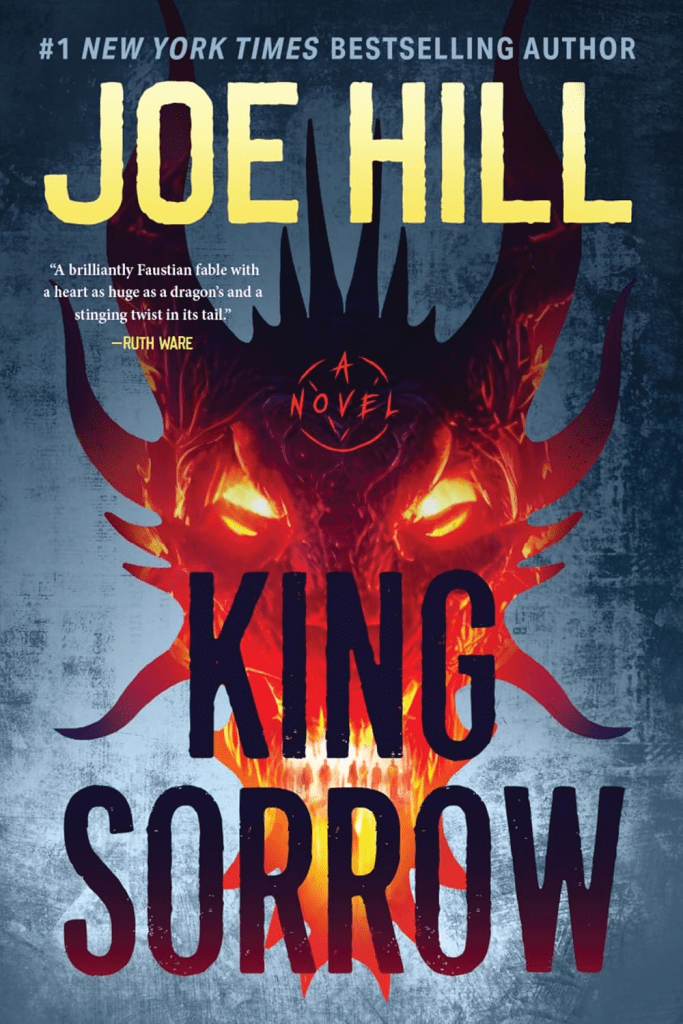
Joe Hill has been reliably wrecking sleep schedules for almost two decades with novels like Heart-Shaped Box, Horns, NOS4A2, and The Fireman, plus the wickedly inventive comic series Locke & Key. The calling card is consistent: big heart, bigger nightmare, and a knack for making the supernatural feel one bad decision away from your own front door. With King Sorrow he leans hard into obsession, class rot, and the malignant gravity of history. Then he grinds it all through a coming-of-age meat grinder.
Arthur Oakes is a literature nerd with a good soul and a mother in prison for an act of principled trespass that went fatally wrong. On a visit to the Black Cricket Women’s House of Correction, he crosses paths with the Nighswanders, a feral storm system of a family whose specialty is violence, extortion, and weaponized pettiness. They quickly put a shiv to the softest part of Arthur’s life, his mom, and coerce him into stealing rare books from his college’s special collection. That collection, by the way, includes a human-skin-bound witch-trial memoir, an ominous cabinet of curiosities, and other talismans humming with old, ugly energy. Meanwhile, Arthur’s orbit fills with sharply drawn friends: the sham-psychic McBride twins, statistics assassin Allie Shiner, inscrutable Gwen Underfoot, and rich-kid curator Colin Wren whose estate, The Briars, is basically a museum of cursed ideas. The mundane crime plot keeps tightening; the occult pressure keeps mounting; and Hill lets both fuse until the pages feel hot to the touch.

This thing is obsessed with ownership: of bodies, books, myths, and futures. Prisons (literal and social) sit everywhere: Erin Oakes behind bars; Arthur trapped by filial love; the Nighswanders caged by poverty and rage; students snared by prestige and legacy. Books are never just books. They’re relics, leverage, currency, and—crucially—containers for the dead. Anthropodermic binding is not a parlor trick here; it’s a thesis: when we glorify our artifacts without owning their violence, the violence leaks out. The Briars, with its butterflies pinned like jeweled cadavers and a player piano that feels like it could play you, not the other way around, doubles as a museum of weaponized memory. Hill keeps dropping references to Philip-style “invented ghosts” and government-grade mind games; the point isn’t whether a ghost is “real” but that belief plus ritual equals power. And power, in this book, is a parasite looking for a warm host.
Stylistically, Hill is in high form: tactile scene-work, dialogue that cracks like a pool cue, and horror imagery that isn’t loud until it suddenly is. He writes Maine with brine on the air and rust on the doorknobs; he writes cruelty with the petty detail that makes it sting; and he writes friendship with the unruly sweetness of a found family that should never, ever be left alone with a cursed cabinet.
The strongest horror makes you complicit. King Sorrow weaponizes empathy itself. Arthur’s a good kid; that’s the trap. The more he tries to protect his mother, the more the book asks what we’ll do for love—and what old powers will do once we start moving the ritual pieces around. The thefts are rituals. The ledgers and letters are grimoires. The prison bureaucracy is a cult with paperwork. And the worst part is how normal it all feels. Hill’s true monster is the systems we tolerate because they wear a badge, a crest, or a tasteful dust jacket.
There’s also a killer meditation on class cosplay. The campus “special collection,” the Wren estate’s curios, even the performative twin telepathy bit—each is a way to manufacture awe and gatekeep it. When violence finally blooms, it feels earned, like a debt with compound interest.

Originality: The collision of rare-book heist, campus novel, and creeping folk-occult is deliciously fresh. Hill’s done Americana dread before, but the bibliomancy angle gives this a new spine, not just haunted places but haunted provenance. When a museum label reads like a threat, I’m in.
Pacing: It’s a slow choke, not a roller coaster. Book One plants human stakes with surgical precision. Then the screws tighten: coercion scene by scene, artifact by artifact. The tempo ratchets in Book Two’s time-stamped sequences and never really lets your pulse return to baseline. It’s confident, patient, mean in the right ways.
Character work: Arthur is heartbreakingly legible: bookish, proud, naïve, morally ambitious. Erin Oakes, in minimal on-page time, radiates complicated grace. The Nighswanders are a symphony of weaponized grievance—funny until they’re terrifying. The friend group is a highlight: Donna and Van’s banter has real sibling funk; Allie’s stats-witch vibe is a blast; Gwen is the quiet blade you don’t see coming; Colin’s curated weirdness hints at a lineage of state-sanctioned spookery that feels too plausible for comfort. Even the side characters skid in with personality already bleeding through the edges.
Scare quotient: The horror here is cumulative and suffocating. You’re not jumping at shadows so much as realizing the room has fewer exits than you thought. A couple set-pieces hit like a bag over the head: weaponized Polaroids, the violation of archives, the sense that the “experiment” never ended and you’re the lab rat. The book also nails social dread, the scene-level humiliation and petty brutality that primes the pump for the supernatural to matter.
Prose quality: Clean blade, not baroque machete. Hill keeps the sentences tight and oxygenated, then sneaks up with a line that cracks your ribs. He’s generous with sensory specifics and stingy with exposition, my favorite combo.
Hell yes. It’s bold, atmospheric as a crypt, linguistically sharp, and thematically loaded. The occult isn’t a mascot; it’s a corrosive logic that eats through kindness, institutions, and the pretty lies of “heritage.”
TL;DR: A rare-book heist crashes into prison-industrial rot and curated occult history, and the result is a patient, ruthless horror novel about love, leverage, and the ghosts we manufacture on purpose. Vivid prose, scalpel-sharp characters, and dread that starts low and ends bone-deep.






Recommended for: Readers who sniff old books like contraband and want their campus novels with teeth; anyone who thinks provenance is a love language; fans of occult slow burns who enjoy watching empathy get used like a crowbar.
Not recommended for: People who think rare books should remain pristine and unthreatened; cozy-mystery enjoyers who prefer their crimes solved by cats; collectors who believe human-skin bindings are “quirky”; anyone with a strict no-Nighswander policy.
Published October 21, 2025 by William Morrow.
 The Blog Without a Face
Leave a comment