
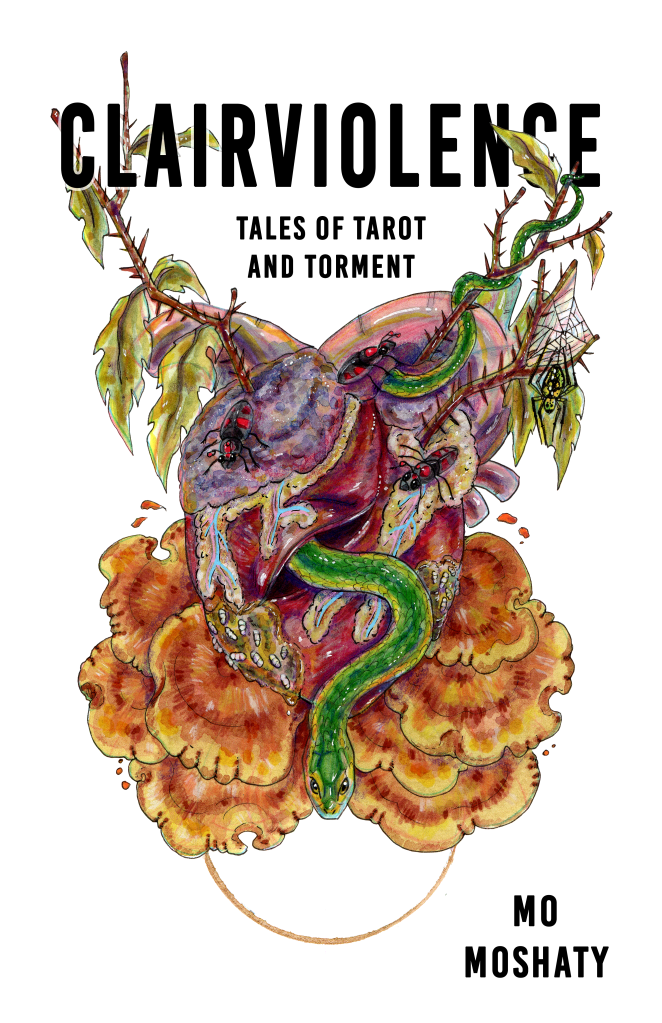
Mo Moshaty’s collection is a deck cut wide open. Each story keys off a Major Arcana card, then bleeds, burns, or writhes its way toward some hard emotional truth. It’s horror that cares about the body and what grief does to it. It’s also messy, horny, and mean in the best way.
Let’s start with the woman behind the nightmare. Mo Moshaty is an Afro-Latina horror writer, screenwriter, and producer who’s been carving out a bloody niche in the indie horror scene. Her background as a Cognitive Behavioral Therapist gives her a scalpel-sharp edge when dissecting trauma, which she wields like a pro in her work. She’s got street cred from lecturing at places like Prairie View A&M and the University of Sheffield, diving into horror’s psychological underbelly with symposiums on Jordan Peele, Yellowjackets, and women’s trauma in cinema. Her short stories have haunted anthologies like A Quaint and Curious Volume of Gothic Tales (Brigid’s Gate Press) and 206 Word Stories (Bag O’ Bones Press). Her debut novella, Love the Sinner (Brigid’s Gate Press, 2024), was a twisted little number, and now she’s running NightTide Magazine, championing marginalized voices in horror. Oh, and she’s a core member of Nyx Horror Collective, producing the 13 Minutes of Horror Film Fest with Shudder. This isn’t some newbie scribbling jump scares; Moshaty’s a force, and Clairviolence is her latest middle finger to bland, cookie-cutter horror.
Clairviolence is exactly what the title promises: clairvoyance with teeth. Each tale maps to a tarot trump:
- The Devil: “The Fever Man.” A couple’s stillbirth fractures reality as a shape made of heat, sickness, and hunger moves in. The twist doesn’t cheapen the grief; it refracts it like ice.
- The Hermit: “Magic Hour.” A home-invasion survivor barricades her life plank by plank until the world itself is a weapon. It’s a claustrophobic descent that ends in a terrible kind of peace.
- The Fool: “Surface.” A dock worker meets an oceanic entity with too many eyelids and an agenda. It’s grotesque, erotic, and oddly tender, like Cronenberg doing “The Little Mermaid” after three shots of NyQuil.
- High Priestess: “The Severity of Things.” A gerontology worker smells death, watches jaws unhinge, navigates a corporate “Compassionate Care” machine, and gets pulled into a darker economy of need.
Others swap in intimacy, collapse, and moral reckoning for jump scares. The table of contents reads like a spread on a velvet cloth; the stories feel like hands flipping those cards and saying: ok, now live with this.
This deck runs heavy on bodies and thresholds. Mouths gape. Teeth bloom like stalactites. Fever becomes a person that can stand in your doorway and bargain. The tarot isn’t just a gimmick. The Devil and Tower entries, in particular, trace classic meanings — bondage, revelation — while avoiding cosplay. The cards give the collection an organizing current without choking the stories into one aesthetic.
Moshaty’s prose toggles between lean and lush. She writes clean declaratives that jitter into mania when needed, then pulls back for surgical lines that land like a bruise. She is especially good at sensory nastiness that never feels cheap. Metallic breath. Static at the edge of vision. The click of a jaw going too far. She also lets humor in, not as a release valve but as salt in the wound. The result reads like bedside confessionals that occasionally get up, pace the room, and spit on the floor.
The book keeps returning to the same sick question: what will you give up to live with the thing you can’t fix. In “The Fever Man,” grief is a parasite but also a deal you keep making with yourself. “Magic Hour” deconstructs safety until it’s indistinguishable from self-harm. “Surface” flips reproductive terror on its head and asks whether consent is possible when a species is going extinct and the ocean itself smells like desire. The High Priestess piece pushes on caretaker ethics — who gets fed, who gets seen, who gets paid to pretend it’s “compassion.”
Threaded through is the tarot’s promise that patterns exist. A card is a story is a fate is a loop. People here are constantly reading signs — a smudge in the corner of the eye, a day’s particular color of dusk — and then deciding to honor or betray them. That’s where the violence comes from. Clair-violence.
Standouts. “The Fever Man” sings because it risks both readings at once: the supernatural is real and the mind is breaking. The end lands like a double exposure. “Magic Hour” nails the texture of post-trauma domestic life, right down to the wrong weight of blankets and the TV that feels like it’s looking back. “Surface” is the audacious banger — vivid, foul, strangely gentle — that many collections promise and few deliver. It’s the story that gets you to text a friend, “you are not ready for the tentacle scene.”
Soft spots. A couple mid-deck entries feel more like solid tarot riffs than fully lived-in lives. The conceit occasionally decorates rather than animates. There are moments of on-the-nose exposition where the ambiguity had already done the job. And while the collection’s emotional register is admirably raw, that very bluntness can sand down character specificity. You feel the archetype first, the person second.
Originality. High. The tarot frame has been done, but the way Moshaty binds bodily horror to domestic spaces and care labor feels distinctly her own. The ocean romance from hell is a genuine new flavor.
Pacing. Uneven by design. Some stories spool slowly and then plunge you through the floorboards. Others sprint into a set piece and dare you to catch up. The ratio mostly works, but two pieces could lose a page or three without losing power.
Characters. Not just meat puppets for set pieces. Even when they’re archetypal, they get interiority and bad decisions that make sense. The caretakers and the bereaved feel observed rather than harvested for misery.
Is it scary? It’s scary like a fever dream you half remember at noon. Less boo, more oh no. There are genuine gross-out images (mouths, knives, sacks from places sacks do not belong) but the lasting fright is existential. The book makes you feel watched by your own coping mechanisms.
This is strong work. A cohesive, gutsy collection with a pulse and a nasty streak, executed with enough control that the big swings don’t wobble off the table. A couple stories underwhelm relative to the killers, but the average is high and the aftertaste is potent. Well-crafted, with distinctiveness and impact. Something I’d recommend often, especially to readers who like their weird with a side of human ruin.
TL;DR: A tarot-themed horror collection that marries body horror to grief, care work, and the lies we tell ourselves to keep breathing. Big swings, sticky images, and a couple absolute rippers. A little uneven, a lot memorable. Strong recommendation for readers who enjoy weird, intimate brutality.







Recommended for: Tarot nerds who want their cards dipped in blood, indie horror freaks who crave prose that bites, and anyone who’s ever cried in therapy and wants to see that pain weaponized into art.
Not recommended for: You want blood, body horror, or tidy structure. Or if the word “trauma” makes your eyes roll into the back of your head.
Published October 21, 2025 by Tenebrous Press.


 The Blog Without a Face
Leave a comment