
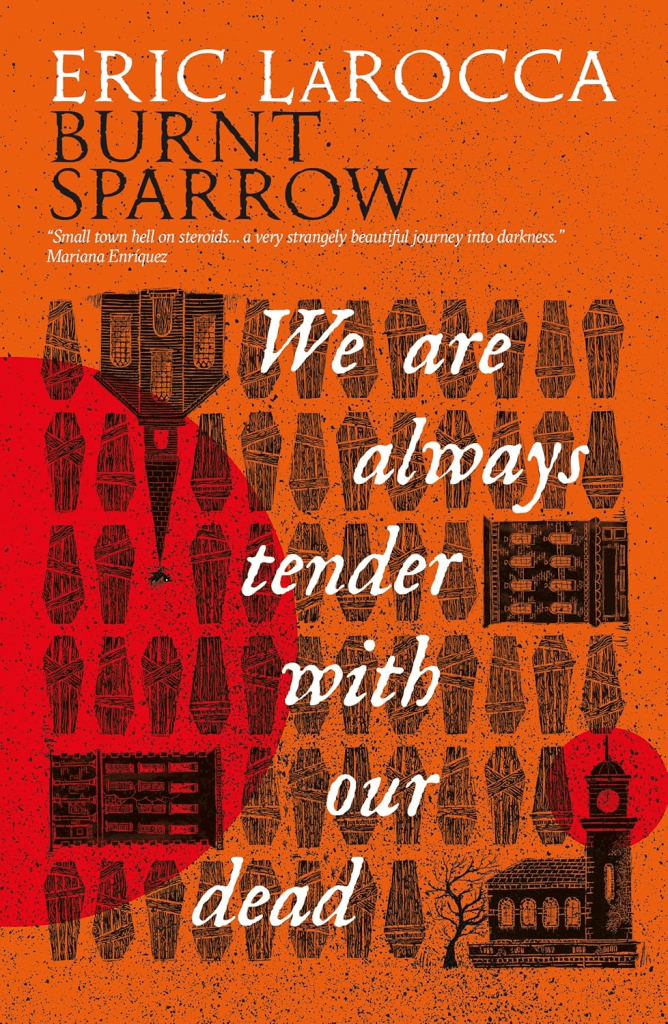
Eric LaRocca’s back, and he’s swinging his steel-toed prose like a drunk brawler at a funeral. We Are Always Tender With Our Dead, billed as Burnt Sparrow Book 1 , is wrapped in a velvet glove of dread. LaRocca’s intro is less a foreword and more a “fuck you, buckle up” warning label, bluntly stating there’s “nothing tasteful about incest, violence, and rape.” He’s not here to coddle or entertain. He’s here to shove you face-first into the muck and make you thank him for it. Consider this your invite to the shitshow, with a side of existential whiplash.
Eric LaRocca’s been carving his name in the transgressive horror scene like a serial killer with a branding iron. His bibliography reads like a haunted library of human wreckage: Things Have Gotten Worse Since We Last Spoke (a masterclass in epistolary depravity), Everything the Darkness Eats (cosmic horror with teeth), The Trees Grew Because I Bled There (body horror meets poetic despair), and At Dark, I Become Loathsome (self-loathing dialed to 11). He’s a New Englander with a knack for turning small-town Americana into a Bosch painting, blending visceral gore with a lyricism that makes you feel guilty for loving it. Early buzz calls Burnt Sparrow the start of a trilogy and a “bold new chapter” in his career. It’s blood splattered on silk, grotesque yet so goddamn elegant you’ll want to frame it.
It’s December 2003, and 17-year-old Rupert Cromwell gets yanked out of bed by his dad, who’s raving about a “backwards miracle.” The sulfur stink that’s been choking their podunk New England town, courtesy of a defunct paper mill, has vanished. Poof. Gone. But don’t pop the champagne; nature’s a bitch who hates a vacuum. Enter something nastier: a mass atrocity leaves Main Street looking like a slaughterhouse floor show. Rupert and his dad are roped in by creepy purple-suited elders as “Preservers,” tasked with guarding the corpses like they’re museum exhibits. Don’t touch, don’t move, just… preserve. In a town where the rot’s baked into the bones, you can guess how that goes. The story weaves news clippings (like a 2004 house fire with a creepy-ass “large bird” imprint), diaries, local lore, and Rupert’s POV into a cursed scrapbook of small-town damnation. It’s a hex.
LaRocca’s obsessed with thresholds, doorways, moral lines, the moment you realize you’re fucked and can’t un-realize it. The epigraph (“The threshold is the place to pause”) sets the tone, and then the book makes everyone freeze there until they fossilize. Rupert’s a walking liminal space, caught between boyhood and manhood, tenderness and violence, wanting to bolt and being chained to home. He stares at himself like he’s a lab specimen, cataloguing flaws and dreaming of anywhere but this shithole. The vanished sulfur stink is a void that the town fills with ritualized carnage and bureaucratic bullshit, like a city council meeting in Hades.
Birds are everywhere, burned into ruins, pinned to clerks’ lapels, baked into the town’s name. Burnt Sparrow’s a place that fetishizes flight but builds cages for fun. Rupert’s line, “every place in this world is a kind of trap,” is the book’s grim-ass mission statement, stitched in barbed wire.
LaRocca writes like he’s got a rose in one hand and a meat cleaver in the other. His prose is lush, then putrid: a “bloodshot sunrise… like dark red smoke” cuts to a memo about leaving corpses where they lie. The mixed-media format (news clips, diaries, oral histories) makes the horror feel like it’s got a city hall stamp of approval. It’s dread by red tape, terror by spreadsheet. The language seduces, then stabs: “a backwards miracle,” an “invisible conveyor belt” dragging Rupert through a civic nightmare. It’s beautiful until it bites.
The book is pretty fucking unsettling. The slow-drip dread of a town that treats rot like policy. The goriest bits (exploded faces, frost-chewed flesh) are bad, but the real kicker is the elders’ perma-grins as they decree the dead stay on display, forever, for reasons that reek of control. That bureaucratic smirk will haunt your nightmares.
Originality. The Preserver gig is a sick twist. Grief as janitorial work, sanctioned by purple-suited weirdos. The vanished sulfur turning omen? That’s a fresh curse ecosystem. Even the news clippings feel like occult Post-it notes leading you deeper into the abyss.
Character. Rupert’s the beating heart, raw and real, wrestling with masculinity and shame so vivid you can feel it. He’s not “likable”. He’s human, flayed open. His dad, a spineless disciple of the Church of Just Following Orders, is pathetic in a way that’s almost tragic. LaRocca nails their dynamic without begging for your tears.
Pacing. Slow as a funeral procession. The dossier format makes you play detective in a cursed town, piecing together the horror instead of racing through it. If it drags, it’s because the book wants you to stew in the awfulness. I bitched once, then got it: this is a vigil, not a sprint.
Burnt Sparrow isn’t just a bad town, it’s a machine that chews up misery and shits out rituals. Watchmen, committees, purple suits: it’s atrocity dressed up as tradition. The sulfur vanishing is an eco-horror flex. Lose one poison, and society brews a worse one, like violence as a community project. Rupert’s grief is both glue and acid; he’s scared to connect with his dad because leaving hurts worse when someone’s held you. The Preserver role makes that literal: you can’t heal if your job is guarding the wounds.
Thresholds are everywhere. Rupert chickened out of entering the mill once; now he’s stuck wading through death daily. The elders gatekeep every meaningful doorway, a sharp jab at who gets to define “normal.” LaRocca’s nastiness isn’t just shock tactics, but a moral gut-check, a promise kept. When a horror novel says it won’t hold your hand, then actually doesn’t, that’s a blood-soaked contract.
A bold, bruising bastard of a book. LaRocca’s prose flips from silk to switchblade, and the Preserver concept is a grim stroke of genius. The dossier structure and town-wide curse make it stick like a bad dream. I’ll shove this at anyone who can handle it, with a warning that’ll have them texting me, “What the actual fuck, dude?”
TL;DR: A New England town ditches its sulfur stink for ritualized slaughter. A teen and his dad play corpse-sitters while creepy elders grin like they’re selling timeshares in hell. Lyrical, grotesque, and original enough to leave a mark. Come for the prose, stay for the municipal decay.




Recommended for: Readers who like their horror beautiful and filthy, fans of dossiers and town-wide curses, and anyone who has ever smelled a paper mill and thought, “what if the smell vanished and then God blinked.”
Not recommended for: Folks who want cozy vibes, tidy morals, or a story that says “move along, nothing to see.” The Preservers would like you to stand there and keep looking, thanks.
Published September 9, 2025 by Titan Books.
 The Blog Without a Face
Leave a comment