

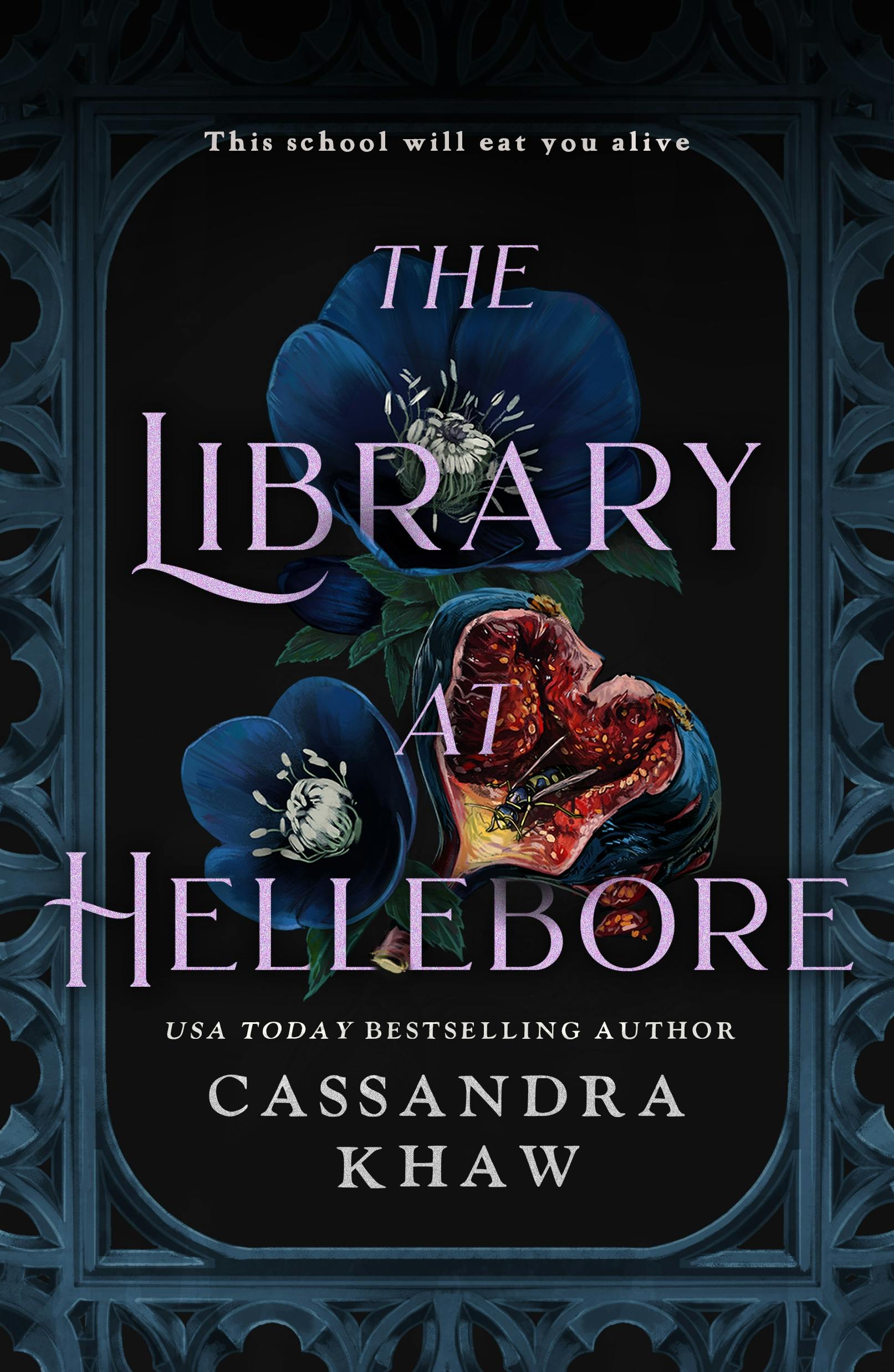
Cassandra Khaw is not exactly new to the nasty. They’re a USA Today bestseller and Bram Stoker Award winner whose CV already includes Nothing But Blackened Teeth, the gristly fairy-tale vivisection The Salt Grows Heavy, the story collection Breakable Things, and the urban-chaos collab The Dead Take the A Train with Richard Kadrey. They also write games, which tracks: their best scenes feel like boss fights, geometry and gore choreographed for maximum impact.
We open in a dorm room painted with human jam. Our narrator, Alessa Li, wakes up next to the very freshly dead Johanna. Viscera is draped like party streamers and Alessa is both guilty and grimly practical about it. It’s a hook, and it works. Soon we learn Hellebore is a Hogwarts for world-enders, a Ministry-regulated school for the “ambitiously gifted” where the headmistress chirps about a “soiree” and tells students to make themselves look “delicious,” which is not exactly subtle foreshadowing for “maybe tonight’s banquet is you.” When she blithely suggests one girl “hang yourself,” the book basically holds up a neon sign that reads: cannibal faculty, run.

From there the plot toggles between barricade-survival in the titular library, flashbacks that sketch how Alessa landed here, and the political machinery of a world that tried to legislate the supernatural back into its cage. Think Battle Royale meets The Magicians if the dean were a shark in a grandmother suit.
Khaw keeps circling the same hungry idea: the institution that promises to “fix” you so it can profit from you. Hellebore isn’t reform; it’s veal. The headmistress’s obsession with looking “delicious” is a tidy symbol for the way prestige systems teach the unruly and traumatized to polish themselves for slaughter. The library as sanctuary is on-the-nose but effective: it’s the one place where knowledge—ugly, old, uncooperative—refuses to be devoured. Doors literally heal after attacks, which is a fun metaphor for collective memory refusing to be erased.
There’s also a vein of rage-feminism running through Alessa’s origin, crystalized in a set piece where her first kill is a retaliatory act against abuse—gruesome, cathartic, undeniably confrontational. The book wants to talk about girls taught to be prey deciding to be the trap instead. It doesn’t moralize; it weaponizes.
Stylistically, Khaw writes like a knife with a poetry degree: high-octane metaphors, gleefully baroque body horror, and an internal monologue that splices gallows humor with genuine ache. Sometimes it’s dazzling. Sometimes it’s like huffing a whole bottle of clove-oil adjectives. The voice is the draw and the hazard.
For all its viscera, this is a novel about consent and capture. Bureaucracy mythologizes its cruelty. The “Ministry” identifies potential apocalypses and corrals them with a smile, promising redemption, employability, a mortgage if you just behave. It’s the fantasy of assimilation with the bill itemized in teeth. The faculty’s transformation into a literal flesh-collective is a blunt but weirdly satisfying embodiment of that machine: institutions that cannot love you try to metabolize you.

Where the book is sharpest is in Alessa’s complicity calculus. She’s not innocent and the narrative doesn’t beg you to absolve her. She’s a survivor who has learned that mercy is what predators and systems demand right before the kill. When she chooses tenderness, it lands. When she chooses violence, it feels like physics.
But the book also keeps telling you it’s about monstrous kids whose worst tendency is being sanded into usefulness. That’s potent. Then it keeps sprinting to the next set piece before it sits with the messy questions: if your power is catastrophe, who gets to say you shouldn’t use it? Hellebore’s “we’ll make you safe for society” pitch is nightmare fuel, but the text sometimes lets the imagery do the arguing for it. I wanted more philosophical claws, fewer theatrical entrails.
Originality: Medium-high in texture, medium in skeleton. The cannibal-academy conceit is not unheard of, but Khaw marinates it in their signature weird: wasp-eyed murals, meat golems, a headmistress who talks like a TikTok nanny and eats like a reef shark. The worldbuilding riffs are fun, if occasionally more moodboard than mechanism. The “magic came back and capitalism tried to paperwork it” backstory is slim but spicy.
Pacing: Choppy. The opening is a sprint through gore and threat and then we hit a start-stop pattern: flashback, barricade, infodump, quip, run, flashback again. Scenes are individually electric but the book sometimes reads like a stack of excellent chapters stapled together slightly out of breath. When momentum flags, it’s because the voice is doing burpees while the plot jogs in place.
Characters: Alessa is a barbed hook of a protagonist: bitter, funny, and terrifying when she means it. Secondary characters wobble. Rowan, Stefania, Portia, and Sullivan each get a handful of memorable beats, then the story largely uses them as rhetorical sparring partners or future snacks. They’re types first, people second, which blunts the emotional stakes when the cafeteria menu turns classmate.
Scare factor: Moderately high on the gross-out, medium on dread. The cannibal faculty sequences are nasty in the best way and the headmistress’s chipper authoritarianism is genuinely skin-crawling. But true fear needs quiet, and the book rarely lets a silence bloom. It’s loud, stylish horror. I enjoyed flinching; I rarely felt haunted.
Prose: You probably already know if Khaw’s register works for you. I’m a fan in small shots. Here it’s a double-pour. Sentences somersault; similes pile up like stage lights. When the imagery clicks—“like saints waiting for the lions”—it’s chef’s-kiss. When it doesn’t, it’s gilding a wound that was already bleeding just fine.

The book’s major strength is its commitment to a feral aesthetic. This world feels wet, feverish, and mean. The headmistress is an all-timer villain introduction, all coo and coercion. The library sequences have that siege-movie tightness I live for. And Alessa’s voice, while occasionally exhausting, is alive with spite and survival. The critique side is mostly structural: set pieces that upstage theme, supporting cast that undercooks, and an ending rhythm that feels more like a last stand than a conclusion earned by arcs. If The Salt Grows Heavy was a scalpel, this is a meat tenderizer. It flattens beautifully. It doesn’t always cut clean.
This is a stylish, gnarly, intermittently brilliant splatter-academy novel that left me hungry for either 50 more pages of character work or 50 fewer pages of filigree. If you want to swim in viscera with a narrator who bites and a school that literally eats its young, dig in. If you need coherence more than mood, maybe audit the class instead of enrolling.
TL;DR: A gorgeously gross cannibal-school romp with a killer voice, jagged pacing, and characters who feel more like decorative knives than people you’ll mourn. Big theme: institutions will “fix” you right into the stew. Plenty to enjoy, not enough to remember. Bring napkins and patience.












Recommended for: Readers who keep a copy of Society on Blu-ray, have ever said “I like my campus novels with cartilage,” and think “make yourself look delicious” is a perfectly normal commencement speech.
Not recommended for: Anyone who prefers tender coming-of-age arcs to tenderized classmates, or who gets hives when a sentence tries on its fourth metaphor like a prom dress.
Published July 22, 2025 by Tor Nightfire.



 The Blog Without a Face
Leave a comment