

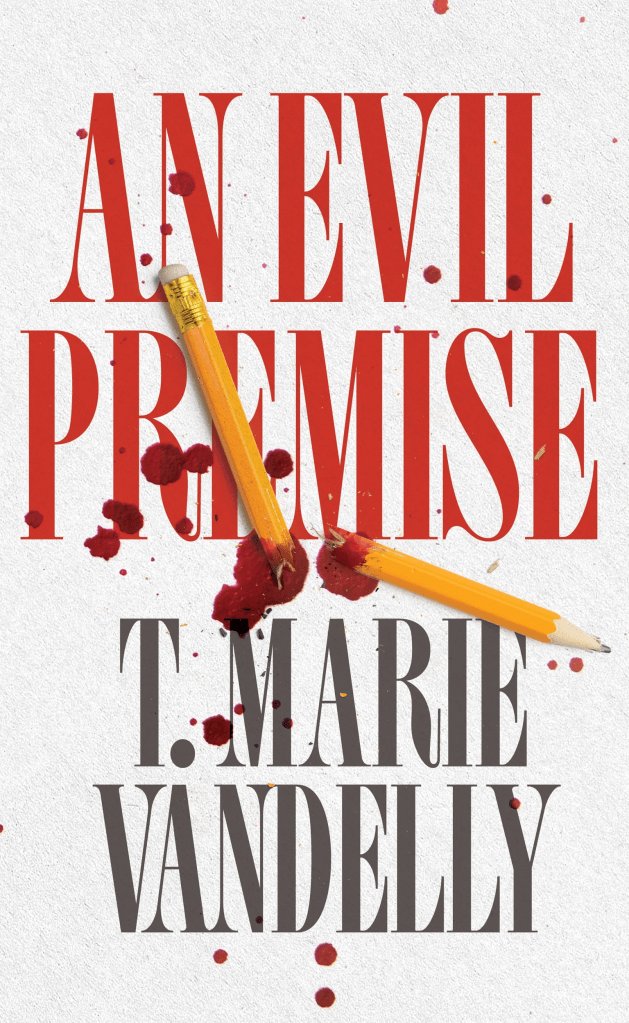
T. Marie Vandelly’s new novel is a cursed book about cursed books that grins like a gargoyle and dares you to keep reading anyway. It’s mean, meta, and unapologetically gooey. It also stumbles on pacing and over-explanation, which keeps it squarely in the “good, not great” camp. Still, if your idea of a fun weekend is letting literature chew on your cortex, welcome to the buffet.
Vandelly is best known for Theme Music and lives on Gwynn’s Island in the Chesapeake. An Evil Premise is her second novel, and you can feel a writer swinging harder at the fences: bigger set pieces, nastier textures, a confidence in letting metafiction track muck across the carpets. The prose favors immediacy and sensory punch. She is very good at making rooms feel humid with threat.
Jewel Maxwell sprints back to small-town Virginia after her older sister Deidre, a once-celebrated fantasy author, gets walloped by a hit-and-run and lands in the ICU. Deidre’s body is betraying her in technicolor. The apartment reeks like a flooded basement full of secrets. The cellar cries at night. The phone rings from places it shouldn’t. Jewel starts house-sitting and immediately realizes the real patient is a manuscript that does not want to stay put. The more she pokes, the more the book pokes back. What begins as a family emergency mutates into an encounter with a text that behaves like a parasite. No spoilers, but the opening warning about letting the story get under your skin is not ornamental. It’s a promise.

This novel treats creativity as an invasive species. Not a muse, exactly, but a tapeworm that convinces you starving is a kind of art. Vandelly keeps pushing that metaphor until it lodges in your throat. The story of two sisters is really the story of authorship and appetite, of who gets to own a narrative and who gets consumed by it. Deidre’s illness literalizes the book’s thesis: words have consequences, and sometimes those consequences are dermatological. The skin isn’t just skin; it is a palimpsest that keeps rewriting itself in scab and seep. Around that body horror coils a domestic Gothic: an attic apartment that feels like a mind you don’t want to be alone with, a hometown that smells of mildew and judgment, a history you swear you outgrew coming back with a box cutter. Vandelly writes in a brisk, venomous register that snaps from gallows humor to clinical dread in a sentence. Documents, drafts, confessions, and conversations braid together into a narrative that is constantly commenting on its own making. When it works, it’s electric. You can hear the pages hum. When it doesn’t, you can hear a whiteboard squeak, like the book is explaining itself to a risk-averse studio exec. Even then, the style is tactile and relentless, an insistence that stories are not airy ideas but sticky, heat-trapping organisms you invite into the house at your peril.
What lands hardest is how the novel refuses to romanticize the cost of creation. There is no cute montage of inspiration. There is malnutrition. There is neglect. There is an older sister who turned her life into product and paid with her body, and a younger sister who thought she could live clean and now has to wade through the runoff. The book points its knife at the whole ecosystem around storytelling. Editors smooth, agents strategize, readers demand blood while insisting they’re above spectacle. Everybody wants a piece of the miracle. Everybody swears they’re not participating in harm. Meanwhile the harm eats well.
Vandelly also has sharp things to say about family myth-making. Sisterhood is a genre. Every household writes its own canon, its own villain, its own deserved crown. The novel keeps interrogating that script: who was the chosen one, who was the disappointment, who got sacrificed on the altar of talent. It’s not subtle, but it is honest, and it gives the supernatural shenanigans an emotional spine. When the apartment closes in and the manuscript starts acting like a Ouija board with a grudge, you feel Jewel’s anger and guilt as much as any jump scare. Horror, at its best, turns feelings into furniture you can bruise yourself on. This book gets that part right.
The hook slaps. From page one, the threat is personal and bodily, not just spooky-lore atmospheric. The hospital scenes are unpleasant in the way you want horror to be unpleasant: precise, sensory, matter-of-factly vile. Vandelly is excellent at staging set pieces. A shadow behind a cracked door is not a new trick, but she holds the moment so tightly you swear the hinge is breathing. The apartment is a character, the cellar is a wound, the sink is a throat. And the metafiction bite is pleasingly acidic. The jokes about ownership, bylines, and how evil scales through narrative feel contemporary without smirking you to death.

The middle act noodles. You get a run of scenes where the book hems and haws about whether the phenomenon is supernatural or psychological after it has already tipped its hand. The engine revs, stalls, then revs again. There are also a couple of monologues that try to build cosmology by explaining everything until the dread thins out. It’s like someone paused the séance to read the meeting minutes. Finally, while Jewel and Deidre are compelling, several side characters exist to carry a single function or deliver a twist on cue. When the narrative punishes them, it feels engineered rather than earned.
The “cursed text that colonizes the reader” idea has a lineage, but Vandelly’s version, with its body-horror literalism and inside-publishing snarl, feels distinct enough to stand on its own mean little feet. It is not a reinvention of the subgenre so much as a flavorful hybrid, marrying domestic Gothic claustrophobia to a parasitic-muse conceit with a satirical edge. In terms of fear, expect malignant unease over outright shrieks. The imagery is gross in a way that clings to you, and a handful of sequences will make you eye your plumbing like it coughed up a confession. It’s more “my shoulders feel tight” than “I slept with the lights on,” but the best moments absolutely gooseflesh. Pacing is the sticking point: when the novel sprints it flies, when it pauses to explain itself you can hear the gears grind. As for character work, the sisters are painfully human and the relationship has teeth; the satellites wobble, never quite escaping archetype.
Good, not great. The concept is juicy and the execution frequently nasty in the best way, but the momentum sputters and the lore lectures take some of the oxygen out of the room. If you like metafiction that bites and leaves a ring of teeth, you will have yourself a delightfully unpleasant time. If you need airtight pacing and secondary characters with full-blooded arcs, you might wish the editor-demon had taken another pass.
TL;DR: A nasty, meta haunted-manuscript novel where creativity behaves like a parasite. Killer hook, juicy set pieces, and a sharp sister dynamic. The middle meanders and the lore speeches overstay their welcome, but it still delivers brain-itch and skin-crawl. Good, not essential.






Recommended for: Readers who grin when a preface threatens to worm into their skull; fans of cursed-text horror who want body-ooze with their footnotes; anyone who’s ever side-eyed an “inspirational” muse and thought, yeah, that thing wants to eat me.
Not recommended for: People who think “the muse” is a scented candle; germaphobes who gag when sinks cough up Satan’s egg water; readers allergic to meta who hear one more speech about authorship and want to punt a hardback into the sun.
Published August 12, 2025 by Blackstone Publishing
 The Blog Without a Face
Leave a comment