
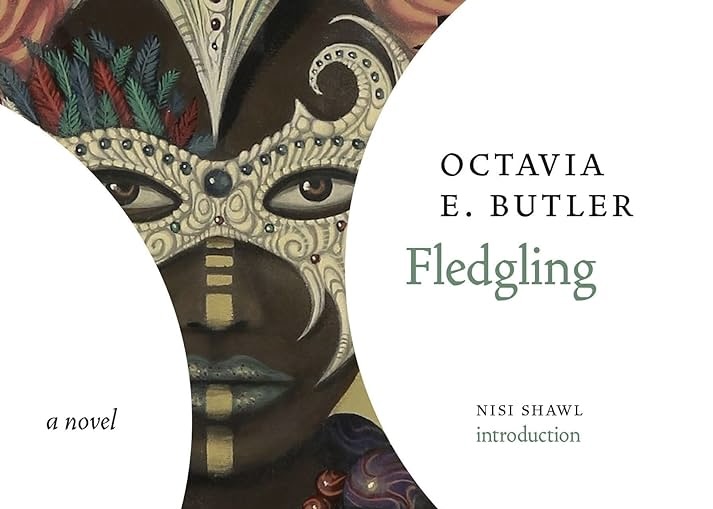

Octavia E. Butler is one of speculative fiction’s undisputed titans, an icon who carved space for Black women in a genre historically dominated by white men. She didn’t just elbow her way into science fiction; she burned the fucking doors off their hinges. Butler’s work is layered with themes of power, identity, and survival, often explored through Afrocentric, feminist, and post-humanist lenses. With seminal works like Kindred, Parable of the Sower, and Wild Seed, she proved that sci-fi and horror could be personal, political, and devastatingly prescient. Fledgling, published in 2005, the year before her untimely death, is her final novel, and damn, what a way to go out.
Often sidelined as “Butler’s vampire novel,” Fledgling is more accurately a quiet act of rebellion dressed as genre fiction. It’s a book that bites, but not just with fangs. It bites through racial theory, gender, consent, addiction, colonialism, and more, using the figure of the vampire (or “Ina”) not for thrills but for revolution.
Fledgling opens with its narrator, a young girl named Shori, awakening alone, disoriented, and badly injured in a forest. Her skin is burned. She has no memory of who she is. She’s not entirely human. We slowly learn that Shori is a genetically modified Ina, a species akin to vampires, engineered to withstand sunlight thanks to the incorporation of human (specifically, Black human) DNA. But while she’s still recovering, Shori finds herself hunted. Someone wants her, and all of her kind, dead. What follows is a strange, slow-burn murder mystery-cum-sci-fi family drama wrapped around vampire lore, where Shori must reconstruct her identity, her history, and her power while navigating the rigid, patriarchal, and disturbingly genteel society of the Ina.
This isn’t a vampire story; it’s a coming-of-consciousness story with fangs.

Let’s not pretend this book is subtle. It sinks its themes deep and bleeds them out slow. The allegorical scaffolding isn’t hard to spot, Fledgling is a thesis on racial hybridity, the politics of “otherness,” the weaponization of purity, and the biological and ethical messiness of dependency.
Shori’s Blackness is pivotal: she is feared and loathed by her own kind not because she’s monstrous, but because she’s a successful hybrid. The Ina, a closed society steeped in tradition and genetic purity, despise the idea of human integration, especially from humans with dark skin. In making Shori both the future of her species and its greatest abomination, Butler executes one of her most razor-sharp dissections of racism and eugenics to date.
The vampire-as-addict trope also gets a facelift. Symbiosis here isn’t just metaphor; it’s literal. The Ina don’t kill humans, they bond with them, feed from them regularly, and provide them with longer, healthier lives. The humans, in turn, become physically and emotionally dependent on their vampire “partners,” often to ethically murky extremes. Is it love, or chemical enslavement? Butler never answers that cleanly, which makes the dynamic all the more unnerving.
And then there’s consent. Fledgling doesn’t shy from its queasy power imbalances. Shori is fifty-three, but appears (and behaves) like a prepubescent girl. Her sexual and emotional relationships, especially with her human male symbiont, will squick you out. They’re meant to. This is a book about dominance masquerading as symbiosis. If you’re not a little uncomfortable, you’re not reading closely enough.
Butler’s prose is deceptively simple. Don’t mistake the clean, unadorned sentences for a lack of depth. She writes like someone surgically removing your organs while keeping you conscious enough to feel it. The book is told in first person, through Shori’s eyes, and the voice has an intentional naivete, an echo of amnesia, of someone rebuilding language and memory in real time. The effect is both intimate and eerie. We see the world not just through someone’s eyes, but through someone who is literally learning what it means to be.
Pacing-wise, it’s slow in that “let me peel your skin layer by layer” way. Don’t come here expecting Anne Rice-style eroticism or Stephen King-style jump scares. This is existential horror, not popcorn horror. That said, the violence, when it comes, is brutal and unflinching, delivered with a sharp inhale and no apology.

Strengths
- Originality: A reinvention of vampire lore that is both genre-savvy and politically loaded. This is not a Dracula remix. This is Butler dragging vampire mythos into a bioethical nightmare of interspecies co-dependency and social hierarchy.
- Prose: Quietly masterful. Never flashy, always effective. Butler knows when to pull back and when to sink the knife.
- Thematic Complexity: Tackles race, consent, memory, sexuality, and evolution without didacticism. You’re never spoon-fed. You’re left to sit with the discomfort.
- Narrative Voice: Shori’s voice is compellingly odd, a blend of childlike clarity and predator calculation. You trust her, then you don’t. Then you do again. And that whiplash is the point.
Critiques
- Ethical Ambiguity in Sexual Relationships: Let’s address the elephant in the coffin: Shori’s physical appearance as a child in sexual and romantic contexts is deeply unsettling. Yes, the novel questions the morality of these relationships, but it also normalizes them within the narrative’s internal logic. Some readers will (rightfully) bounce off this hard. It remains one of the book’s most challenging and controversial aspects.
- Expository Bulk: A good chunk of the novel is courtroom drama and Council politics. While rich with world-building, it can feel like dry exposition by the time we reach the climax. If you came for stakes and blood, you might feel like you’ve walked into a speculative ethics seminar by mistake.
- Pacing: The first act is absorbing. The middle? A bit sloggy. There’s a noticeable drop in narrative urgency when the book shifts from survival horror to sociopolitical intrigue.
Fledgling isn’t a perfect book, but it is a necessary one. It’s a vampire novel for readers who think vampire novels are stupid. It’s Butler’s parting thesis on power, evolution, and how much of our humanity survives contact with the other. If it makes you uncomfortable, good. It’s supposed to. If it doesn’t, read it again.
It’s unsettling. It’s brilliant. And 20 years later, it still has its fangs deep in our collective jugular.
TL;DR: Vampires. Blackness. Eugenics. Consent. Amnesia. Political murder trials. A protagonist who is a hybridized preteen vampire with adult instincts and a kill list. Octavia E. Butler’s final novel is a cerebral stake through the heart of whitewashed, romantic vampire fiction and it dares you to like it.





Recommended for: Readers who want their horror chewy with moral ambiguity and hard sci-fi edges. People who thought Twilight needed more death, racial theory, and government hearings.
Not recommended for: Readers triggered by sexual relationships with characters who appear underage (seriously, read with caution). Anyone who wants a “sexy vampire romp.” Unless your kink is evolutionary ethics and genocide.
Published September 8, 2005 by Grand Central Publishing

 The Blog Without a Face
Leave a comment