Let’s get something out of the way: John Langan is the thinking horror fan’s horror writer. If you want emotional gore without intellectual gristle, go read something with a dripping skull on the cover and a font that screams “13-year-old boy’s locker sticker.” But if you’re ready to read a horror story that quotes Heraclitus between decapitations and pulls off an exegesis on M.R. James while scaring the hell out of you—then John Langan has you cornered. The man’s back catalogue (including The Fisherman, Children of the Fang, and Sefira and Other Betrayals) is literary horror at its most self-conscious, most expansive, and yes, sometimes most frustrating.
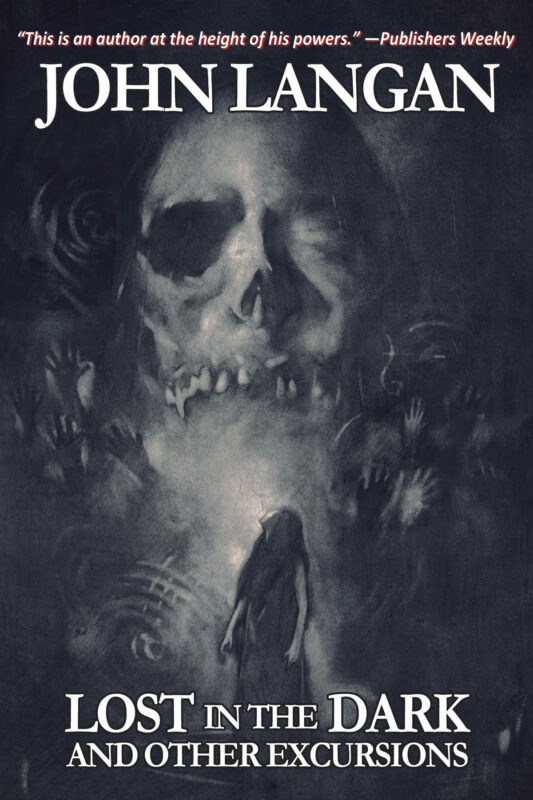
Lost in the Dark and Other Excursions continues that trend. It’s a cerebral, uneven, but often exhilarating collection of horror stories that range from found-footage hauntology to uncanny satire and cosmic dread with a theological twist. Sometimes it feels like he’s showing off. Sometimes it works. Sometimes it’s like sitting through a lecture on horror theory with a ghost at your back tapping Morse code onto your spine.
By now, Langan’s style is its own genre. Long sentences, meta-narrative intrusions, “stories within stories,” and a frequent tendency to swap out climactic action for theological musings or structural experimentation. He’s like if Lovecraft had tenure, or if Borges wanted to make you shit your pants.
That tendency toward recursive narrative and high-literary horror is both his gift and his vice. In earlier collections (The Wide, Carnivorous Sky or Mr. Gaunt), Langan flirted with pulp but always pulled back toward the canonical. By The Fisherman, he had settled into his groove: old grief, haunted landscapes, and ancient things that don’t give a damn about your therapy bills.
This latest collection is firmly post-Fisherman—ambitious, scholarly, emotionally raw, and maddeningly opaque.
Lost in the Dark and Other Excursions is a grab bag of stories: haunted documentaries, doomed science fiction allegories, semi-comic philosophical pieces, and a few straight-up horror tales that sneak up behind you while you’re still admiring the prose.
The titular novella, Lost in the Dark, is the anchor piece: a layered, pseudo-academic breakdown of a found-footage horror film that maybe isn’t fiction. It centers on a woman named Agatha Merryweather, a long-imprisoned girl turned death-spirit host, and the doomed film crew who stumble upon her. It’s an inspired riff on The Blair Witch Project by way of The Exorcist, with an undercurrent of cosmic Catholic horror that would make Ligotti nod in approval.
The rest of the collection includes stories about reanimated philosophers, seaborne terrors, undead prophets, and (because it’s Langan) a garden gnome with secrets. Each story feels like its own excavation site—some buried treasure, some dusty bones.
Catholicism, horror folklore, the myth of narrative redemption, and the terror of interpretation. That’s your cheat sheet.
Langan loves to explore the idea that storytelling itself is a kind of magic or imprisonment. The act of framing horror, whether through cinema, academia, or family legend, becomes its own kind of summoning. In Lost in the Dark, Agatha isn’t just a ghost—she’s the archetype every town invents to explain its buried sins, mutated over time like an urban legend under radiation exposure. She’s also a literal manifestation of the “Keres”—death-spirits of primordial darkness, unkillable and unholy.
We get echoes of Beowulf, biblical exorcisms, and ritual containment. But Langan’s real monster isn’t the supernatural—it’s our inability to understand the horror until it’s too late. Knowledge, in this collection, is poison disguised as salvation.
Langan’s prose is dense. Sometimes breathtaking. Sometimes bloated. At his best, he writes sentences that tremble with dread and lyricism.
But pacing? Not always his friend. A 25-page build-up for a 2-page payoff is Langan’s signature move, and it doesn’t always land. Readers who love the sloooooow burn will find much to admire. Others may feel trapped in a lecture on haunted epistemology when they came for the blood.
The structure of the title novella mimics a critical essay, including breakdowns of key scenes and even film theory tangents. It’s brilliant—or insufferable, depending on how much horror academia you can stomach in your fiction.
Strengths
- Ambition: Langan is swinging big. These stories aren’t just about monsters. They’re about belief systems, epistemology, and the porous boundary between fiction and folklore.
- Atmosphere: Whether he’s setting a story in a mold-ridden mine, a decaying chapel, or the eerie waters of a dark sea, Langan is a master of conjuring unease.
- Originality: Very few writers would conceive a story like Lost in the Dark, let alone deliver it in the voice of a quasi-film professor narrating the behind-the-scenes trauma of a cursed production.
- Intertextuality: Horror nerds will eat this up. References to myth, folklore, horror cinema, and literary tradition abound. It’s the kind of book you can write a thesis about.
Critiques
- Glacial pacing: Several stories overstay their welcome. Oscar Returns from the Dead, Prophesizing and Alice’s Rebellion especially feel like clever concepts dragged through molasses.
- Emotional detachment: For all the fear, there’s a chilly distance to some of the stories. Characters often feel like mouthpieces for big ideas rather than people you grieve when they’re disemboweled.
- Over-intellectualization: Sometimes, Langan disappears up his own thematic wormhole. The writing is too smart for its own good, and not always in service of the horror.
If The Fisherman was his Lovecraftian eulogy to grief, and The Wide, Carnivorous Sky was him riffing on genre tradition, Lost in the Dark feels like Langan’s dissertation on horror as praxis. It belongs on the shelf beside Brian Evenson, Caitlín R. Kiernan, and Mark Z. Danielewski, but it will appeal most to readers of Victor LaValle and T.E.D. Klein—folks who want horror with both fangs and footnotes.
Lost in the Dark and Other Excursions is high-concept horror filtered through a PhD’s fever dream. At its best, it’s genre-defying and intellectually exhilarating. At its worst, it’s a bit like being haunted by a professor who won’t shut up.
Ambitious, uneven, occasionally brilliant, and undeniably Langan.
TL;DR: Think The Blair Witch Project if it was adapted by Werner Herzog, rewritten by Thomas Ligotti, and annotated by a deranged film critic. Dense, dark, and very smart… sometimes too smart.




Published August 5, 2025 by Word Horde
Recommended for: Horror scholars, cursed film fanatics, fans of postmodern spooks.
Not recommended for: Anyone who thinks reading should involve fun. Or plot. Or characters who don’t quote Greek mythology in caves.

 The Blog Without a Face
Leave a comment