
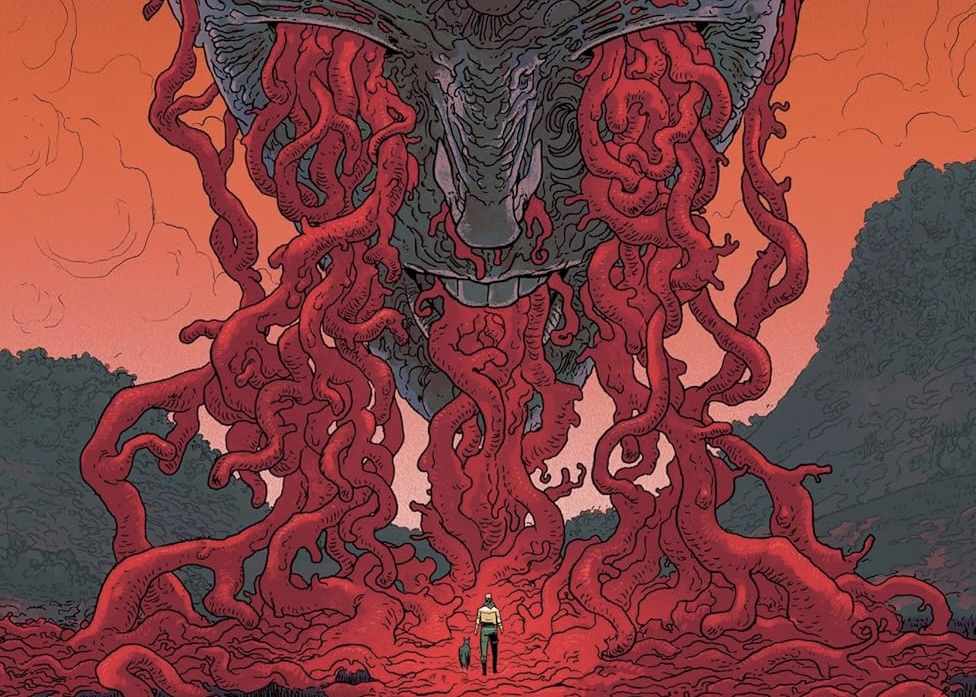
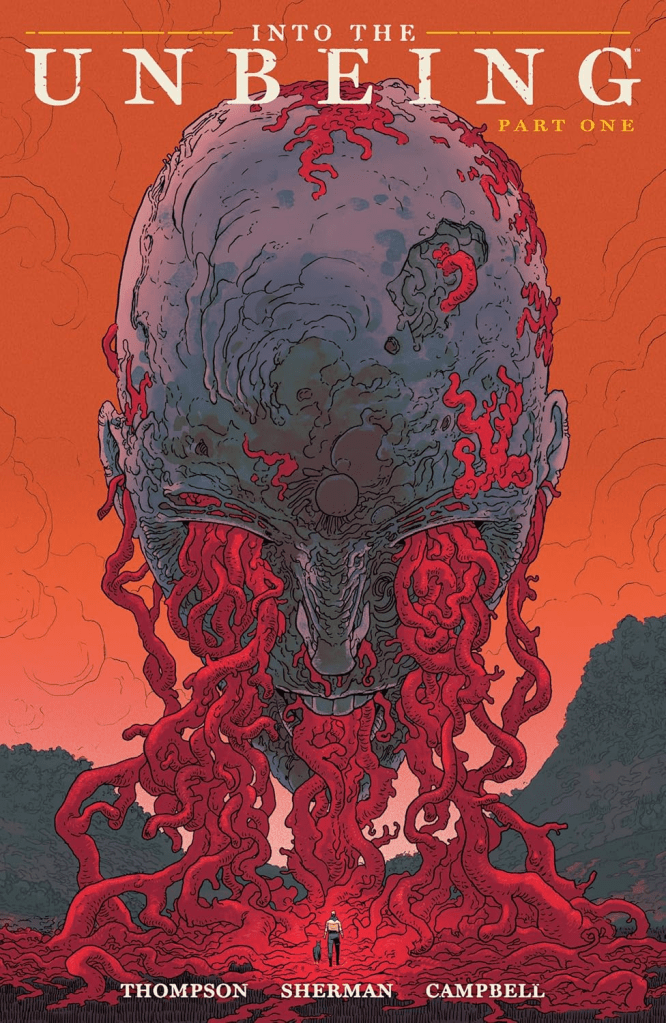
Zac Thompson, hailing from Prince Edward Island, Canada, is a horror-slinging scribe who’s clawed his way from Marvel’s superhero trenches (X-Men, Cable) to indie bloodbaths like I Breathed a Body and Lonely Receiver. His work thrives on visceral, boundary-pushing terror, earning praise like “lowbrow brilliant” from New York Magazine for The Dregs. Hayden Sherman, the artist, is no slouch either, with a knack for twisted visuals in titles like Dark Spaces: Dungeon and Wasted Space. Jim Campbell, the letterer, brings clarity to chaos, having worked on Monsters Are My Business and Midnite Show. Together, this trio crafts Into the Unbeing Part One, a project that screams their collective obsession with the weird and grotesque.
In a ravaged 2034 Australian outback, a team of climate scientists from S.I.N.E.W. (Scientific Institute for Nascent Ecology and Worlds) stumbles upon a geological anomaly that defies logic: a massive, possibly living landform. Led by botanist Hildur Johansson, the crew, accompanied by a dog named Galko, embarks on a routine mission to map this bizarre terrain. What they find is a hostile, alien ecosystem teeming with strange flora, fauna, and lurking predators. As they venture deeper, propelled by curiosity and hubris, the landscape challenges their understanding of nature itself. This 120-page graphic novel, blending eco-horror and cosmic dread, sets the stage for a descent into the unknown, where survival hangs by a thread and the environment feels like a malevolent entity. It’s a slow-burn setup that promises to unravel into something vast and terrifying.
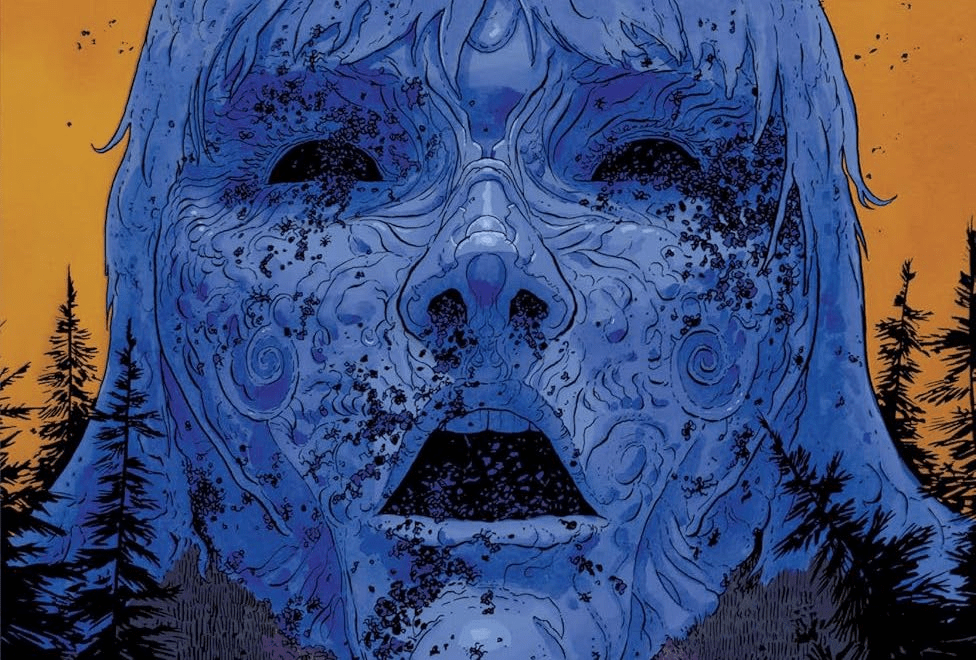
Into the Unbeing Part One is a festering stew of eco-horror and cosmic horror, steeped in the Anthropocene’s existential guilt. Thompson’s script grapples with humanity’s arrogance, our relentless need to poke and prod at nature, even when it’s screaming “fuck off.” The landform, a pulsating holobiont, symbolizes Earth’s rebellion, a living rebuke to our ecological sins. It’s Lovecraftian in its unknowable vastness but grounded in climate collapse, making it feel like a warning carved in bone. Sherman’s art is the real star, with jagged lines and vibrant colors that turn the outback into a fever dream of flesh and flora. His panels, often structured like fractured stained glass, disorient and immerse, reflecting the team’s unraveling sanity. Campbell’s lettering, with notebook-style captions, adds a raw, diaristic intimacy, like reading a doomed explorer’s final scrawls.
Thematically, the book probes human frailty against an indifferent universe, echoing Annihilation but sidestepping its cerebral haze for a more visceral gut-churn. It questions whether knowledge is worth the cost when the unknown is a predator. It’s a big fuck you to our tech-bro fantasies of conquering nature, showing a world where the planet bites back. Thompson’s dialogue, while occasionally stiff, weaves in enough gallows humor to keep it human. The pacing leans slow, letting dread simmer, but it’s not without purpose. Every page feels like a step deeper into a trap. Sherman’s grotesque visuals amplify this, making the landscape a character that’s both beautiful and malevolent, a paradox that mirrors our own conflicted relationship with Earth.
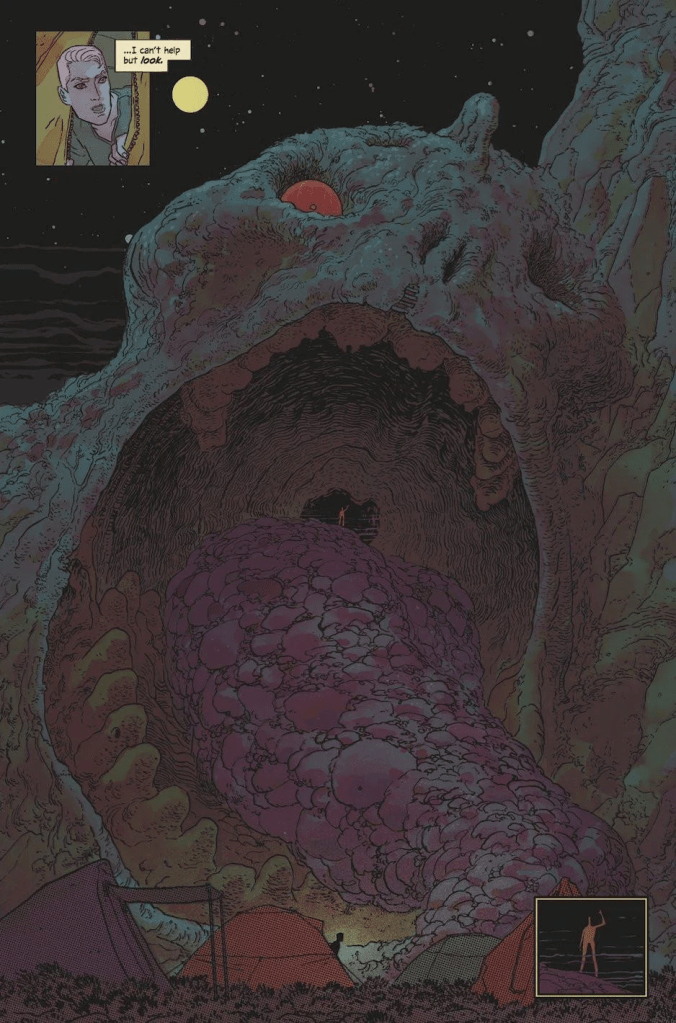
Let’s not bullshit: Into the Unbeing Part One is a bold swing, and it mostly connects. Its originality lies in its fusion of ecological and cosmic collapse, a combo that feels fresh yet primal. The premise, a living landform that defies science, is a goddamn fever dream, and Thompson sells it with enough real-world science to make the insanity plausible. Sherman’s art is a knockout, with every panel dripping with unease; the way he renders the organic chaos of the holobiont is like Giger on a bad acid trip. The use of color, with vivid greens and sickly yellows, makes the environment feel alive and hostile, a stark contrast to the washed-out despair of the outback. Campbell’s lettering is subtle but effective, grounding the surreal visuals in a tactile, human perspective.
The characters, while functional, are a weak link. Hildur and her crew feel like archetypes, gruff leader, skeptical scientist, token cynic, lacking the depth to make you care if they get eaten by the scenery. Zara’s flashback, hinting at a mercenary past, is intriguing but underdeveloped, leaving her motivations murky. The pacing, while deliberate, drags in places; issue two’s cave sequence feels like a slog before a killer cliffhanger redeems it. Dialogue can be clunky, with exposition dumps that scream “we’re scientists!” instead of letting the horror speak for itself. It’s not particularly emotionally resonant, leaning too hard on atmosphere over character. The horror is strong but not shattering. More creeping unease than heart-stopping terror. It’s daring, but it’s not quite incredible.
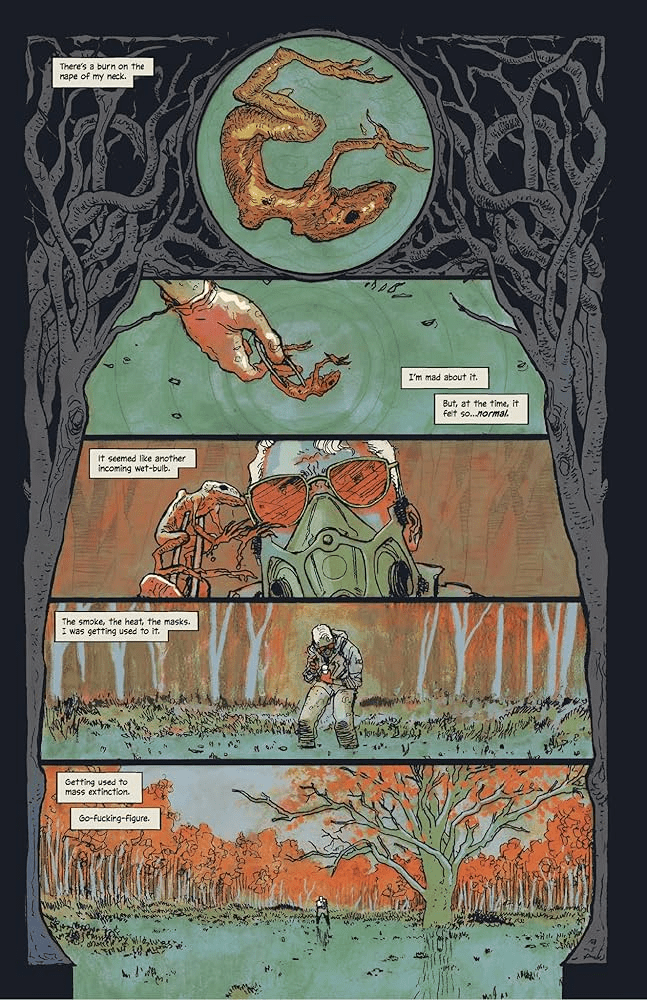
Still, the book’s ambition is undeniable. The slow burn works when Sherman’s visuals carry the weight, and the ecological subtext gives it a bite that’s both timely and timeless. It’s not perfect, but it’s got enough guts to make you forgive its stumbles. Into the Unbeing Part One has vivid writing and atmospheric dread with a premise that’s genuinely unique. Sherman’s art is a masterclass in grotesque beauty, and Thompson’s eco-horror twist feels like a fresh wound in the genre. But the characters are thin, and the pacing is occasionally a slog. It earns its spot for daring to be weird and unflinching, but it needs more emotional heft to hit harder. It’s a must-read for its bold visuals and cosmic unease, even if it doesn’t fully stick the landing. Despite its faults, I genuinely can’t wait to see where it goes in Part Two.
TL;DR: A climate science crew dives into a living, alien landform in the Australian outback, blending eco-horror and cosmic dread. Sherman’s art stuns, but thin characters and sluggish pacing keep it from greatness. A bold, grotesque ride for weird fiction fans.




Recommended For: Sickos who salivate over alien ecosystems that might eat them, craving a comic where the Earth itself is a pissed-off cosmic horror show.
Not Recommended For: Softies who want cuddly characters or a quick scare, too spineless for a landscape that’ll chew their soul to bits.
Writer: Zac Thompson
Artist: Hayden Sherman
Lettering: Jim Campbell
Published January 28, 2025 by Dark Horse.
 The Blog Without a Face
Leave a comment