

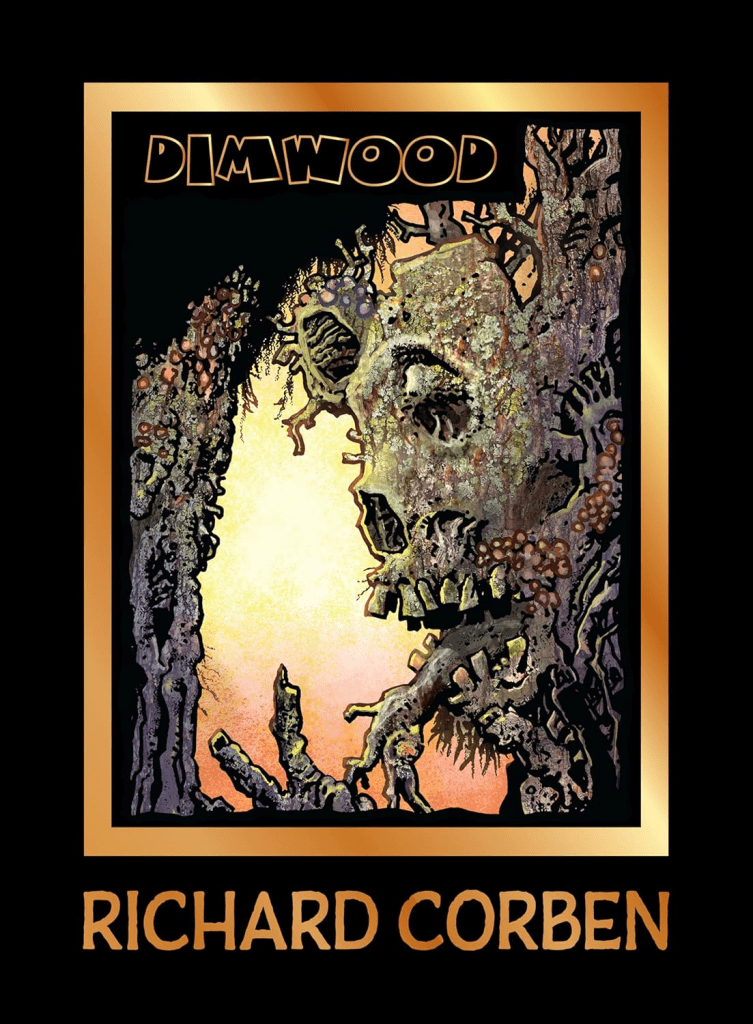
Richard Corben (1940–2020) looms as a legend in comic art; an Eisner Hall of Famer, Angoulême Grand Prix recipient, and Spectrum Grand Master. Famous for underground fantasy like Den and early graphic novel Bloodstar, he pushed boundaries with sensory, grotesque visuals. In Dimwood, he handled both script and art duties, with Nate Piekos (Blambot) re‑lettering the final edition—Piekos is early Dark Horse favorite for hand‑crafted, atmospheric type that fits gothic horror. Colorist/restorer José Villarubia, and longtime Corben collaborator, helped salvage Corben’s final, unpublished work into shape; his touch plus an intro by Joe Lansdale gives the book extra cred. It’s a deluxe Dark Horse hardcover with restorations, bonus epilogue, and lush dust jacket, marking its place in the Corben Library series, joining Murky World, Den, and Rowlf

In Dimwood, Xera, a young woman, returns to her ancestral home in Dimwood after years away, emotionally adrift and experiencing deep memory gaps. The family mansion looms like a moss‑draped beast, corridors twisting as if alive, mirroring the murky horrors locked in her subconscious. As she explores, she finds signs of old tragedies; disappearances, unsolved murders, whispers of something inhuman. The line between her fractured memories and the forest’s own malevolence blurs. Is she uncovering buried truths or reliving nightmares? Without spoiling specifics, Dimwood unfolds as a gothic mystery soaked in atmosphere. It’s less a plot‑driven chase and more a descent into a haunted psyche with Corben’s art rising in tension as Xera inches toward the core of her past and the mansion’s cursed legacy.
Corben’s final tale hinges on the interplay of memory, decay, and psychological hauntings. The forest isn’t just backdrop, but rather a living symbol of buried horrors. Moss‑choked limbs within the wood echo Xera’s own obscured mind, as if the landscape physically guards what she must rediscover. The mansion, twisting inward, feels like a visual metaphor for introspection; each panel’s angles and shadows press claustrophobically on the reader, a perfect inversion of the typical sweeping graphic panel. This is horror that seduces through environment and suggestion.
Stylistically, Corben’s use of chiaroscuro and painted textures remains unmatched. The panels breathe, not roar. There are muted palettes, jagged linework, anatomical distortions that go beyond grotesquerie into emotional symbolism. A dripping tear may be drawn as an oil map; a rotting stairbanister may gasp with life. When violence appears, it’s rarely gory for gore’s sake. It punctuates emotional beats. He doesn’t film the violence; he focuses on the aftermath, the psychological scars, the fossil of fear left in memory.

Symbolically, Xera’s memory gaps parallel deep trauma. Her journey becomes a metaphor for digging up repressed self. The forest’s creatures are barely glimpsed, yet their presence is more potent than full exposure. These unseen forces resonate with cosmic or fairy‑tale dread, peeling reality’s wallpaper. The result is oppressive—an immersive psychogeographical exploration.
Culturally, Dimwood echoes the revival of gothic horror steeped in nature’s sublime terror. In contrast to sanitized ghost stories, this presses into the roots: a reckoning with history, legacy, and inner decay. There’s cultural weight here: the idea that land, family, and history intertwine, binding the living to unspoken sins. Dimwood is unapologetically an atmosphere‑first experience. For those tired of derivative stories, Corben’s final work feels both familiar and alien: gothic yet psychedelic, grounded yet dream‑logic. It refuses convention, offering neither neat resolution nor punch‑the‑monster ending. Instead, it delivers a haunting indentation into your subconscious long after the last page.
This is the kind of book that knows your brain better than your taste buds: slow‑burn, intentionally muddled pace, trading kinetic whiplash for creeping dread. Corben’s environments are characters, a fungal breathing wall, a rotting floor that seems to pulse under foot, but some readers may find the lack of conventional scares frustrating. If you need an explicit monster reveal or a high‑octane climax, Dimwood plays you like a fiddle. That said, this subversion of expectations is precisely where it thrives: it lingers in corners, eavesdrops on echoes, thrives on ambiguity. Refreshing as a breath of moldy air.
This thing sags toward the center. The middle third stretches memory sequences and forest wanderings longer than strictly necessary. One can lose narrative grip. That said, it’s deliberate: the pacing mirrors Xera’s fractured mind. Personally, I got restless, but then that discomfort slid into unsettling immersion. Your mileage may vary depending on tolerance for “hall‑of‑mirrors pacing.”
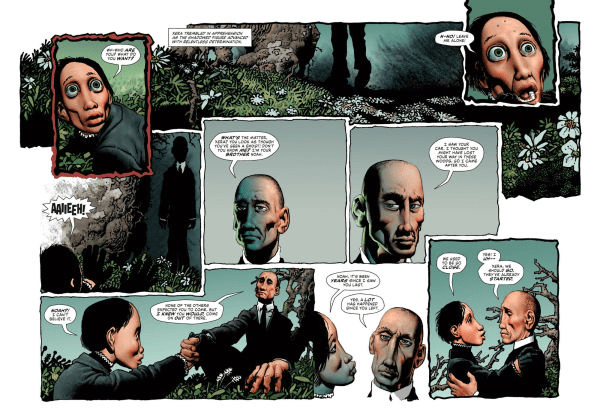
Xera isn’t a thrill‑seeker; she’s a haunted soul. Her character growth is quiet, less about overcoming and more about mapping the terrain of guilt and loss. You won’t root for her in a classic hero’s journey, but her internal logic holds. Supporting characters are more like ghosts, or thoughts in her head, glimpsed, felt, but never explained. This supports theme but leaves wanting more relational meat. I wanted stakes beyond memory, some hint of emotional investment with living people, not just memories and shadows.
Corben’s line work and painting still set the gold standard. Each page echoes portent, nothing is gratuitous. The re-lettering by Piekos gives voice to memory’s fragmentation: speech balloons twist, dribble, jitter. It’s the rare case where lettering goes beyond legibility into emotional layering. Villarubia’s restoration doesn’t sanitize Corben’s weirdness: he amplifies it. Colors seep into shadows instead of canceling them. Every gutter feels like a potential trap.
This is a horror for brains, not bowels. It’s about uncanny, not gore. Disappearances and implied violence hang as unresolved notes. The terror here is psychological gravity. So, if you’re craving immediate jolts, this isn’t it. An audacious final work that honors Corben’s strengths, textural horror, psychological depth, environment‑driven dread, while occasionally wearing thin in narrative propulsion. It’s one of those rare books that feels like an experience rather than a story, and for those of you who burn for weirdness and grit, that’s a virtue.
TL;DR: Dimwood is a slow-burn gothic psychodread soaked in Corben’s textural art. It’s a grotesque plunge into memory and decay, with Xera’s fractured psyche delivering a haunting, mature horror tale. It’s for fans of decadent atmosphere and weirdness, a rare treat.





Lines/Writer: Richard Corben
Colors: José Villarubia
Lettering: Nate Piekos
Published June 10, 2025 by Dark Horse.
Recommended For: Creeps who jerk off to Goya’s Black Paintings and think House of Leaves needed more gore.
Not Recommended For: Folks who want monsters front-and-center or narratives tied with a tinsel ribbon.


 The Blog Without a Face
Leave a comment