
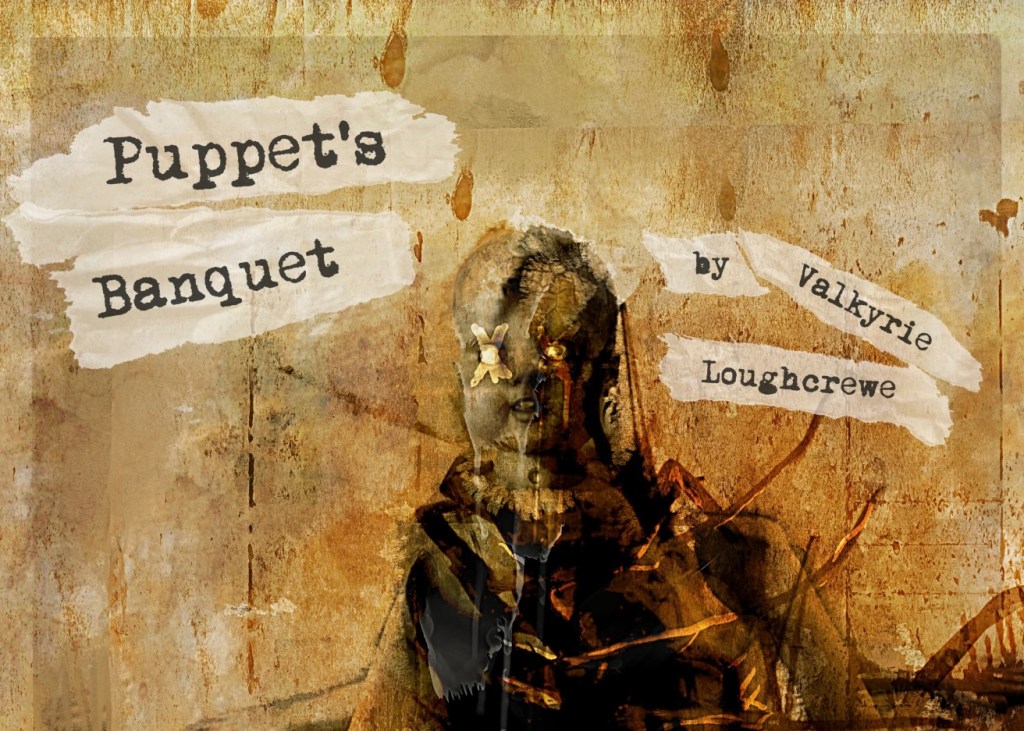

Imagine if Eraserhead, Dead Ringers, and The Wicker Man had a grotesque ménage à trois and birthed a squirming, unholy novel about itself. That’s still not quite Puppet’s Banquet by Valkyrie Loughcrewe, but it’s damn close. This book is a feverish, trans-corporeal nightmare. A glitching Irish gothic descent so unhinged, so layered in existential dread and meaty horror, that I half-expected my copy to grow teeth and demand a blood sacrifice. This isn’t horror as metaphor. This is horror as an invasive species, burrowing into your veins, rewriting your DNA, and laughing while you scream. You don’t read this book. It fucking rewrites you.
Valkyrie Loughcrewe isn’t just some rando with a pen and a vendetta against sanity. She’s a literary alchemist who’s been brewing nightmares for years. Hailing from the misty bogs of Ireland, Loughcrewe’s work is steeped in the primal muck of Celtic mythology, Catholic guilt, and the kind of existential despair that only comes from staring too long into the Irish Sea. Her previous novel-in-verse, Crom Cruach, was a feral pagan howl, a text that felt like it was scratched into existence with peat, blood, and snakebone. It was raw, unapologetic, and so steeped in Ireland’s ancient spiritual rot that it practically smelled of damp earth.
But Puppet’s Banquet is Loughcrewe leveling up into something even more deranged. Where Crom Cruach was content to haunt your soul, this book wants your kidneys, your reproductive system, and your entire sense of self as a coherent entity. It’s no surprise she pulled this off. Loughcrewe’s background is a kaleidoscope of weird: a former performance artist who once staged a “ritual dismemberment” of a mannequin in a Dublin gallery, a folklore scholar who’s published essays on the intersection of Irish mythology and body horror, and a self-professed “lapsed Catholic” whose work drips with the trauma of institutional religion. She’s also got a knack for collaborating with other freaks—here, she’s teamed up with Daniel Rooney, whose original story forms the warped spine of this novella, and Tenebrous Press, a publisher that’s basically the literary equivalent of a haunted carnival. Together, they’ve created a book that’s pure horror ecstasy, a work so unsettling I was nervous to turn the page—not out of fear of what happens, but fear of what it means.

The story kicks off with Martin and Celia Campbell, a financially strapped Irish couple driving home from a family party that probably involved too much whiskey and passive-aggressive jabs about money. It’s all very relatable, until they hit a pale, ghostly woman with their SUV on a fog-choked road. From this mundane tragedy, shit spirals into a world of medical nightmares, reproductive terror, and ecological collapse faster than you can say “what the actual fuck.”
Martin gets snatched by Dr. Whitehead, a feral pseudo-scientist who makes Cronenberg’s mad doctors look like pediatricians. Whitehead turns Martin into a pregnant patchwork abomination—think Frankenstein meets Rosemary’s Baby, but with more oozing fluids. Meanwhile, Celia’s left to pick up the pieces, grappling with grief, guilt, and a reality that’s fracturing like a shattered mirror. Her psyche splinters, her body mutates, and she’s slowly absorbed into the same unknowable, organismal horror that devoured her husband. The birth at the center of this story? It’s not salvation. It’s assimilation. And it’s fucking terrifying.
You think you’ve got this figured out? You don’t. This plot that eats you.
If there’s a beating heart to Puppet’s Banquet, it’s the violation of bodily autonomy as a stand-in for every kind of decay—sociopolitical, ecological, personal. Loughcrewe dissects horror like a surgeon with a grudge. Pregnancy here isn’t sacred or miraculous. It’s fungal, capitalistic, a weaponized glitch in the human operating system. It’s a metaphor for how systems—family, medicine, religion, capitalism—invade and rewrite us until we’re no longer ourselves.
Celia’s descent is the book’s emotional core, and it’s full of tragic complexity. What starts as mental disintegration becomes metaphysical unmooring. Her name erased, her body hijacked, her agency stolen by institutions that claim to “help” but really just rebrand horror as salvation. There’s a gut-punch line where she describes the institute as a place that doesn’t cure horror, it commodifies it, like a startup trying to monetize the Antichrist. It’s bleak, it’s brilliant, and it hits like a fucking brick to the face.
The book’s also lousy with subtext: medical colonialism, Catholic trauma, the alienation of late-stage capitalism, and the ecological entrapment of flesh in the Anthropocene. But Loughcrewe doesn’t spoon-feed you these themes. They fester, rot, and pulse like the malformed fetus in Martin’s womb: unspeakable, unmanageable, and so alive it hurts.
Let’s not fuck around: Loughcrewe’s prose is a goddamn revelation. It slaps you, spits in your face, then apologizes with a kiss so tender it leaves you with lockjaw. She juggles theatrical second-person monologues, post-human stream-of-consciousness, and realistic dialogue that feels more surreal than the hallucinations. The structure is fractured but deliberate, with scenes introduced as “Slides” like some clinical presentation gone horribly wrong. The narrator? It’s not human. It’s a post-organic witness, gleefully dragging you into the collapse of meaning itself.
Tonal shifts are where Loughcrewe flexes hardest. One minute, you’re in gritty marital drama. The next, you’re in a Giger-esque birthing chamber that smells of rust and regret. Then, boom! You’re on an island that feels like Midsommar reimagined by the SCP Foundation. Somehow, it all coheres. This isn’t literary chaos; it’s designed psychological disintegration, and it’s executed with the precision of a serial killer.
Strengths
- Originality: You won’t read another book like this. It’s Antichrist meets The Fly meets Mother!, filtered through Irish post-Catholicism and biopunk eco-horror. It’s like someone weaponized “body horror” and dropped it on a sleepy Dublin suburb.
- Prose: Sharp, poetic, dense, and unrelenting. Not since Caitlín R. Kiernan have I read sentences so tuned to psychic rupture.
- Symbolic Density: This is a book of ideas, screamed into your spinal cord through imagery that never quits. Fetuses, fungi, bureaucratic gaslighting, memory distortion… it’s a delirious stew.
- Horror Impact: Several scenes left me physically uncomfortable, not from gore, but from existential fears so wrong you want to claw your eyes out. The “baby room” scene? Sweet Jesus, I need therapy.
- Thematic Ambition: This is about despair, powerlessness, and the meaty trap of being human in a collapsing world.
Critiques
- Narrative Coherence: Sometimes, the book pushes its fractured structure too far. The hallucination/reality boundaries blur so much that narrative stakes can feel like they’re drowning in weird soup.
- Pacing: Mid-book, some institutional chapters drag like a hungover Sunday. Loughcrewe’s clearly in love with the island’s aesthetic horror, but it can feel like we’re wading through dread without moving forward.
- Character Depth: Celia’s a tragic powerhouse, but Martin turns into more symbol than person in the second half. It’s arguably intentional, but it still stings given his early depth.
Puppet’s Banquet isn’t for everyone. Hell, it’s barely for anyone. This is weaponized weird horror—ambitious, sickening, beautiful, and completely uninterested in holding your hand. If you like your horror sharp, philosophically rabid, and delivered through the flesh-mangled lens of a fever dream, this might be your new liturgical text. If you prefer tidy arcs and characters you’d grab a pint with? Run. Run fast. And maybe say a prayer while you’re at it.
TL;DR: Puppet’s Banquet is a post-human, body-horror descent into reproductive madness and institutional gaslighting. It’s Rosemary’s Baby rewritten by Thomas Ligotti on psilocybin, staring into the Irish Sea. You won’t feel “good” when you finish, but you’ll feel changed.








Published May 14, 2025 by Tenebrous Press
Recommended for: People who thought Possession was too chill. Readers who want their horror to smell like hospital disinfectant, milk rot, and burnt skin.
Not recommended for: Book club moms looking for the next Verity. Anyone who says “I like horror, but not too weird.”
 The Blog Without a Face
Leave a comment