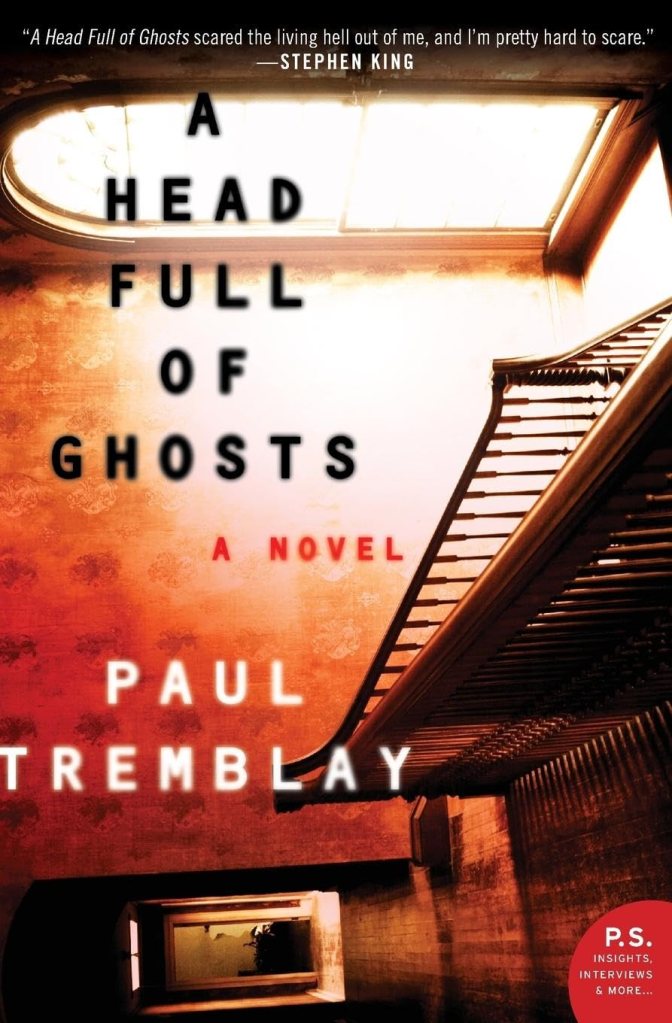
When A Head Full of Ghosts was first published in 2015, it took the horror literary world by storm. A decade later, Paul Tremblay’s novel still lingers in the psyche, its ambiguity and unsettling narrative leaving an indelible mark on modern horror. The book deftly explores themes of mental illness, family dysfunction, media exploitation, and the enduring power of horror storytelling itself. With its mix of psychological horror and supernatural elements, A Head Full of Ghosts earns its place in the pantheon of contemporary horror classics.
Paul Tremblay, known for his psychologically rich and deeply unsettling narratives, was not always a full-time horror writer. Before A Head Full of Ghosts, he made a name for himself with crime fiction and literary works. However, his talent for horror, particularly in exploring the tension between belief and skepticism, became evident with this novel. Tremblay is also a mathematician and a teacher, which lends his writing a structural precision and analytical depth. He doesn’t just write horror—he dissects it, analyzing how fear works on both an individual and societal level.
A Head Full of Ghosts is structured as a narrative within a narrative. The protagonist, Merry Barrett, recounts the events of her childhood to a journalist. At the center of the story is her older sister, Marjorie, who begins displaying signs of schizophrenia—or perhaps demonic possession. As Marjorie’s behavior grows more erratic and disturbing, their financially struggling parents agree to let a reality TV crew document the ordeal, turning their lives into The Possession, a six-part horror spectacle.
The novel skillfully plays with perception. Is Marjorie truly possessed, or is she suffering from a mental illness? Is the reality show manipulating the family’s crisis for entertainment? Or is there a genuine supernatural presence lurking beneath the sensationalism? Tremblay never gives a definitive answer, leaving the reader to wade through the murky waters of uncertainty.

Tremblay excels in weaving multiple layers of horror, each more terrifying than the last. The novel operates on psychological horror, existential horror, and traditional supernatural horror all at once. One of its most compelling themes is the conflict between mental illness and supernatural possession. Marjorie’s erratic behavior could be attributed to schizophrenia, yet the story never confirms this diagnosis. The novel forces us to question whether belief in the supernatural is just another way of rationalizing what we don’t understand.
Another major theme is the corruption of reality TV. A Head Full of Ghosts highlights how the media exploits suffering for entertainment, turning Marjorie’s illness—or possession—into a spectacle and reducing a family’s trauma to viral content.
The novel also explores the unreliability of memory. Merry, recounting her past, serves as an unreliable narrator, and her memories of the events may be tainted by trauma, media influence, or even self-preservation. This theme reinforces the book’s core tension: what is real and what is fiction?
Finally, Tremblay delves into the power of horror stories. The book is littered with references to classic horror novels and films, from The Exorcist to House of Leaves, playing with horror tropes while also examining how horror storytelling shapes our fears and beliefs.
The novel is rich with symbolism that deepens its psychological and thematic complexity. The Barrett home serves as a psychological battleground, both a literal space where supernatural and psychological horror collide and a symbol of family dysfunction. As Marjorie’s condition worsens, the home deteriorates—just as the family’s stability does.
Another powerful symbol is the book Merry reads. She clings to Richard Scarry’s Cars and Trucks and Things That Go, a children’s book, even as horror unfolds around her. This contrast between innocence and trauma serves as a stark reminder of how childhood memories are colored by later realizations.
The idea of possession itself also functions as a potent symbol. Whether Marjorie is actually possessed is secondary to how belief in possession impacts those around her. She becomes a vessel for fear, media exploitation, and even her father’s religious fanaticism. This reflects the novel’s broader meditation on belief systems, control, and the ways we construct narratives around fear.
Tremblay’s prose is deceptively simple yet deeply unsettling. He employs an unreliable narrator, mixed media elements (such as blog posts analyzing The Possession), and fragmented storytelling to create a sense of disorientation. The novel shifts between past and present, blurring the lines between what Merry remembers, what the TV show presented, and what might actually have happened. This narrative complexity ensures that no reader walks away with the same interpretation.
Strengths:
- Masterful Use of Ambiguity: The novel never reveals the full truth, making it an intellectually and emotionally engaging read.
- Meta-Horror Elements: Horror fans will appreciate the nods to genre classics and the self-awareness in how the story critiques horror tropes.
- Emotional Resonance: Beyond the horror, the novel is a tragic story about family, belief, and the devastating impact of mental illness and media exploitation.

Critiques:
- The Ending May Frustrate Some Readers: Readers expecting a concrete resolution may be left unsatisfied. The ambiguity, while a strength, can also feel like a lack of closure.
- Pacing Issues: Some sections, particularly the blog-style commentary, might feel too dense or distracting from the main narrative.
- Heavy-Handed Symbolism: While the novel’s themes are powerful, some of the symbolism (such as the role of media) might feel overly deliberate to some.
A Head Full of Ghosts is a modern horror masterpiece that still feels fresh and terrifying a decade later. Its psychological depth, social commentary, and narrative complexity make it a standout in contemporary horror literature. While its ambiguity may not satisfy all readers, its lasting impact is undeniable.


William Morrow
Published June 2, 2015
 The Blog Without a Face
Leave a comment