
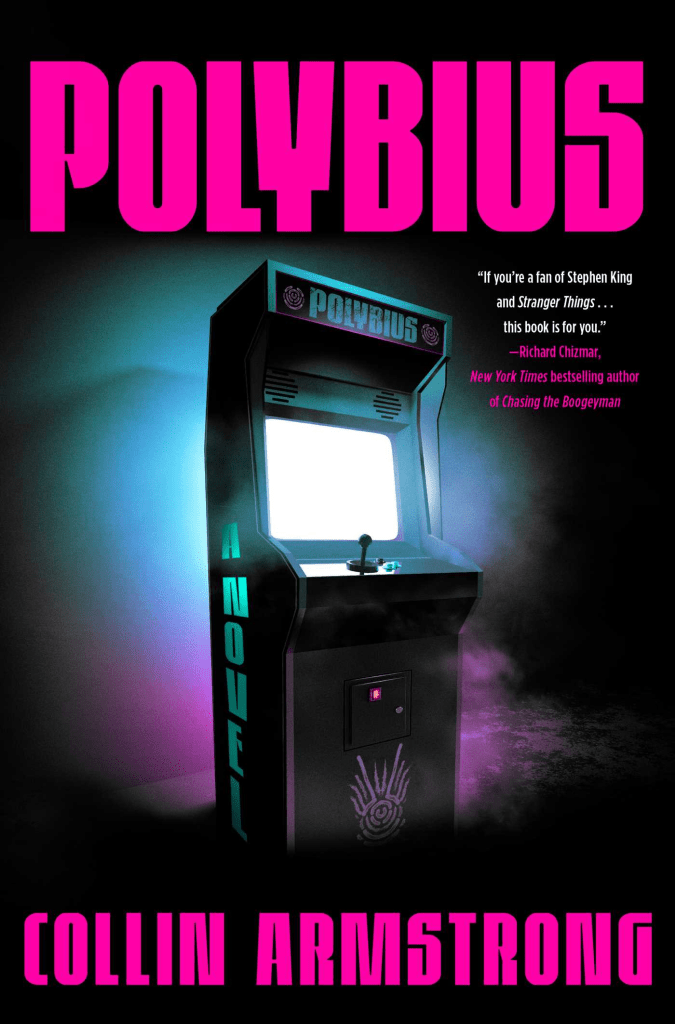
Alright, horror hounds, grab your quarters and brace for a ride through Polybius, Collin Armstrong’s debut novel that tries to cash in on the creepy urban legend of a mind-warping arcade game. I’m writing this with a whiskey buzz and a grudge against books that promise a pixelated nightmare but deliver a glitchy ROM. Polybius is a fun, action-packed romp through 1980s nostalgia, but it’s got more bugs than a dive-bar jukebox. Let’s plug in and see if this cabinet’s worth your time.
For those who haven’t scoured the internet’s darkest corners, the Polybius urban legend is a juicy slice of 1980s paranoia. The story goes that in 1981, a mysterious arcade game called Polybius popped up in Portland, Oregon, arcades, sporting trippy graphics and a name tied to a shady company called “Sinneslöschen” (German for “sense deletion,” because of course). Players got hooked, but the game allegedly fried their brains, causing nausea, seizures, amnesia, and a side of suicidal urges. Men in black suits supposedly swooped in to collect data, hinting at a CIA plot, maybe a leftover from the MKUltra mind-control experiments exposed in the ’70s. No cabinet, ROM, or proof ever surfaced, and the legend’s first trace was a sketchy 1998 coinop.org post, likely a prank that snowballed into creepypasta gold. By the 2000s, forums like Reddit and 4chan turned it into a viral myth, fueled by Cold War distrust and moral panic over arcade addiction. Real-world incidents (like kids collapsing from marathon Tempest sessions in Portland) gave it just enough plausibility to haunt arcade nerds. Armstrong’s novel grabs this spooky campfire tale and runs with it, but does it deliver the high score?
Set in October 1982, Polybius drops us into Tasker Bay, a sleepy Northern California seaside town where high schooler Andi, a tech-savvy teen itching to ditch her mom’s forced relocation for Silicon Valley, works at Home Video World, a grimy arcade/video store run by Mal, a sleazy wannabe gangster. Andi’s life is all about fixing cabinets and dodging attachments, but Ro, the sheriff’s son with a crush, keeps hanging around, and their budding romance adds a flicker of warmth to the neon-lit gloom. When a mysterious arcade game called Polybius shows up, courtesy of Mal’s sketchy auction buys, the town goes apeshit. Players get addicted, fights break out, and soon Tasker Bay is gripped by a virus-like epidemic of rage, paranoia, and hallucinations, just as a storm cuts the town off. Andi, immune to the game’s effects, teams up with Ro, while her doctor mom and Ro’s sheriff dad run parallel investigations. As mutilated horses and dead bodies pile up, the crew races to unravel Polybius’s origins before the town implodes. Is it a government experiment gone rogue, or something darker?
Collin Armstrong, a Los Angeles-based writer with a decade in the entertainment biz, has penned scripts for 20th Century Fox TV, ABC Family, and others, which explains the cinematic sheen of Polybius. His debut novel draws from his love of ’80s horror and sci-fi, citing influences like Stephen King’s Carrie and Gremlins. Armstrong’s been kicking around the Polybius idea since the late 2000s, initially as a film concept, but the 2020 COVID lockdowns, when he was stuck at home with kids and an existential crisis, pushed him to turn it into a novel. The result is a book that feels like a love letter to his childhood, steeped in arcade culture and Cold War paranoia, but also shaped by modern anxieties about tech’s grip on our minds. His background in TV and film gives Polybius a polished, visual flair, but it also leans hard into familiar tropes, like he’s pitching a Netflix series rather than breaking new ground.

Polybius wants to be a cautionary tale about technology’s dark side, and it’s got the bones for it. The game acts as a virus, spreading chaos like a digital plague, mirroring real-world fears of screens warping our brains (MKUltra meets Black Mirror). Armstrong channels 1980s paranoia about government overreach, tying it to the Polybius legend’s CIA conspiracy roots, while also nodding to today’s tech dystopia, where algorithms and devices turn us into angry, paranoid drones. The arcade setting is a perfect symbol: a place of joy turned sinister, like a corrupted childhood memory. Mal, the arcade owner, embodies the sleazy opportunist who unleashes doom for profit, a stand-in for unchecked tech moguls. Andi’s tech skills and immunity to the game’s effects position her as a reluctant hero, fighting the system from within, while Ro’s loyalty grounds the story in human connection.
But here’s the rub: the themes feel half-baked. The government-conspiracy angle is straight out of a B-movie, and Armstrong doesn’t dig deep enough to make it unsettling. The “tech is bad” message lack subtlety, and the symbolism—arcade as a microcosm of society, Polybius as a mind-control metaphor—gets lost in the action. It’s like Armstrong wanted to say something profound about how screens twist our souls but got distracted by explosions and fistfights. There’s a missed opportunity to explore the psychological horror of addiction or the moral ambiguity of tech, leaving the themes stuck in a shallow loop.
Armstrong’s prose is lean and cinematic, with a knack for vivid settings. Home Video World feels like every sticky-floored arcade you’ve ever visited, reeking of stale popcorn and buzzing with CRT hum. His dialogue pops, especially Andi’s snarky quips and Mal’s greasy bravado, capturing the ’80s vibe without overdoing the slang. The action is relentless and frequently brutal, with a body count and chaos that keep you flipping pages like you’re chasing a high score. But the writing stumbles with pacing and perspective shifts. Multiple POVs (Andi, Ro, the sheriff, the doctor) jumble the narrative, making it hard to connect with anyone deeply. The pacing is a rollercoaster, speeding through violence but dragging in expository slog, like a game with too many cutscenes. Armstrong’s TV background shows: the story feels like it’s begging for a screen adaptation, prioritizing visuals over emotional depth. It’s readable as hell, but it’s more Stranger Things fanfic than a King-worthy chiller.
Strengths:
- Nostalgia Done Right: The ’80s arcade vibe is a love letter to geeks who grew up dropping quarters, with enough retro grit to make you smell the cigarette smoke.
- Action-Packed Chaos: From brawls to mutilated livestock, the book’s a gore-soaked thrill ride that doesn’t let up. It’s like a slasher flick with a joystick.
- Compelling Premise: The Polybius legend is a horror goldmine, and Armstrong milks its creepy potential, even if he doesn’t fully crack it.
Critiques:
- Derivative as a Knockoff Cartridge: The Stranger Things comparisons are generous; it’s more like a SyFy original that wishes it were Netflix. The government-experiment trope and teen-hero setup feel recycled from every ’80s horror flick.
- Shallow Horror: The scares are jumpy but not haunting. It leans on gore and chaos over psychological dread, missing the chance to make Polybius a truly unsettling force.
- Pacing and POV Mess: Too many viewpoints dilute the stakes, and the uneven pacing makes it feel like Armstrong couldn’t decide whether to go slow-burn or all-out splatterfest.
- Thematic Fumble: The tech-dystopia angle is more set dressing than substance, leaving the book’s big ideas stuck in demo mode.
Overall, Polybius is a fun, messy ride that doesn’t quite live up to its legendary premise. You might enjoy it if you’re a genre fan jonesing for ’80s nostalgia and don’t mind a few plot holes. But if you’re craving a horror novel that rewires your brain, this one’s more of a quarter-eater.




TL;DR: Polybius is a fast, bloody romp through an ’80s arcade nightmare, but its derivative tropes, shallow scares, and half-baked themes keep it from classic status. Fun for horror junkies, forgettable for anyone else.
Recommended for: Teens who think Stranger Things is peak horror and have a stack of quarters for nostalgia.
Not for: Snobs who demand their horror leave a psychic scar and don’t trust anything with a “From the producer of” vibe.
Gallery Books
Published April 29, 2025


 The Blog Without a Face
Leave a comment