
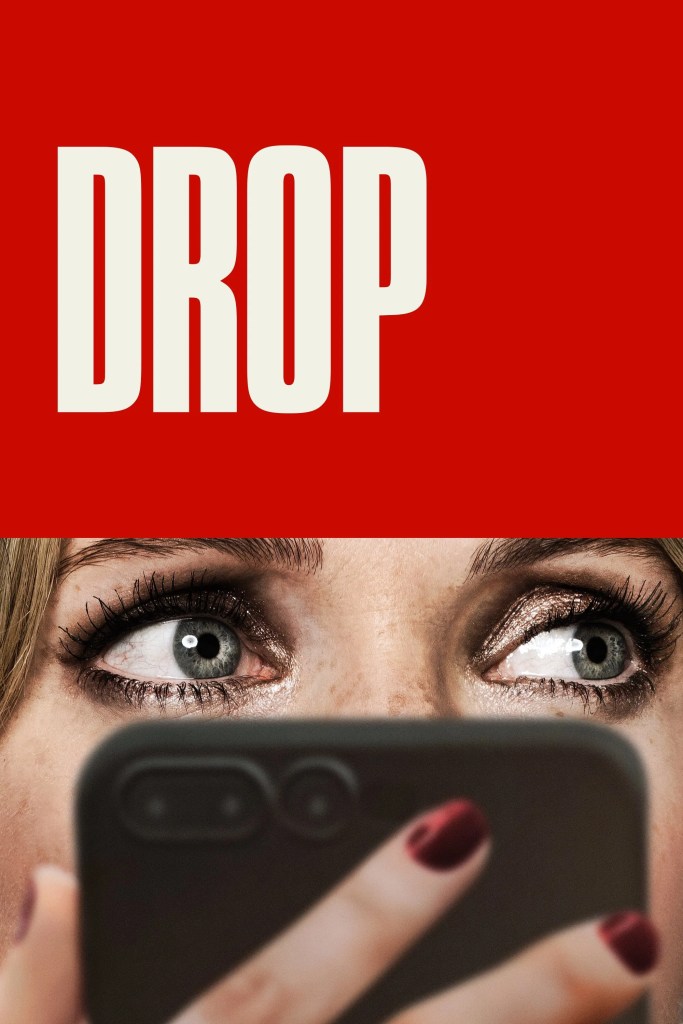
Let’s say this up front: Drop is the kind of movie where, if you love genre—if you own a poster for The Guest, if your Letterboxd list of “Techno Horror” includes Cam and Searching, if you say “this reminds me of Unfriended” with a straight face—you’ll probably have a decent time. Maybe even a good one, if you squint. But if you’re looking for a thriller with emotional weight or a script that doesn’t unravel faster than an influencer’s apology tour, you’re gonna leave this table hungry.
Christopher Landon (Happy Death Day, Freaky) trades in time loops and body swaps for a stripped-down, single-location thriller with a pinch of Black Mirror seasoning and a side of Instagram dread. Drop is sleek, easy to digest, very watchable, and mostly devoid of substance—like cinematic fast food served on a silver platter.

Violet (Meghann Fahy) is a single mom and trauma survivor trying to get her life back on track after the violent death of her abusive ex. The film opens with a flashback full of bruised intimacy and unresolved rage, then fast-forwards to Violet’s return to dating, marked by a dinner date at a chi-chi Chicago restaurant called Palate. Her suitor is Henry (Brandon Sklenar), a photography-lovin’ himbo. You can already smell the threat.
Before the first course hits the table, Violet starts receiving strange AirDropped messages via a suspiciously named app called “DigiDrop.” The texts escalate: someone nearby claims to be holding her son and sister hostage. She must follow their instructions—no cops, no slip-ups, or they die. The whole thing unfolds in (mostly) real-time over the course of a single night. And for a while, the tension works.

Drop wants to say something about the way we use technology to curate intimacy while simultaneously exposing ourselves to surveillance and harm. It flirts with themes like domestic abuse, performative femininity, and maternal guilt, but never really commits to anything more than vague gestures in their direction. Violet is haunted, sure, but not richly. Her past exists to justify her paranoia and drive the plot, not to deepen her as a character.
Symbolism, when it appears, is as subtle as a TikTok thirst trap. An upscale restaurant becomes a prison. Text messages light up Violet’s face like a ghost story around a campfire. Everyone is a suspect, and nobody really matters.

The script, penned by Jillian Jacobs and Chris Roach (Truth or Dare, Fantasy Island), is efficient but threadbare. You get the feeling every beat was reverse-engineered from a logline. There are some decent character moments, particularly in the first act, but by the halfway point, the plot stops making sense and the dialogue devolves into “explain the twist” territory.
Visually, Landon has fun. He’s a gifted stylist, and there’s undeniable tension in the staging. Split screens, flashy lighting, and the constant ding of digital messages keep things moving, even when the story stalls out. But the style can’t hide the fact that Drop has no emotional spine. It wants to be Hitchcock for the iPhone generation, but lands closer to Now You See Me with WiFi.

Meghann Fahy is doing work. Real work. She delivers a layered, convincingly frayed performance that hints at the movie Drop could have been, one where the trauma isn’t a plot device but the emotional nucleus. Her eyes carry the film. Her face tells the story the script forgets to. Brandon Sklenar is… fine. Generic hot guy on a Bumble date. He has chemistry with Fahy but vanishes from memory the moment the credits roll.
Everyone else? Walking plot devices. The pianist, the waiter, the suspicious couple on a blind date: cannon fodder for suspicion. The script wants us to wonder who’s behind the torment, but gives us zero reason to care who any of these people are.

Let’s get real: the twist sucks.
It’s one of those “Ohhhh… that’s it?” reveals, followed by a double-back to make you question everything and then a third-act swerve into action-thriller nonsense that doesn’t suit the film’s tone at all. The emotional beats don’t land because the groundwork isn’t there. We’re told Violet’s trauma defines her, but we’re never invited to sit in it, or explore it. And when it’s finally “resolved,” it’s through generic revenge catharsis, not anything meaningful.
For all its flaws, Drop is watchable. The pacing is snappy. There are a few genuine “oh shit” moments. And for about 40 minutes, it plays like a good episode of Inside No. 9 or The Twilight Zone reboot—just long enough to get you invested before the house of cards collapses. And again: Fahy is a star. She deserves better than this script.

Drop isn’t bad-bad. It’s just shallow, undercooked, and nowhere near as clever as it thinks it is. It’s the kind of film you throw on during a rainy night when you want to feel something tense but not think too hard. A fine streaming pick, but not worth a trip to the theater, or even a second rewatch.
If you go in expecting Die Hard in a dining room with AirDrop anxiety, you’ll probably be satisfied. If you’re hoping for a meaningful thriller about post-traumatic survival in the digital age… yeah, others have done it better. A sleek genre exercise with a killer premise and zero follow-through. Stylish and surface-level, with just enough tension to pass the time. You might enjoy it if you’re a genre fan. You probably won’t if you have taste buds.

TL;DR: Drop wants to be tech-savvy Hitchcock but ends up feeling like a Black Mirror episode that got left in the drafts folder. Great lead, solid style, but not much underneath the hood.
Recommended for: People who think their phone is trying to kill them.
Not recommended for: Anyone who wants their thrillers to have, you know… actual thrills.
Our Rating
Director: Christopher Landon
Writer: Jillian Jacobs, Christopher Roach
Distributor: Universal Pictures / Blumhouse
Released: April 11, 2025


 The Blog Without a Face
Leave a comment