
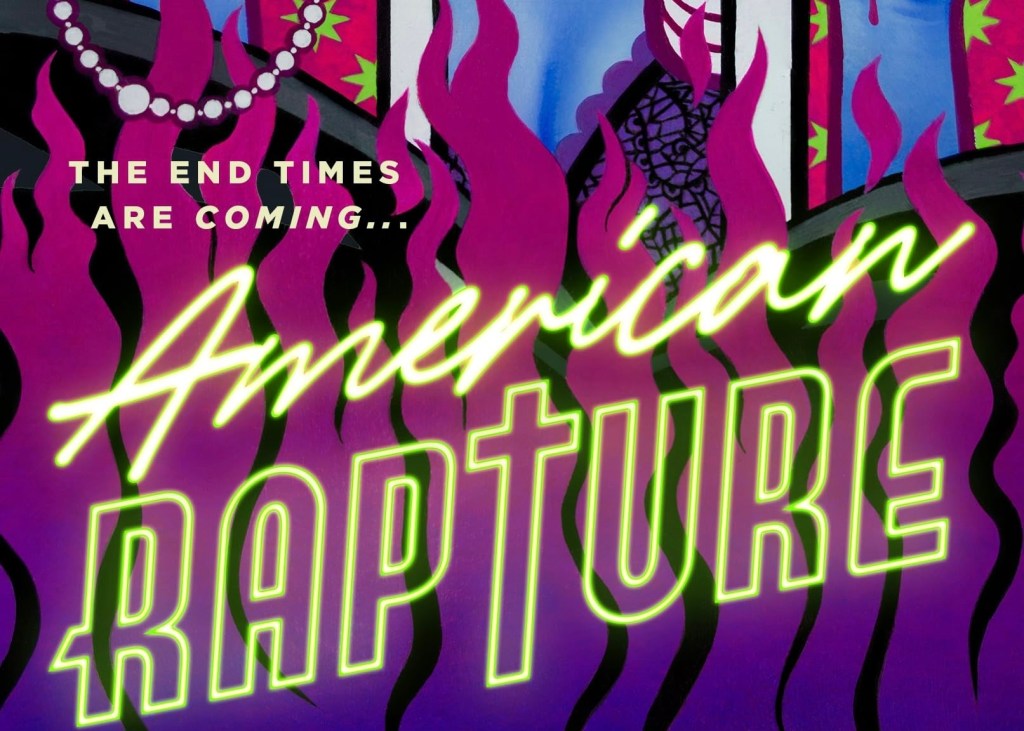

If you’ve ever wondered what happens when you mix a deadly virus, unbridled lust, a Catholic girl on a road trip, and a collapsing America, then American Rapture by CJ Leede is your apocalypse-in-waiting. Think 28 Days Later meets The Virgin Suicides—except, you know, instead of yer typical zombies, the infected are driven by a horrifying sexual mania. And trust me, it’s as chaotic and fascinating as it sounds.
Set in a Midwest hellscape where normality has pretty much packed its bags and left, the novel follows Sophie, a 16-year-old sheltered Catholic girl, as she embarks on a journey through a world rapidly transforming into a feral nightmare. Along the way, she learns that dying a virgin might just be the least of her worries. Oh, and did I mention that this whole scenario is caused by a virus? But not just any virus—this one turns people into sex-crazed, rage-fueled maniacs. It’s basically the most grotesque coming-of-age story you’ll ever read. Buckle up, folks. It’s gonna get weird.
But before we dive into the madness of American Rapture, let’s take a moment to get to know the woman behind the chaos: CJ Leede. She’s an author who’s spent years working on this novel, and her journey is as much about personal growth and defying genre norms as it is about the story she’s telling. The novel itself, with all its outrageous scenarios and unapologetic exploration of taboo subjects, is a reflection of Leede’s own worldview—sharp, witty, and not afraid to rip apart societal expectations like a wet napkin.
CJ Leede is one of those rare writers whose personality jumps off the page and slaps you across the face with both wit and raw honesty. She’s a self-proclaimed “die-hard Trekkie” who admits she spent much of her childhood faking sickness just so she could read under the covers. Yeah, we all did it—but Leede took it to the next level. Her formative moment came in a school library when she realized that a whole world of books was just waiting for her to devour them.

When asked about the books that influenced her, Leede mentions The Library at Mount Char, a dark and twisted story that sparked her writing journey. For American Rapture, she took a decade to craft, honing the wild concept into a novel that’s as much about identity and sexual awakening as it is about surviving an apocalyptic hellscape. In a world where horror often feels like it’s circling the same tired tropes, Leede’s novel stands out like a neon sign that says, “We don’t care if you’re comfortable. We’re here to make you think.”
And if you were wondering just how much of herself is in Sophie, Leede doesn’t shy away from admitting that Sophie’s experiences are in some ways a reflection of what she herself wished she’d been told growing up. The author’s ability to give voice to Sophie’s inner turmoil, sexual confusion, and fight for survival in an increasingly hostile world feels like a therapeutic release. It’s a story of catharsis, wrapped in dark humor and the kind of chaos that only someone like Leede could pull off.
The plot of American Rapture is as brutal and absurd as you’d expect from a novel with a title like that. The narrative begins with a virus—because of course, it does—that spreads across the country, transforming its victims into lust-driven, feral creatures. But the virus isn’t just a plot device to explain the chaos; it’s a metaphor for the collapse of society’s moral boundaries. You’ve got a virus that isn’t just about death; it’s about pushing the boundaries of shame, control, and desire.
And then there’s Sophie. Our intrepid protagonist. A good Catholic girl who’s mostly concerned about grades, family, and the occasional awkward crush. Suddenly, she finds herself thrown into a world where sexual violence, chaos, and madness reign supreme-the dangers are men and women who’ve lost their ability to control their most primal urges. Sophie’s journey across a wrecked Midwest is both literal and metaphorical: she’s fighting for survival in a world that has lost its mind, all while she’s navigating her own sexual awakening.
The beauty of American Rapture is how it mixes the horror of an apocalyptic plague with deeply human moments of self-discovery. You might expect this to be an easy ride full of eye-roll-worthy tropes, but Leede doesn’t do easy. She explores themes of self-worth, sexual identity, and religious shame while throwing in a few wild and weird moments where characters are forced to confront just how much they’re willing to survive for.
The virus isn’t just an external threat—it represents the breakdown of societal control over something as taboo as sex. It’s as if Leede is asking, “What happens when you remove the filters, the rules, and the guilt?” And Sophie’s journey is a front-row seat to that devastating, often grotesque spectacle.
American Rapture is a love letter to chaos, sexual liberation, and the grotesque beauty of a world falling apart. At its core, the novel explores one of the most taboo and complex human experiences: sexual awakening. Sophie, the protagonist, is a good Catholic girl—her world has been carefully constructed with boundaries and rules, largely dictated by her faith and the small-town morality of the Midwest. But when the world goes to hell, so does her sense of self. It’s this collision between a sheltered religious upbringing and the lawless, primal urges unleashed by the virus that drives the thematic heart of the book.
Leede taps into the symbolism of the virus as a physical manifestation of guilt, shame, and desire. The virus transforms people into lust-crazed zombies, exposing their suppressed urges, forcing them into the open. The societal collapse that follows is about the destruction of the structures we rely on to control our emotions and instincts. In this sense, the virus is both an actual apocalypse and a metaphor for the unchecked desires that lurk under the surface of every character. Sophie’s journey to find her brother in this apocalyptic world becomes a parallel to her own sexual awakening. She’s literally navigating through a hellscape, both external and internal, where her survival is as much about understanding her own body and desires as it is about avoiding the dangers of the world outside.
The symbolism of the Catholic faith is also crucial here. Sophie’s religion represents the control she’s been taught to exert over her body and mind. The virus’s spread is a kind of antithesis to that—an uncontrollable force that rejects shame and transforms the very core of societal norms. As Sophie ventures deeper into this new world, the purity she once clung to unravels, revealing the terrifying and liberating aspects of her sexuality. It’s a grotesque awakening, one where self-discovery comes at the cost of innocence—and in this twisted world, there’s no turning back.
The novel also touches on the theme of “found family.” In the midst of a world falling apart, Sophie bonds with various characters who each embody different responses to the crisis. The relationships that form in the chaos—some romantic, some platonic—act as a counterbalance to the destruction around them, highlighting the resilience of human connection in the most extreme circumstances. It’s not all sex, violence, and despair; there’s a strange sort of beauty to the fleeting moments of camaraderie in a world gone mad.

If you thought American Rapture would follow the typical rhythm of apocalyptic fiction—grim, hopeless, and introspective—you’d be wrong. Leede takes us through hell and adds a soundtrack of irreverent humor, witty dialogue, and brutal honesty. This is a book that’s as much about laughing in the face of disaster as it is about confronting it head-on. Sophie’s journey, while certainly dark, is also filled with moments of sharp humor, absurdity, and sharp commentary on everything from American life to the realities of sexual identity.
Leede’s writing is brash and unapologetic. She doesn’t shy away from using coarse language or explicit scenes, and she uses this rawness to underline the chaos in Sophie’s world. The virus itself is a symbol of sexual liberation—uncontrollable and messy—but also a mirror to society’s hypocrisy and hidden desires. The narrative doesn’t just embrace this chaos; it revels in it. For every moment of grotesque horror, there’s a wink or a sarcastic quip that sometimes cuts through the tension, but sometimes highlights a very grim truth.
Let’s not mince words here: American Rapture is a hell of a ride. One of its biggest strengths is its ability to blend horror with deep emotional stakes. Sophie is a character you can’t help but root for—she’s vulnerable, tough, confused, and yet somehow manages to survive in a world that’s designed to chew her up and spit her out. Leede doesn’t sugarcoat anything. Sophie’s sexual awakening is both disturbing and relatable, making her journey a reflection of many real-life struggles that are rarely talked about in such an unflinching manner.
Leede’s writing is also a huge strength. She knows how to balance horror and humor, making you laugh when you should be scared and forcing you to confront some uncomfortable truths when you least expect it. The characters are rich and varied, each responding to the apocalypse in their own way, and the relationships they form are raw and genuine—no matter how temporary or strange they may be.
Another standout element is the world-building. Leede’s vision of a ravaged America is both visceral and haunting. The descriptions are vivid without being overly graphic, and you can almost smell the decay in the air. The virus is a central character in the story, wreaking havoc and pushing Sophie to the edge in ways that are both physically and emotionally devastating.
As much as American Rapture is a wild, unapologetic ride, there are moments where it might feel like it’s trying too hard to balance the absurd with the profound. Some readers might find the tonal shifts—dark humor followed by moments of deep introspection—jarring. The pacing also dips a bit in the middle, especially when the plot shifts into more introspective territory, but these are relatively minor complaints in an otherwise compelling narrative.
Also, the sheer wildness of the premise might be a turn-off for some. If you’re not into horror that mixes in sexual themes or extreme body horror, this might not be your cup of tea. But then again, if you’ve made it this far, you’re probably not here for gentle, feel-good stories.
CJ Leede’s American Rapture is not for the faint of heart—but it’s an unforgettable journey for anyone who’s willing to take the plunge. It’s bold, bizarre, and unflinchingly honest about the human experience. The novel tackles themes of identity, shame, and survival through a lens of chaotic horror that makes you question what it means to live in a world where the rules no longer apply.
So, if you’re ready to face a virus that turns people into lust-crazed monsters while simultaneously exploring the depths of human desire, then hop in. The apocalypse is waiting, and Sophie’s story is one you won’t forget. Just be prepared—things get messy. And sometimes, that’s exactly what makes the ride worth it.





Tor Nightfire
Published October 15, 2024

 The Blog Without a Face
Leave a comment